site.btaJune 7, 1988: Space Flight Makes Bulgaria Sixth in World to Have Sent Two Cosmonauts into Space
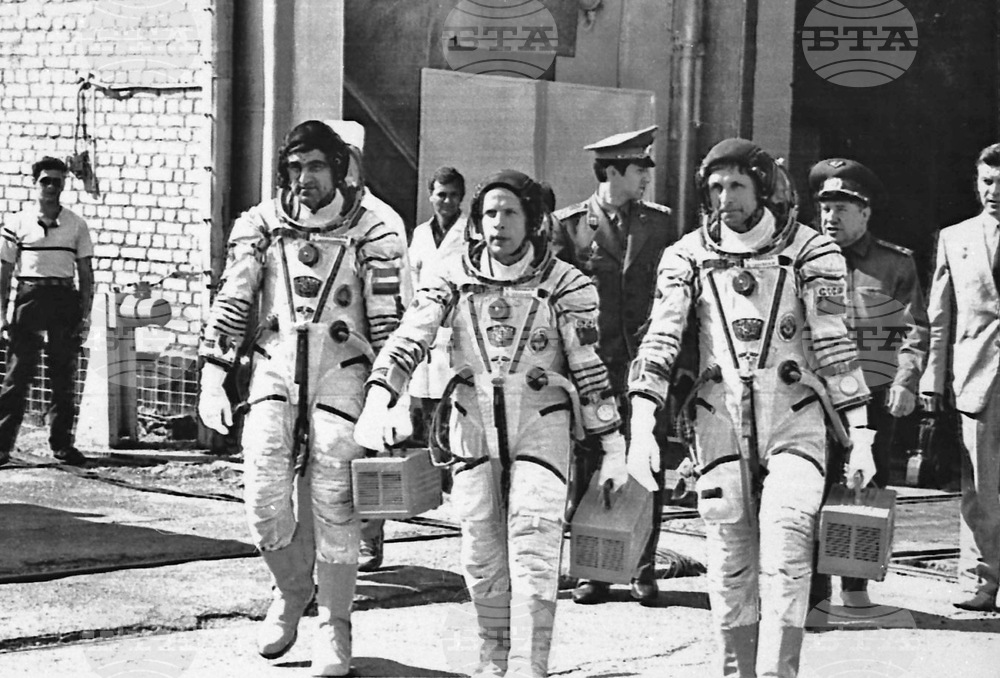
On June 7, 1988, the second joint Bulgarian-Soviet space flight took place. With the successful completion of Alexander Alexandrov’s mission, Bulgaria became the sixth country in the world to have sent two of its own cosmonauts into space, following Georgi Ivanov’s flight in April 1979.
The flight was part of the USSR’s Interkosmos international space programme, established in the mid-1960s to promote cooperation among socialist countries in the field of space exploration.
At 6:03 p.m. local time (5:03 p.m. Bulgarian time), the Soyuz TM-5 spacecraft was launched into Earth orbit from the Baikonur Cosmodrome in Kazakhstan aboard a Soyuz-U2 carrier rocket. The three-member crew on board included flight commander Anatoly Solovyev and flight engineer Viktor Savinykh from the Soviet Union, as well as cosmonaut-researcher Alexander Alexandrov from Bulgaria. The flight lasted ten days - until June 17, when the cosmonauts successfully landed in the vicinity of the city of Dzhezkazgan, Kazakhstan.
On June 9, 1988, the spacecraft docked with the Soviet modular orbital station Mir, where Soviet cosmonauts Vladimir Titov and Musa Manarov had been stationed since December 1987. For nearly eight days, the five cosmonauts carried out the large-scale scientific research programme Shipka, developed by the newly established Institute for Space Research at the Bulgarian Academy of Sciences under the leadership of Academician Dimitar Mishev.
The Shipka space programme included experiments in space physics, remote sensing of the Earth, space biology, space medicine and microgravity technologies. A total of 15 space instruments were developed, which operated aboard the now defunct Mir orbital station. Among those were the Liulin radiation dosimeter (it collected data to create a new radiation belt on Earth) and the Spectrum-256 video spectrometry system, which was used to take pictures of Phobos, one of Mars’ two moons.
One of the most important experiments conducted was titled “Sleep.” The study demonstrated that cosmonauts go through all phases of sleep. The results obtained contribute to the expansion of scientific knowledge in the fields of biology and medicine, as there had previously been insufficient data on the sleep process in microgravity conditions.
During the mission, in coordination with the mission control centre in Moscow - the main operational body responsible for manned orbital complexes - assistance was also provided by the International Situation Centre in Stara Zagora, which processed the results of the scientific experiments and transmitted the data to the Moscow centre. This was the first backup spaceflight control centre in the Balkans and one of the few in the world to establish such a practice.
/DS/
Additional
news.modal.image.header
news.modal.image.text
news.modal.download.header
news.modal.download.text
news.modal.header
news.modal.text