site.btaUnion of Disabled Servicemen and War Victims Insists on Higher Pensions
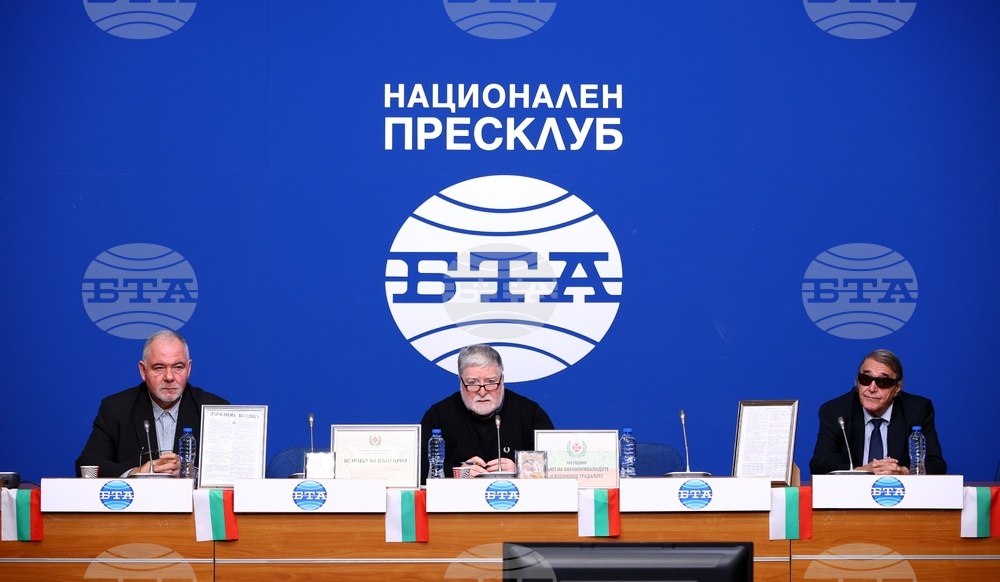
The Union of Disabled Servicemen and War Victims insisted on higher pensions, stating that when determining the pensions of military invalids, the social old-age pension should not be used as a basis, but rather the poverty line or the minimum wage, said the Union Chair, Petar Velchev, during a press conference at the BTA National Press Club in Sofia on Wednesday.
The press conference was held on the occasion of December 3 - the International Day of Persons with Disabilities - and the 100th anniversary of the establishment, by decree of Boris III of Bulgaria, of the “Department for Care of Disabled Servicemen and War Victims” at the then Ministry of War.
Velchev stated that according to the Insurance Code the pension of disabled servicemen falls under non-employment income. “Our pensions are calculated using a specific percentage and the social old-age pension as a basis, which is unacceptable,” Velchev said. “A very small number of our members are able to work and receive additional income besides their pension,” he added.
“We do not believe we should be placed under this category of non-employment income. Over the years, many provisions for military personnel have been removed from the pension system,” Velchev also said.
“We want an increase in the subsidy for people with disabilities under the employment programme. We want at least the inflation rate to be taken into account and reflected, which so far has not been done,” said Velchev.
“Unfortunately, in the current budget, which is being withdrawn or will be revised, this subsidy has been only slightly increased for all nationally representative organizations of people with disabilities. Specifically, disabled servicemen and war victims are at the very bottom of the social ladder, so to speak, despite having served compulsorily,” he commented.
“A large proportion of military invalids and war victims are people with mental disabilities. They are left to fend for themselves. To be well, they need to take their medication, but there is no one to monitor whether they do so if they have no relatives. And many of them do not have families, they are not married. In the past, there were psychiatric dispensaries where they were cared for, but these were removed,” Velchev explained.
“We want additional rights in the Disabled Servicemen and War Victims Act regarding medication, treatment in sanatoriums – we want free treatment,” Velchev added.
According to figures provided in June by the secretary of the Union, Iliyan Hristov, there are a total of 3,268 disabled servicemen and war victims, of whom 1,776 are disabled servicemen and 1,492 are war victims. Disabled servicemen, according to their percentage of reduced working capacity, are distributed as follows: 50% to 70.99% – 1,926 people; 71% to 90% – 608 people; and over 90% – 240 people, with 233 of them requiring assistance from another person, according to Hristov.
/RY/
news.modal.header
news.modal.text