site.btaNovember 28, 1981: Monument to Founders of the Bulgarian State Is Inaugurated near Shumen
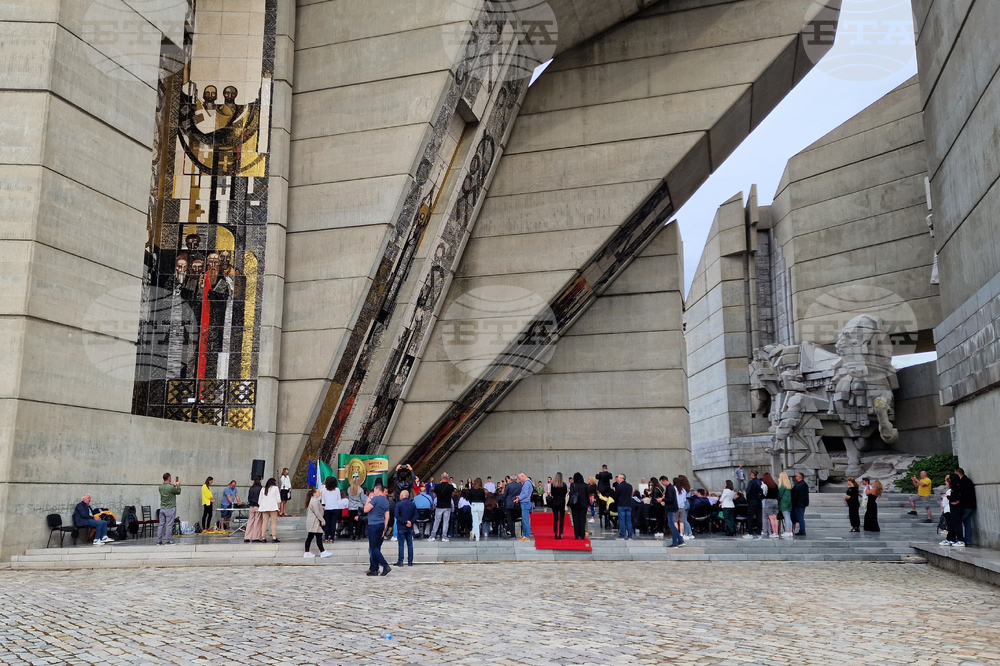
Forty-four years ago on Friday, on November 28, 1981, Bulgarian Communist Party General Secretary and State Council President Todor Zhivkov cut the ribbon of a Monument to the Founders of the Bulgarian State, overlooking Shumen (Northeastern Bulgaria). The ceremony was part of events marking the 1300th anniversary of the foundation of the Bulgarian State in 681 CE.
The Shumen Municipality Tourist Information Centre of Shumen says the idea to build the monument emerged in 1977 during preparations to celebrate the 13th centennial jubilee. The memorial went under construction in August 1979.
Measuring 140 metres in length and 70 metres in height, it can be reached by climbing 1,300 steps starting from the city centre. The structure is surmounted by a giant 1,000 tonne sculpture of a lion (the emblem of Bulgaria) with a stylised butterfly behind its tail, symbolizing all the ups and downs in the country's history.
The project was implemented by architects Georgi Gechev and Blagoy Atanasov, sculptors Krum Damyanov and Ivan Slavov, artists Vladislav Paskalev and Simeon Venov, and engineer Preslav Hadzhov. The monument is one of the country's 100 national tourist sites. It is located in the Shumen Plateau Nature Park and is a stop on several hiking trails in the area.
That was the first time in Bulgaria that figures had been sculpted using a combination of a futuristic style and elements borrowed from the Old Bulgarian stone masonry school. Galleries and niches were incorporated into the composition to preserve the intimacy of the images and emphasize the distinctive features of the historical mission of each of the four medieval Bulgarian rulers commemorated here.
The first statue is of the founder of the State, Khan Asparuh, with a sword stuck in the ground. His outstretched hands point in different directions, indicating where the new State will be located. Behind him is a horseman, reminding viewers that horses were Proto-Bulgarians' most revered animals.
Next stand the sculptures of Tervel the Diplomat, Krum the Legislator, and Omurtag the Builder - three of the most famous khans who reigned in the 8th and 9th centuries. They look down from a height of 18 metres, and a short quotation from the Byzantine chronicles relating to them is inscribed beneath each.
Tervel is renowned as the first Bulgarian diplomat. His hands are positioned in the gestures of diplomacy, demonstrating that major conflicts should be resolved peacefully rather than through war. He is credited with helping Byzantine Emperor Justinian II regain power, for which he was awarded the second most honourable title of "Caesar". The inscription under his sculpture reads: "When Tervel came to the Emperor, he threw a royal cloak over him and proclaimed him Caesar".
In the middle is Krum, the strictest legislator in Bulgarian history and a brilliant strategist. He laid down the first written laws, renowned for their severity, which are synonymous with him to this very day.
The centrepiece in this group is Tsar Simeon I, considered to be the greatest ruler in Bulgarian history. During his reign, the State reached its greatest territorial expansion, bordering on three seas: the Black Sea, the Aegean and the Adriatic, and north to the Carpathian Mountains. In addition to its military successes, the country achieved a significant spiritual and cultural advancement, as a result of which the entire period of Simeon the Great's reign came to be known as the "Golden Age of Bulgarian Literature and Culture".
To the right of the monument is Europe's largest outdoor mosaic triptych, tracing the establishment, development and rise of early Bulgaria. Each panel is positioned at a different angle to represent the country's gradual progress. The first panel, titled "The Victors", depicts warriors greeting the khan in purple armour. The second panel is devoted to the adoption of Christianity, and the stern expressions on the figures' faces suggest that this did not happen without resistance. The third panel shows the brothers Cyril and Methodius together with their disciples Clement, Nahum, Angelarius, Sabbas and Gorazd. The top part of each mosaic follows the development of writing. First is the runic system, consisting of lines and strokes, which was used by the Slavs and Proto-Bulgarians. Next comes the Glagolitic, devised by Cyril and Methodius, and finally the Cyrillic alphabet, which is still used throughout the Slavic world.
/LG/
news.modal.header
news.modal.text