BTA exclusive
![Антарктида - 34-та българска антарктическа експедиция - журналист - Живко Константинов]()
![Антарктида - 34-та българска антарктическа експедиция - журналист - Живко Константинов]()
![Антарктида - 34-та българска антарктическа експедиция - журналист - Живко Константинов]()
![Антарктида - 34-та българска антарктическа експедиция - журналист - Живко Константинов]()
![Антарктида - 34-та българска антарктическа експедиция - журналист - Живко Константинов]()
![Антарктида - 34-та българска антарктическа експедиция - журналист - Живко Константинов]()
![Антарктида - 34-та българска антарктическа експедиция - журналист - Живко Константинов]()
![Антарктида - 34-та българска антарктическа експедиция - журналист - Живко Константинов]()
site.btaJournalist Jivko Konstantinov: We Show Contribution of Bulgarian Scientists in Antarctica to Humanity
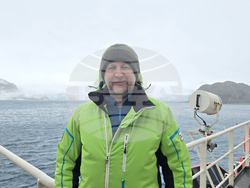
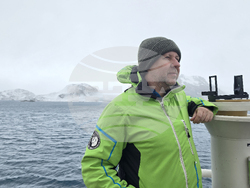
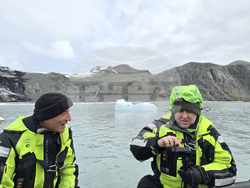
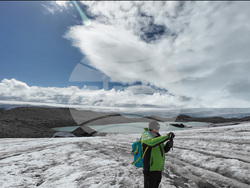
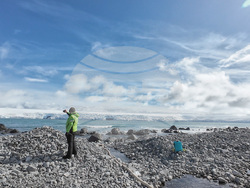
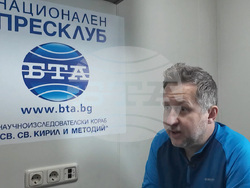
In an interview with BTA, Bulgarian journalist Jivko Konstantinov, who has been making documentary films about the life and scientific projects of the Bulgarian Antarctic base for ten years, said they showcase the work of Bulgarian scientists and their research in Antarctica and how they contribute to humanity. "This is my tenth anniversary year, and in these ten years I have had seven expeditions," he told BTA's special correspondent on Livingston Island.
"My first expedition was in 2016, and now I am on my seventh, which is exactly ten years later. The focus of the documentaries has always been on scientists and life in Antarctica, as well as animals. Each film has a different emphasis," he explained. "Global changes are always present because climate change is the focus of the films. We always mention it because there is constantly new research that confirms new facts and data," Konstantinov said.
He is an established journalist who has built his career in various Bulgarian media outlets. His films about Antarctica have been broadcast outside Bulgaria and have won him numerous awards. Konstantinov also covered the first voyage of the Bulgarian naval research vessel Sv. Sv. Kiril i Metodii (RSV 421), describing the experience as very exciting and memorable.
"The focus in the films is to make them interesting for the general public. In other words, the films we make are not for scientists or the scientific community, but for people. Because people are the ones who learn new things through them, including about science. I think this makes science more accessible to people," he explained.
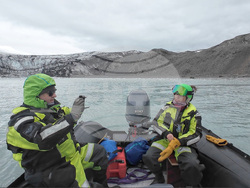
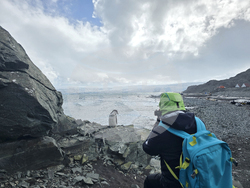
This year, the journalist is again working on a documentary film, focusing on scientists. "I am emphasizing their research, which is why I am here for the seventh time. I want to show people what they are doing here and why their mission is important. Why they are nearly 14,000 km away from Bulgaria, what they are trying to do, what they are trying to prove," Konstantinov said.
According to him, his role as a storyteller is very important because "if I feel and see with my own eyes what they are doing and experience it, I will convey it in the best possible way."
His latest film, shot during the 33rd Bulgarian Antarctic expedition, was created especially for children so that they can hear and see a little more about Antarctica and want to seek out more information themselves. "The reactions are always very strong. I conceived it as a 24-minute film so that there would be 16 minutes for questions and answers in a 40-minute meeting, which is the length of a school lesson. But in fact, those 16 minutes turn into one, two, three hours. Children have so many questions, they are so curious, and that was the goal of the film: to spark their interest, not to overload them with information, not to serve them something ready-made that they would just watch and say, 'Okay, we saw it,' but to provoke a reaction in them, to make them ask questions," Konstantinov noted.
He shared that each of his expeditions is exciting in its own way, as every year something is different from the previous ones.
"In 2016, it was one thing: the base had only one or two buildings. Now, in 2026, ten years later, many buildings have sprung up, how modern they are, how beautiful they are, how many amenities they offer. Something that was unthinkable in 2016 - to imagine that such a building could exist. But with the arrival of the ship, things changed: it became much easier to deliver building materials and construct a laboratory, one so modern that scientists could conduct their research," Konstantinov explained.
He told BTA about the most exciting event of all his expeditions so far. "I have a story from a few years ago. We were having dinner and there was a beautiful sunset. (...) I walked about two kilometres from the base to a spot where you can see the ocean and the sunset. And what I will never forget is a group of whales - maybe five, six, seven, there were many - they had literally made themselves a romantic dinner at sunset. There were krill, lots of krill in the bay, and imagine them rising up, opening their huge mouths, taking in the food and diving back down, and this happened several times. Because the ocean was golden from the rays of the sunset, everything looked very romantic," Konstantinov recalled.
According to him, the most valuable thing about the Bulgarian base in Antarctica is that the people there are a small community.
"You go to a place that is the end of the world, and it is logical to feel good with the people around you," he said. "It is very important that those who come to the base are sociable. It is not a place for individualists who only look after themselves and want things to happen only to them. In my opinion, a person who comes to the base must be open-minded and able to fit into a team. So the community here is very important."
Konstantinov explained that people often form friendships at the base that continue beyond the borders of Antarctica. "I have great friendships that were born at the base and have continued outside of it, in real life in Bulgaria," he concluded.
The Bulgarian naval research vessel Sv. Sv. Kiril i Metodii (RSV 421) departed for Antarctica from Varna (on the Black Sea) on November 7, 2025. After a month-long voyage across the Atlantic Ocean, the ship arrived at the Argentine naval base in Mar del Plata on December 13.
BTA has had a national press club on board the ship since 2022 and another on Livingston Island since February 2024. BTA Director General Kiril Valchev said they exist thanks to the generous support of RSV 421 and Bulgaria’s St Kliment Ohridski Base, which provide the necessary facilities. These two press clubs are added to the news agency’s other 41 national press clubs (33 in Bulgaria, seven abroad in neighbouring countries and in nations with large Bulgarian communities, and one mobile National Book Press Club).
The news items of BTA's special correspondents on RSV 421 and Antarctica are freely available in Bulgarian and English on the agency's website. They can be used free of charge by all media, with attribution to BTA. Valchev recalled that thanks to its correspondents, the news agency appears among the top results on Google when searching for the phrase “Antarctica correspondent”.
/RY/
Additional
news.modal.image.header
news.modal.image.text
news.modal.download.header
news.modal.download.text
news.modal.header
news.modal.text