Green Transition Forum 6.0
![Bulgaria Warns EU Budget Reform Could Double Country's Contribution]()
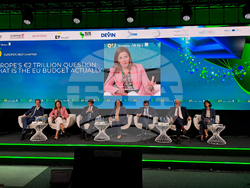
![Bulgaria Warns EU Budget Reform Could Double Country's Contribution]() On Day 3 of the Green Transition Forum 6.0 in Sofia, participants discuss the European Commission's proposal for the EU's next long-term budget for 2028-2034, June 3, 2026 (BTA Photo/Anelia Tsvetkova)
On Day 3 of the Green Transition Forum 6.0 in Sofia, participants discuss the European Commission's proposal for the EU's next long-term budget for 2028-2034, June 3, 2026 (BTA Photo/Anelia Tsvetkova)
![Green Transition Forum 6.0 - бюджет на ЕС - обсъждане]()
![Green Transition Forum 6.0 - бюджет на ЕС - обсъждане]()
![Green Transition Forum 6.0 - бюджет на ЕС - обсъждане]()
![Green Transition Forum 6.0 - бюджет на ЕС - обсъждане]()
![Green Transition Forum 6.0 - бюджет на ЕС - обсъждане]()
site.btaBulgaria Warns EU Budget Reform Could Double Country's Contribution
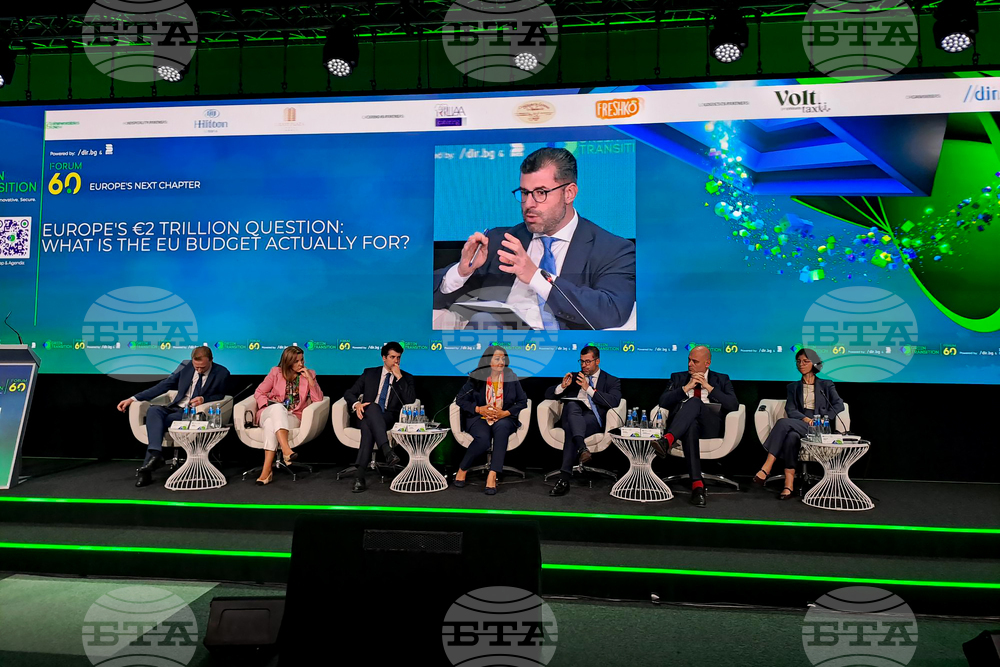
Politicians and experts Wednesday took part in a panel discussion in Sofia dedicated to the European Commission's proposal for the EU's next long-term budget for 2028-2034. The discussion was held on the third day of the June 1-5 Green Transition Forum 6.0, organized by the online platform Dir.bg in cooperation with the Bulgarian-Greek Chamber of Commerce and Industry. BTA is among the event's media partners.
The proposal for the next seven-year period, unveiled by the European Commission in July 2025, is for an EU budget of approximately EUR 2 trillion.
According to Deputy Finance Minister Metodi Metodiev, the debate about the revenue side of the EU budget should focus on the issue of fair sharing of the revenue burden. For Bulgaria, calculations based on the European Commission's proposal for a "basket" of new own resources show that the country would double its contribution, Metodiev said.
The proposed basket of own resources and the resulting regressivity would be extremely significant and detrimental to the Bulgarian economy, he noted. Metodiev explained that Bulgaria would rank as the third-most affected economy in the EU in terms of the degree of regressivity embedded in the basket of new own resources. This means that, in terms of the burden of contributions relative to each country's level of economic development, Bulgaria would rank third in the EU. From this perspective, Bulgaria remains reserved and sceptical about the European Commission's proposal for the so-called new own resources, which will be the subject of discussions in the coming months, Metodiev said.
Iliyana Tsanova, Chief Risk Officer at the European Commission's Directorate-General for Budget, who presented the main elements of the proposal for the new EU budget, noted that in recent years Europe has had to deal with increasingly serious and systemic crises, requiring it to act in new ways. Tsanova added that the EU budget is no exception, as it is one of the principal instruments for achieving European policies and priorities.
The head of the European Investment Bank Group's office in Bulgaria, Teodor Radonov, commented that the next budget must enable Europe to act on an even greater scale through more investment, faster implementation and simpler instruments capable of attracting additional private capital. The world will not wait for Europe, and relying solely on public funding will not be sufficient, he said. There must be a simplified framework, which is what policymakers are currently seeking, that will allow the attraction of private investment, Radonov added.
Tsanko Arabadzhiev, Chief Executive Officer of the Bulgarian Development Bank (BDB), noted that discussions about the European budget too often become debates about redistribution - who receives more, who benefits more, and how much each country absorbs. In his view, however, Europe's future will not be determined by how it allocates EUR 2 trillion, but by how ambitious it is and what it wants to build with those funds.
The real question is not how to spend EUR 2 trillion, but how to turn that EUR 2 trillion into EUR 10 trillion or EUR 12 trillion in investment, he said. The challenge is to make the available money work, to create greater trust, investment projects and partnerships, Arabadzhiev added. This is precisely where development banks have a crucial role to play, as their mission is not merely to provide financing but to transform public priorities into investment opportunities, connect public ambition with private capital and turn ideas into projects.
/DS/
Additional

news.modal.image.header
news.modal.image.text
news.modal.download.header
news.modal.download.text
news.modal.header
news.modal.text