site.btaExperts Discuss Incomes in Bulgaria at Continue the Change Event
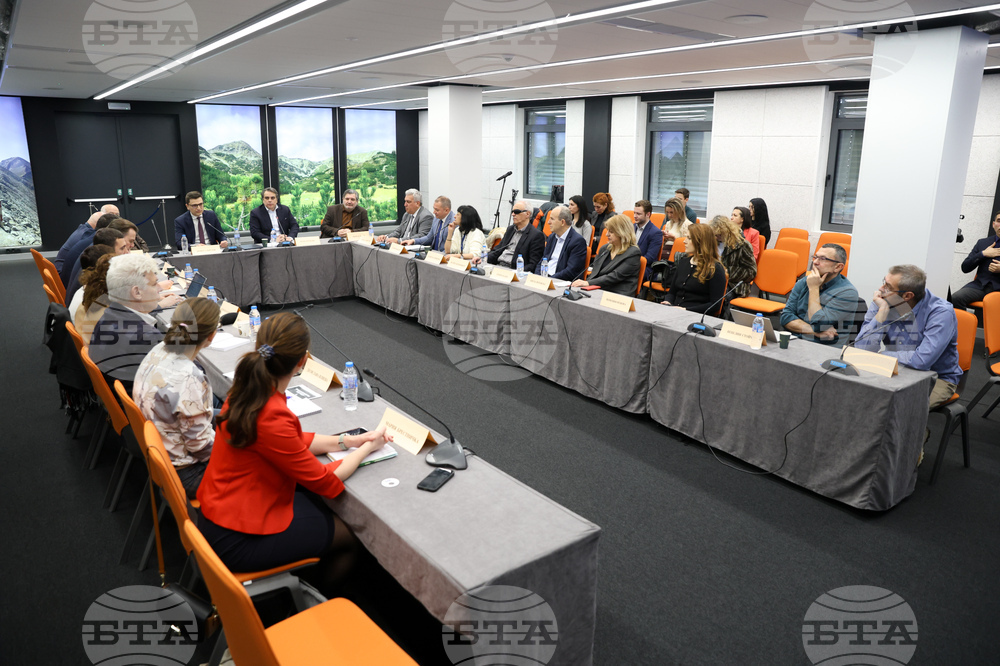
Trade unions, employers, the academic community, experts, and representatives of the NGO participated in a discussion titled "Young Families and Incomes" here on Monday. The discussion is part of a series of debates organized by Continue the Change (CC) on important topics for the future of Bulgaria, and was held under the motto "A Strong Bulgaria in a Strong Europe". Topics included European incomes in Bulgaria, how to get back to a population of nine million people, fair pensions and equal access for people with disabilities.
At the beginning of the meeting, CC leader Assen Vassilev said that the discussion was being held outside of the election campaign and was focused on where Bulgaria should be in 15 years' time, regardless of who is in power. Vassilev said that the increase in the minimum wage did not lead to higher unemployment, adding that this means that even in regions where the minimum and average wages have converged, the market has absorbed these levels quite normally.
According to data presented by Assoc. Prof. Atanas Atanasov, President of the National Statistical Institute (NSI), there has been an upward trend in minimum and average wages in Bulgaria between 2007 and 2024. In 2007, the average wage was BGN 480 (EUR 245,42), rising to BGN 2,413 (EUR 1233,75) in 2024. He noted that the gap between the average and minimum wages is widening. According to 2024 data, Bulgaria's minimum wage is currently between those of the Republic of North Macedonia and Turkiye. He added that inequality remained high in terms of income throughout the period and that, compared to EU countries, Bulgaria had the highest income inequality, with only Latvia and Lithuania ranking higher.
Lyuboslav Kostov, the chief economist of the Confederation of Independent Trade Unions in Bulgaria (CITUB), pointed out that Bulgaria's gross domestic product (GDP) in 2007 was 4.2 times lower than it is today in nominal terms. He said that the problem with the budget is not salaries, but the capital programme, which is either not being implemented or the funds are being misused. He stated that there are currently around 600,000 people employed in the Bulgarian public sector, which adds up to some 1.2 million people with their families included. However, there is no budget allocated for them as the government has not approved it.
Atanas Katsarchev, chief economist of the Podkrepa Confederation of Labour, said that people with the lowest incomes should not be taxed. According to statistics, two-thirds of households have been on the brink of poverty in recent years, an issue that can be alleviated with a tax and social security reform.
Petar Ganev from the Institute for Market Economics said that the next parliament must find a solution to avoid increasing the tax burden without resorting to extreme populist measures regarding wages. He added that changes are needed in social assistance provided by the State to reduce inequalities and ensure that the support reaches those who need it most.
Georgi Ganev from the Centre for Liberal Strategies said that, according to Eurostat, Bulgaria is not at the bottom of the EU in terms of minimum wage and purchasing power. He said that tax system reform can be discussed once the State convinces everyone that their money is being spent effectively. Ganev also stated that the practice of high-income people receiving social assistance must be stopped.
/RY/
news.modal.header
news.modal.text