BTA interview
![Antarctica - Razvigor Darlenski - dermatologist]()
![Antarctica - Razvigor Darlenski - dermatologist]()
![Antarctica - Razvigor Darlenski - dermatologist]()
site.btaProlonged Antarctic Stay Alters Skin Function, Says Dermatologist Razvigor Darlenski
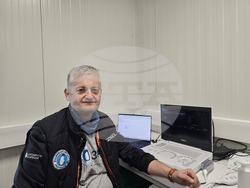
Prolonged stays in Antarctica affect skin functions, the Bulgarian dermatologist, Professor Razvigor Darlenski, told BTA.
"Our research shows that skin physiology - the functions of the skin - changes during extended Antarctic exposure. We now aim to study how the skin's structure and morphology are affected," he said.
Prof. Darlenski is on the team of Acibadem City Clinic - Tokuda Hospital and Trakia University's Faculty of Medicine. As a participant in the 30th Bulgarian Antarctic expedition and in the current 34th expedition, he has worked on the project studying skin changes due to exposure to extreme conditions with Assoc. Prof. Ivan Bogdanov from the hospital in Kyustendil (Southwestern Bulgaria) and Assoc. Prof. Karen Manuelyan from Trakia University in Stara Zagora (South Central Bulgaria).
Prof. Darlenski explained that before departure, the skin microbiome is similar to that of healthy Europeans. After about two months in Antarctica, these microorganisms are replaced by species typical of the cold, saline southern seas, highlighting the microbiome's dynamic nature and its potential for modification in certain conditions.
So far, the team's research has observed increased melanin production during extended Antarctic stays, serving as a protective mechanism against UV-induced mutations. Previous studies by marine biologists suggest this response is an evolutionarily ancient mechanism and is seen in Antarctic invertebrates.
More recent research has found that UV exposure for outdoor workers, particularly logistics personnel, who spend extended periods in the open, is many times higher than what a lifeguard receives over an entire season in Bulgaria. The current project is funded through the National Programme for Polar Studies and is being carried out with the logistical support of the Bulgarian Antarctic Institute.
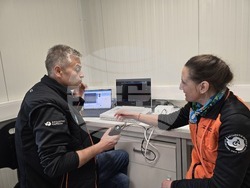
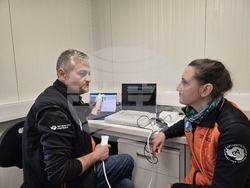
"In this project, building on previous results which show that skin physiology - that is, the functions of the skin - changes during extended stays in Antarctica, we want to see what happens to skin structure and morphology using two instruments. One is a UV light camera, called Visioscan, which we use to examine the skin surface, the stratum corneum, which forms the skin barrier," said Prof. Darlenski. He added that a high-frequency skin ultrasound is also used for this purpose.
"This allows us to study what happens in the layers of the skin just beneath the stratum corneum," he explained. The project will run for two years to allow final conclusions to be drawn. The findings could be applied not only in Antarctica but also in other regions with similar climatic conditions, such as countries in Northern Europe.
"The findings of the dermatological studies to date, and those we expect to obtain, can be used to protect the skin when exposed to Antarctic or similar conditions. Based on what we have observed, two steps are essential to maintain an adequate skin barrier: first, protection against UV radiation with various sunscreens, and second, proper skin hydration," Prof. Darlenski said.
He also spoke about potential future projects for the dermatology team in Antarctica.
"One exciting avenue of research we are planning to pursue in greater detail is air pollution, fine particulate matter, and how it affects the skin. We want to see how this differs between Europe and Antarctica, comparing the same periods of the year and the same season," Prof. Darlenski said. Another direction the team aims to explore is the study of various cytokines in the skin - the molecules through which immune system cells communicate.
According to him, these molecules can sometimes predict or indicate inflammation that cannot be seen with the naked eye or even with highly sensitive equipment.
The Bulgarian naval research vessel Sv. Sv. Kiril i Metodii (RSV 421) departed for Antarctica from Varna (on the Black Sea) on November 7, 2025. After a month-long voyage across the Atlantic Ocean, the ship arrived at the Argentine naval base in Mar del Plata on December 13.
BTA has had a national press club on board the ship since 2022 and another on Livingston Island since February 2024. The news items of BTA's special correspondents on RSV 421 and Antarctica are freely available in Bulgarian and English on the agency's website. They can be used free of charge by all media, with attribution to BTA. Valchev recalled that thanks to its correspondents, the news agency appears among the top results on Google when searching for the phrase “Antarctica correspondent”.
/DD/

Additional
news.modal.image.header
news.modal.image.text
news.modal.download.header
news.modal.download.text
news.modal.header
news.modal.text