site.btaLiving Between Two Cultures Is Great Wealth, Tirana-Born Translator Milena Selimi Says
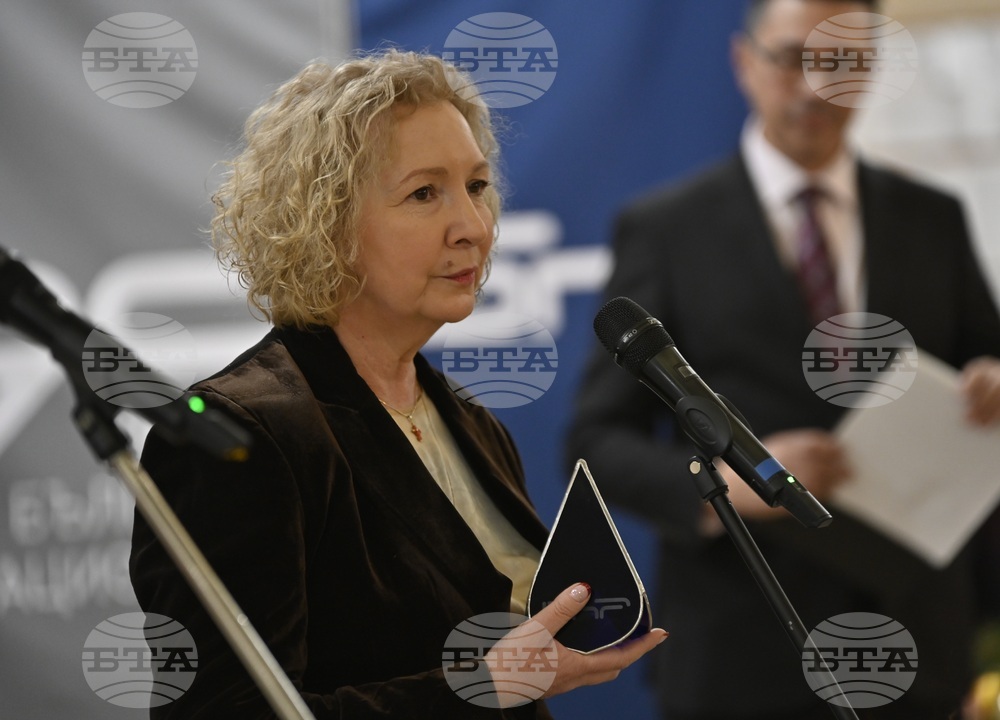
Being a person shaped by two cultures, the Bulgarian and the Albanian, is a great wealth, Tirana-born translator Milena Selimi told BTA.
For her work as a writer, journalist, and translator from Bulgarian into Albanian, Selimi was honoured as a Bulgarian Ambassador of Culture for 2024 at a ceremony held at Bulgarian National Radio on Thursday night.
Milena Selimi was born in Tirana to a family deeply rooted in culture and arts. Her mother, Yanka Trifonova-Selimi, originally from Dobrich, Northeast Bulgaria, is a translator from Bulgarian into Albanian and a journalist, while her father, Skender Selimi, is the founder of the Albanian ballet school, a choreographer, and ballet master.
Milena Selimi’s mother was the first to translate Georgi Gospodinov into Albanian, beginning with Natural Novel. Milena Selimi herself has translated several of Gospodinov’s major works into Albanian, including The Physics of Sorrow, Time Shelter – for which she received the award for Best Translation at the Tirana Book Fair in 2024, and Death and the Gardener.
Among the Bulgarian books she has translated into Albanian are Mission London by Alek Popov, Beans by Elin Rahnev, Summit by Milen Ruskov, Is There Anyone Who Loves You by Kalin Terziyski, Hagabula by Todor P. Todorov, among others. For her graduation thesis on Bulgarian poetry, she also translated poems by Peyo Yavorov, Elisaveta Bagryana, Blaga Dimitrova, Dora Gabe, and Nikola Vaptsarov.
In addition, Milena Selimi is a representative of the Bulgarian national minority on Albania’s Committee for National Minorities, officially recognized in Albania in 2017.
In her interview with BTA, Selimi spoke about the richness of belonging to two cultures – the Bulgarian and the Albanian, about what she has received and learned from her mother, about what is untranslatable between Albanian and Bulgarian, about the translator’s role as a “border guard”, and about the shared contemporary task of presenting the literatures of Bulgaria and Albania beyond national borders.
Asked what the most important thing she has inherited from her mother, a Bulgarian woman who made her life in Tirana, beyond translation itself and in relation to Bulgarian identity, Selimi reflected on her personal path as a translator and the feeling of existing between two cultures and two languages.
“Translation came to me as a necessity for the survival of my Bulgarian roots. And this comes from my mother, because from her I have always taken perseverance and love. When you live outside Bulgaria, it is very difficult to truly know what is happening in the country. Nostalgia remains, illusions remain. Perhaps we Bulgarians who live abroad, both my mother and I, look at Bulgaria in a different way. I don’t know whether that is good or not, but I want to thank my mother for it. Because truly, to be a person of both cultures, Albanian and Bulgarian, is a great wealth,” Selimi said.
She added that every time she travels to Bulgaria, she says: “I am going to my homeland. And for every Bulgarian author I translate into Albanian, I think to myself: ‘My homeland loves the authors of my homeland.’ It is a blessing to belong to two cultures. It is an advantage that enriches your mind, your soul, and your judgment. I feel very comfortable in both languages thanks to my mother,” she emphasized.
Asked whether there is something untranslatable between Albanian and Bulgarian, Selimi noted that while working on her most recent translation, Death and the Gardener, she struggled with rendering the Bulgarian phrase “Nyama strashno” (“There’s nothing to worry about”), which is of key importance in the novel.
“Of course, when you use this phrase, it seems simple and you understand its meaning, but what you say in Bulgarian is difficult to bring close to the Albanian reader. So, I had to have a very long conversation with my mother. She is my mentor, and I am deeply grateful to her, because she has passed on to me not only her love for Bulgaria, but also the profession of translator,” Selimi said.
She added that there is always a way to translate words, and that the opportunity to talk to the author can be invaluable. “I have been very lucky to translate contemporary authors, which has allowed me to speak directly with them,” she said.
According to Selimi, the translator is a “border guard” who defines the boundaries of translation and carries the vital mission of “transporting the word to the other shore”.
“The word is extremely important and precious. Nowadays we no longer pay attention to words. Gospodinov asks: ‘What is the weight of a word?’ Today we have forgotten that weight. We have forgotten the value of the word. We try to speak quickly, superficially, without going into the depth and core of things. But the word remains,” Selimi explained.
She added that as a professional translator, her responsibility is to ensure that every word is in its proper place and carries its meaning, because the books she translates will remain on someone’s bookshelf.
Asked what she would say to Bulgarians about Albanian literature, given that Balkan literatures often do not seek each other out and tend to orient themselves more toward the West, Selimi explained that this is partly due to limited financial resources.
She expressed her gratitude to the Traduki network, which over the past decade has supported the translation of Bulgarian authors into Albanian and Albanian authors into other languages, such as German.
Selimi also noted that there is growing interest in Albanian authors in Bulgaria, recalling recent titles such as Everyone Goes Crazy in His Own Way by Stefan Capaliku (2022, Ergo Publishing, translated by Rusana Bejleri), Sunday Bells by Anna Kove (2022, Perseus Publishing, translated by Ekaterina Tarpomanova), and works by Grigor Banushi, including Unfinished Symphony (2024, Izida Publishing, translated by Ekaterina Tarpomanova), as well as other authors already translated or currently in translation.
Selimi voiced hope that these writers will continue to be read not only in Bulgarian, but in other languages as well, as they are authors of great significance in Albanian literature.
Asked how she “persuades” Albanian readers to read Bulgarian literature, Selimi spoke about her participation in the Tirana Book Fair in November, where she presented two of her translations, Hagabula and Death and the Gardener. She said that during the times she stood at the book fair stand, because she enjoys talking to readers, and she noticed that Albanian readers often had not read any Bulgarian literature, or would choose a book simply because she was the translator, not because it was by a Bulgarian author.
“I asked why there was no interest. Some told me they had never felt curious about Bulgarian literature,” she said, expressing surprise at this attitude given the number of contemporary Bulgarian writers. Among them, she mentioned the late Alek Popov, Milen Ruskov, Zdravka Evtimova, Yordanka Beleva, Kalin Terziyski, Nikolay Terziyski, among others.
“There are authors who truly represent Bulgaria very well abroad, and the lack of interest seems strange. But I think this is a culturally inherited factor – Albania believes Bulgaria is still one of the ‘Eastern Bloc’ countries, while Bulgaria believes Albania is still shaped by the mentality of the former dictatorship. Meanwhile, we are very close – Tirana and Sofia are only 500 kilometres apart,” she said, adding: “We are not far apart, and I believe that all of us, you (BTA) as a media outlet, me as a translator, and especially the authors, must each do our part so that we can present Bulgarian and Albanian literatures on both sides of the border.”
/KK/

news.modal.header
news.modal.text