site.btaMedia Review: March 23
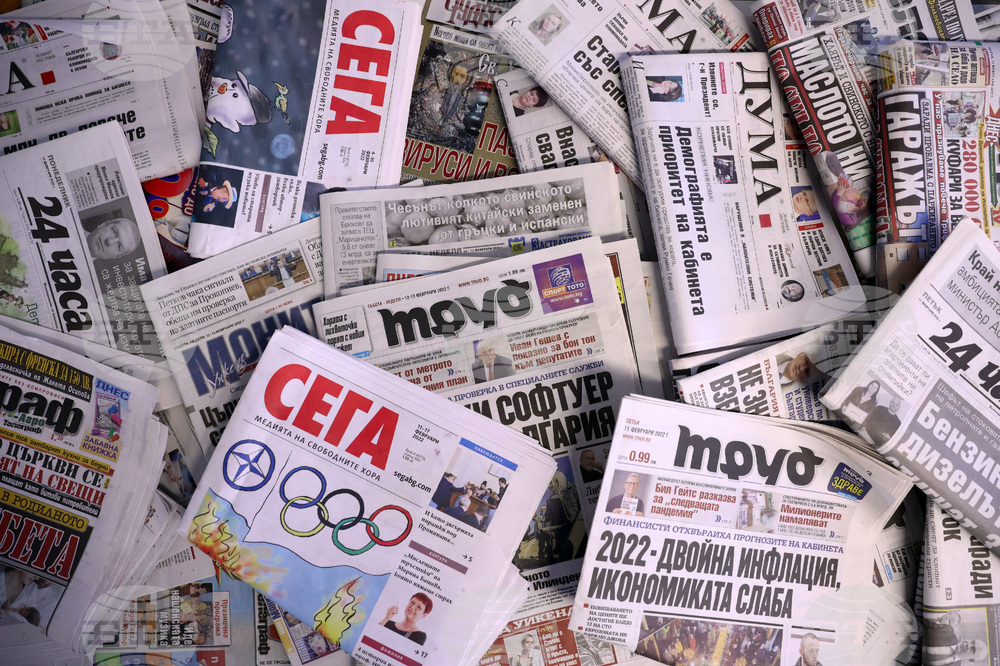
The April 19 parliamentary elections and the ongoing conflict in the Middle East and its effect on fuel prices are the dominant topics in the news media on Monday.
POLITICS
24 Chasa daily runs an interview with Trend polling agency head Dimitar Ganev about the upcoming parliamentary elections. In the interview, Ganev stated that the electoral map for the moment remains static with 5 parties expected to enter parliament and 2 that are close to the 4% threshold, the latter being the Bulgarian Socialist Party and Morality, Unity, Honour (MECh) party. On the topic of former president Rumen Radev’s Progressive Bulgaria coalition, Ganev said that the coalition is running a standard campaign with standard anti-corruption, anti-Establishment messages, trying to broaden its appeal and to harness the so-called "protest vote". He added that GERB leader Boyko Borissov and MRF leader Delyan Peevski have refrained from attacking him so as to not legitimize his message. Instead, Borissov stated that many of the candidates in constituencies across the country are former GERB members, and he would be happy to work with them again. Ganev claims this is an attempt to undermine Radev by creating the impression that their parties are closely aligned. Ganev stated that, should a government be formed, it would be led by Progressive Bulgaria. If the BSP is represented in Parliament, this would seem like a natural partnership, given that Radev was the BSP's presidential candidate and his lists include many people associated with the left. However, based on the current electoral landscape, it seems unlikely that Radev's coalition and the BSP will earn over 120 deputies in the 240-seat Parliament, meaning a third party will need to be sought to secure a majority. Another option is for the two parties to form a minority government but that would still require the support of other parties in Parliament.
***
Trud carries an interview with Prof. Antoaneta Hristova, director of the Institute for Population and Human Studies at the Bulgarian Academy of Sciences. She says that until now, a pre-campaign full of disinformation and manipulation was observed, and a coalition that was met with curiosity but remained silent until recently, stirs fear into the other political players. Progressive Bulgaria went into silent mode right after its was established, causing a buildup of tension, with all forces harnessed in search of something to attack the party with. She added that public opinion is that money in politics is not clean and that the whole system is corrupt. Bulgarians have become so accustomed to it that they don't even ask where it comes from anymore, which is one of the main reasons why people have been demotivated from participating in elections so far. She stated that there are insufficient safeguards in place to prevent voter fraud and that the public debate is overly focused on technical details. Hristova also stated that a politician-sociologist-media relationship exists and it provides an opportunity for publicity and the formation of attitudes. She called for polling agencies’ activities to be subject to an external review since currently they are not subject to any science-based evaluation. She argued that controlling and manipulating election results is directly linked to the results of pre-election opinion polls since it is not possible to have final data that is dramatically different from these polls.
***
Speaking on Bulgarian National Radio, Silvia Georgieva, chair of the National Association of Municipalities in the Republic of Bulgaria, said that the work of the municipalities on organizing the election process is proceeding calmly and without disruptions. Georgieva also analyzed the benefits of opening the access by the Regional Development Ministry to an interactive map with the municipal projects funded by the state budget. She promised that the information in the system would be updated every 14 days. She noted that municipalities in Bulgaria need much greater financial autonomy since they are dependent on the central government for all their actions. She said that only 20% of a municipal revenues are their own. However, she said, the association has not lost confidence that things will change for the better.
***
bTV’s morning show featured an interview with political analyst-turn-MP candidate Slavi Vassilev. He said that the Progressive Bulgaria coalition has not discussed anything with either Boyko Borissov or Delyan Peevski since that is "red line" for the political leadership. According to him, Progressive Bulgaria is open to collaboration with other political forces. However, in terms of judicial reform and the fight against corruption, it cannot work with GERB and MRF. Vassilev also commented on Rumen Radev's approach to leadership: he listens to the opinion of those around him, but ultimately makes the decisions himself. He expects Radev's coalition to achieve a "historic result" in the elections. He questioned some poll results showing support for Radev going down after an initial spike, and argued that Progressive Bulgaria's popularity would only increase with the start of the active campaign. He said that many people who have already decided to vote but have not yet chosen who to vote for, may turn to Radev's party.
***
Segabg.com reports that only the Association of Prosecutors in Bulgaria and the Chamber of Investigators continue to advocate the possibility of an unlimited term in office for acting Prosecutor General Borislav Sarafov. The positions were submitted to the Constitutional Court as part of a case concerning the legal limits on how long a magistrate may serve in an acting capacity. The case originated from a request by the Varna Appellate Court for an interpretation of a legal provision limiting a stint to six months. The court then proceeded to directly challenge the constitutionality of this restriction. According to the publication, the prevailing opinion in the case leans towards the view that unlimited tenure in such a powerful position creates a risk of arbitrariness and a lack of accountability. In contrast, prosecutorial organizations argue in favour of maintaining the possibility of extended or indefinite term in acting capacity.
ECONOMY
On bTV’s morning show, Svetoslav Benchev, head of the Bulgarian Petroleum and Gas Association, said that fuel prices will continue to rise due to the continuing escalation of the Middle East conflict. He added that petroleum prices in Bulgaria remain some of the lowest in the EU and that price caps should not be introduced. Benchev stated that the sooner permission is granted from the United States for sanctions on Lukoil to not be applied, the safer the market will be. According to Belchev, all kinds of contracts can be discussed, but if the refinery cannot pay for the raw material on April 29 because there is no bank to process the transaction, it does not matter whether there is petroleum or not.
***
Bulgarian National Radio has an interview with energy expert Slavcho Neykov regarding parliament’s decision to ban Energy Minister Traicho Traikov from making structural changes to companies within the Bulgarian Energy Holding (BEH). Neykov called this decision "pre-election populism" and said that discussions in both the parliamentary committee and the plenary session were mainly related to coal. He said that the European Union is firmly committed to a low-carbon economy and its role in achieving energy independence, a position that conflicts with statements made in Bulgaria. According to Neykov, there is a huge discrepancy between what Parliament is focusing on and what is actually important. He also noted that the impact of the mining industry on people's health is not being addressed. The energy expert noted that the focus should be on preserving people's incomes, not coal, because coal is a dying industry.
EDUCATION
Dnevnik.bg reports that an internal audit ordered by Sofia University Rector Prof. Georgi Valchev at the Faculty of Medicine has identified a number of legal violations in the conduct of the medical education process. As a result, he has partially frozen the work of the Faculty, ordering central administration employees to stop processing and forwarding files related to decisions of its Faculty Board. The audit found that certain lectures and courses were conducted in breach of established state requirements and internal academic regulations. Among the irregularities were inconsistencies in how classes were scheduled and delivered, as well as deviations from approved curricula and teaching standards. The findings indicate systemic issues rather than isolated cases, raising concerns about compliance with national higher education regulations and the overall quality assurance of the academic process. The report suggests that some of the problems may be linked to weaknesses in administrative oversight and internal control mechanisms. According to the publication, the violations are part of a broader context of ongoing tensions and allegations of mismanagement within specific faculties, including tipoffs about irregularities in governance and academic practices. The university leadership is expected to take follow-up measures to address the identified shortcomings, including potential disciplinary actions, administrative reforms, and stricter monitoring of teaching activities to ensure compliance with legal and institutional standards, the story says.
***
Segabg.com reports that four procedures totaling over EUR 25 million will be opened under the EU's Education Operational Programme (2021-2027). The funds will support adult literacy, children and students from vulnerable groups, and the training of education specialists. Applicants may include municipalities, schools and kindergartens. The procedure for creating access to education by overcoming demographic, social and cultural barriers is brand new. Applications are planned for March–April this year. The aim is to support children and students from marginalised groups by improving their access to education. EUR 8 million will be made available through the procedure for complex programmes at the municipal level to promote school desegregation, prevent secondary segregation, and combat discrimination. The funds will be used to create school and local communities that support school desegregation and reduce negative public attitudes towards education. Training will be provided for those working in a multicultural environment, including local and school administrators, educational mediators, social workers, and pedagogical specialists. Support will also be provided for mobility and the exchange of experiences, as well as for specific school activities that promote desegregation.
SOCIETY
Trud reports on a practice that allows drivers involved in traffic accidents to avoid higher insurance costs by transferring vehicle ownership to another person, most commonly a spouse. According to the publication, under the current framework related to Motor Third Party Liability Insurance the price of the policy can increase significantly after a driver causes an accident. As a result, some individuals exploit a loophole by registering the vehicle in the name of their wife or another family member in order to secure a lower premium. The article highlights that this practice is formally legal, as insurance premiums are tied to the vehicle owner rather than strictly to the driver responsible for previous incidents. This creates conditions in which risk is effectively reassigned on paper, without reflecting the actual driving history of the person using the car. The article adds that there are ongoing discussions about reforms in the insurance sector, including potential changes aimed at linking premiums more directly to driver behavior and accident history, rather than solely to vehicle ownership.
/NF/
news.modal.header
news.modal.text