site.btaMedia Review: March 16
HEADLINES
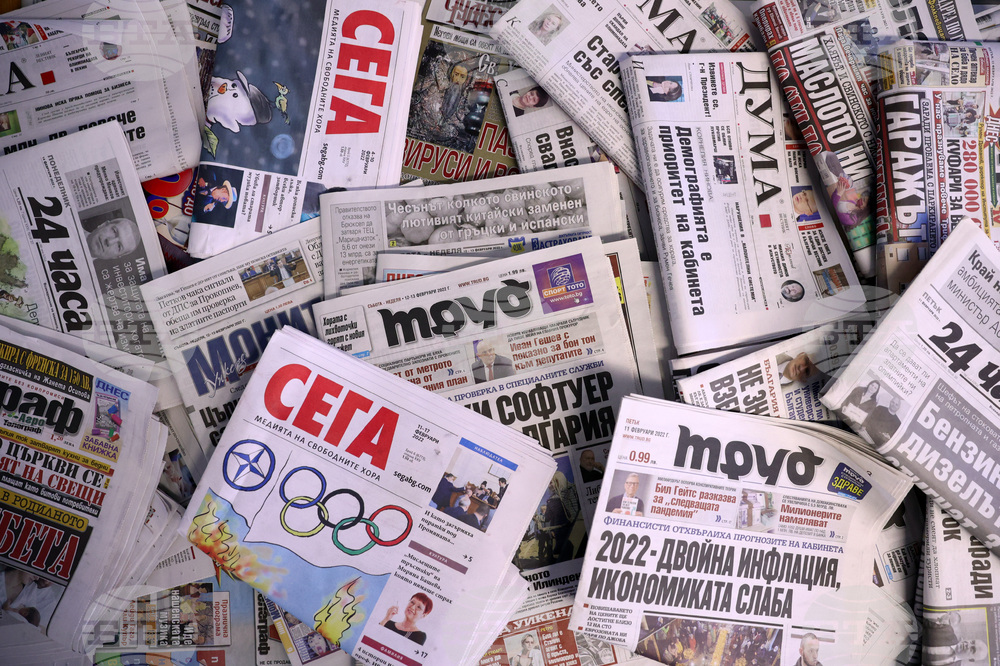
Monday’s print media highlight rising living costs, political developments and economic trends. 24 Chasa leads with a report that food prices are expected to increase ahead of Easter, warning of a more expensive traditional holiday salad followed by broader price pressures in food and transport. The newspaper also reports on attempts to revive wind energy projects through the designation of 25 zones, while noting that wind turbines will not be allowed along the Black Sea coast. Another article focuses on a new heating price formula that will take into account the energy efficiency class of residential buildings.
Trud focuses on political and economic issues, reporting that six parties are likely to enter the next parliament according to current projections. The daily also writes about a proposed monthly fuel subsidy of EUR 20 for petrol and diesel, while commenting that the newly introduced heating formula largely replicates the previous one.
Telegraph reports on growing interest from Israeli buyers in Bulgaria’s real estate market. Other articles cover problems in the railway sector, alleging that the national railway company BDZ continued selling tickets despite an incident obstructing travel, as well as consumer disputes over travel vouchers and refund demands.
Duma leads with an article quoting Bulgarian Socialist Party leader Krum Zarkov who says that the party's path forward is one of change so that the party can also change Bulgaria. Other frontpage headlines are about the state support to the most vulnerable of EUR 20 due to the high fuel prices, expected high prices of bread and milk, and Bulgarians cancelling planned holidays in light of the war in the Middle East.
Leading interviews include former caretaker prime minister and National Audit Office Chair Dimitar Glavchev in 24 Chasa, who says checks are under way into bonuses distributed to civil servants in several institutions to determine whether they were awarded according to the rules. In Trud, political scientist Stoycho Stoychev comments that if former president (2017-2026) and Progressive Bulgaria party leader Rumen Radev aligns himself with a political actor, he may inherit that actor’s negative public perceptions rather than its support. Analytical pieces examine the growing presence of foreign workers such as Uzbeks and Nepalis on the Bulgarian labour market, the decline in industrial output linked by some commentators to EU policies, and election administration issues discussed by representatives of the Central Election Commission.
The morning interviews of the Bulgarian National Radio (BNR) focus on taxation, tourism, politics and public finances. The National Revenue Agency reminds taxpayers that annual tax declarations must be submitted by the end of April and that while declarations are still filed in levs, payments can be made in euros. Tourism expert Pavlina Ilieva comments that ongoing conflicts are increasing travellers’ fears and affecting demand for trips. Political scientist Hristo Panchugov says the political stalemate is likely to continue, predicting that even after three elections no party will secure a full parliamentary majority. Economist Petar Ganev from the Institute for Market Economics adds that it is legally and financially possible for the state to operate under an extended budget for an entire year, but warns this would likely come at the expense of public investments and municipal capital programmes.
Morning programmes on national television on Monday focus on international tensions, domestic politics and rising living costs. Bulgarian National Television (BNT) examines the continuing conflict in the Middle East and its impact on fuel prices and geopolitical developments. The programme also looks ahead to the start of the election campaign, with Bulgarian Socialist Party (BSP) representative Valeri Zhablyanov discussing candidate lists and expectations for the April 19 vote. Other segments include a report from North Macedonia marking a year since the tragedy in Kocani, medical advice from Prof. Todor Kantardzhiev on preventing Legionnaires’ disease, and a human-interest story about community support after a fire destroyed a home in Kocherinovo.
bTV highlights concerns about election integrity, with caretaker Labour Minister Hasan Ademov saying checks will be stepped up to prevent pressure on vulnerable voters. The programme also discusses the growing use of quick loans among Bulgarians and examines rising airline ticket prices linked to tensions around Iran.
Nova TV focuses on possible political decisions and future coalition scenarios ahead of the elections, as well as the continuing rise in fuel prices. Another report covers complaints from households in Sofia that received unusually high water bills, including invoices reaching EUR 840.
POLITICS
Trud has an interview with political scientist Assoc. Prof. Stoycho Stoychev, who comments on the possible political role of former president (2017-2026) and Progressive Bulgaria party leader Rumen Radev ahead of the upcoming snap elections in April. Stoychev says that if Radev openly aligns himself with a particular political party or project, he is more likely to inherit that actor’s negative public perceptions rather than its support. According to him, the Radev's current political influence stems largely from maintaining a position above party politics. Stoychev argues that the fragmentation of the political landscape makes it difficult for any single force to secure a stable majority, which could prolong the cycle of elections and unstable governments. In his view, political actors should focus on building broader consensus and restoring public trust in institutions rather than relying solely on protest energy or personal popularity.
* * *
BNT reports that Valeri Zhablyanov of the Bulgarian Socialist Party (BSP) said the party Progressive Bulgaria positions itself as a centrist political formation and that BSP could hold dialogue with it. Speaking on the Bulgarian National Television morning programme, Zhablyanov discussed the political landscape ahead of the upcoming elections and the possible configuration of alliances. According to him, BSP remains open to talks with political forces that share similar priorities and could contribute to forming a stable governing majority. Zhablyanov said the party is preparing its electoral lists and campaign strategy while seeking partners for cooperation in the next parliament.
* * *
bTV reports that Hasan Ademov, caretaker Labour and Social Policy Minister and MP from the Movement for Rights and Freedoms (MRF), said checks will be stepped up to prevent pressure on vulnerable groups during voting. Speaking on the morning programme of bTV, Ademov said institutions will monitor more closely whether voters from socially disadvantaged communities are subjected to coercion or manipulation ahead of the upcoming elections. Ademov stressed that ensuring free and fair elections requires stronger institutional control and clear signals that attempts to influence voters illegally will not be tolerated. He added that protecting vulnerable groups from electoral pressure is essential for maintaining public trust in the democratic process.
ECONOMY
24 Chasa writes that rising energy prices and global tensions are likely to push up the cost of food, transport and other goods in the coming months. Greenhouse vegetables such as lettuce, cucumbers and tomatoes, which are currently being planted for the Easter market, could become about 30% more expensive because most large greenhouses in Bulgaria are heated with natural gas, whose price is expected to increase. Energy costs account for 60–70% of greenhouse production costs, and producers warn that without state compensation higher prices will be unavoidable. The article also notes that the rise in nitrogen fertilizer prices, triggered by tensions around Iran and disruptions in global markets, is affecting agriculture worldwide. Since fertilizers are produced using natural gas and many major plants are located in the Persian Gulf region, further price increases could reduce yields and raise the cost of agricultural products. At the same time, the increase in fuel prices - with diesel up more than 17% in the past month - is already raising transport costs. As fuel represents about a quarter of a transport company’s expenses, logistics firms may pass these costs on to clients, which would further push up the prices of goods. The publication warns that if the trend continues, consumers may start feeling the effect on household budgets as early as April.
* * *
24 Chasa publishes an interview with former caretaker prime minister and National Audit Office Chair Dimitar Glavchev, who says inspections have begun into bonuses distributed to civil servants in several institutions to determine whether they were awarded in accordance with the rules. According to him, the checks aim to clarify whether the additional payments were justified and complied with existing regulations. Glavchev comments that transparency in public administration and responsible management of public funds are essential for maintaining public trust. He adds that the review will help establish whether irregularities occurred and whether corrective measures are necessary.
* * *
BNR reports that economist Petar Ganev from the Institute for Market Economics says it is both legally and financially possible for Bulgaria to operate for an entire year under an extended budget if a regular state budget is not adopted. However, he warns that such a scenario would come with significant drawbacks, particularly a reduction in public investments and municipal capital programmes. According to Ganev, while the extended budget mechanism allows the state to continue functioning and covering current expenses, it limits the ability to launch new policies or projects. As a result, infrastructure development and other investment initiatives would likely be postponed, which could have longer-term economic consequences.
CRIME
Dnevnik publishes an analysis entitled “My Life Is Not Your Porn: Is There Legal Protection Against Non-Consensual Intimate Images?” examining the legal framework in Bulgaria regarding the distribution of intimate images without consent. The article discusses the growing problem of secretly recorded or leaked intimate footage and the limited legal mechanisms available to victims. According to the analysis, while certain provisions of the Criminal Code and data protection legislation can be applied in such cases, Bulgarian law does not yet contain a clear and specific offence addressing the non-consensual sharing of intimate images, often referred to internationally as “revenge porn.” The author notes that victims frequently face difficulties proving responsibility and removing the content from online platforms, particularly when it is distributed through foreign websites. The article argues that stronger legal instruments and clearer regulation are needed to protect personal dignity and privacy in the digital environment, alongside faster procedures for blocking and removing such content.
/YV/
news.modal.header
news.modal.text