site.btaMedia Review: January 15
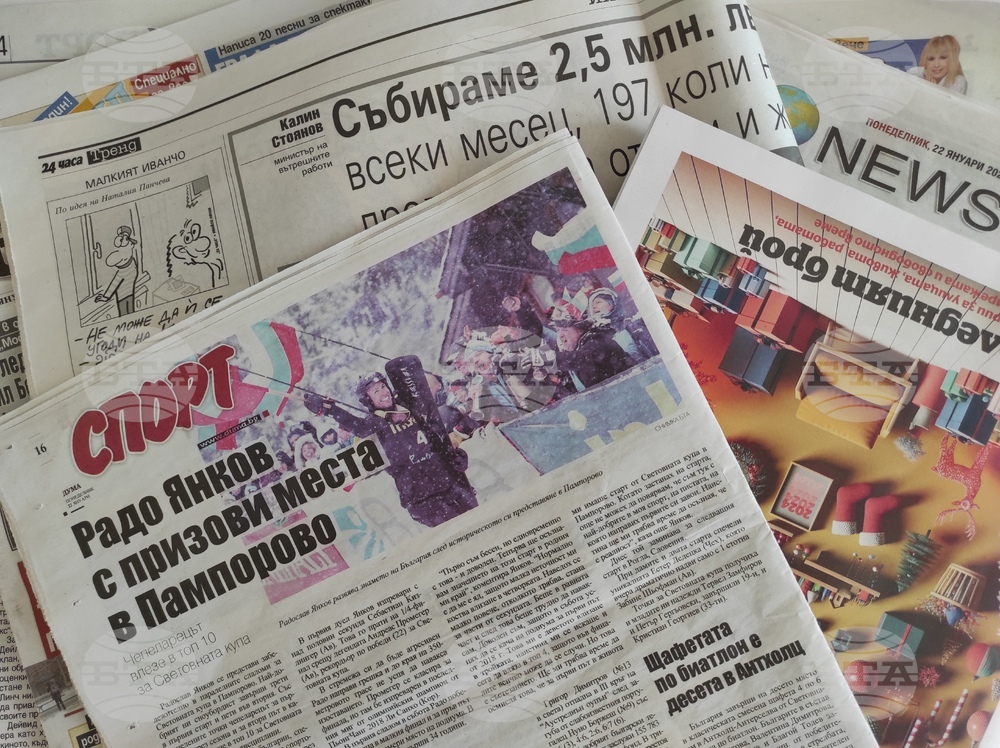
The topics of the upcoming elections and the euro changeover dominate Thursday's news media.
POLITICS
24 Chasa has an interview with sociologist Evelina Slavkova, who argues that if President Rumen Radev does not run in the upcoming snap elections with a political formation, he will suffer political damage because he will continue to raise expectations that he will come up with his own political project without actually doing so. At some point, such a discrepancy between expectation and action begins to work against him rather than in his favor, the sociologist argued. The claims that Radev will bring Bulgaria back to Russia with his party are more like slogans - the country is a member of the EU and is part of the Schengen and the eurozone, so how exactly and where will he "turn", the sociologist asks. In her words, it is hard to imagine a single political formation having all the power after the elections; Continue the Change – Democratic Bulgaria (CC-DB) calling on voters to give them such power is not realistic but rather a mobilization call.
On Nova TV's morning show, sociologist Kolyo Kolev and analyst Krystian Szkwarek commented on whether President Radev would enter politics, agreeing that should the head of State do that, the party configuration in the National Assembly would change entirely. According to Szkwarek, Radev has two options for his political image: he can push harder on the image of a Bulgarian Orban – more conservative, more sovereignist - or push harder on anti-mafia and anti-backroom deals. Depending on the chosen like, Radev would play with Vazrazhdane or CC-DB, respectively. Kolev predicted that the outcome of the President's intentions will become known within seven to ten days, and he could try to combine both lines – conservative-sovereignist and anti-status quo.
On Bulgarian National Radio, political scientist Atanas Radev commented on whom President Radev might choose for the third government-forming mandate, given that the Constitution leaves the choice of a parliamentary group to him. "Given the President's playful messages, occasional criticism of political parties, and so on, I believe Radev would either rely on his familiar tactic - the BSP - or we may see something more interesting this time - why not rely on Vazrazhdane? Although if he does so, he is more likely to disappoint specific people and potential voters around him." "Politics and governance in the country have been reduced to a personal level in recent years," the political scientist also said. "It [politics in Bulgaria] depends on who likes what and how they feel about it, but in politics, no one cares how anyone feels; we need to talk about alternatives and policies - how much they would satisfy the needs of Bulgarian citizens," Atanas Radev told Bulgarian National Radio.
***
Trud interviews sociologist Andrey Aslanov on the situation with the Bulgarian Socialist Party (BSP), which will hold a congress in February to elect new leadership. Aslanov was a member of the BSP National Council from 2008 to 2020 and was one of the leaders of the internal party opposition against the leader at the time, Korneliya Ninova. In his words, the BSP will have to get used to its new status of a small party fighting for survival. He describes the decision to hold a BSP congress in February as foolish because, instead of identifying measures to prepare the party for the snap elections, the congress will devote itself to yet another leadership battle. In the elections, the BSP will bear the consequences of its mistake to join the government with GERB. Instead of becoming part of the Zhelyazkov Cabinet, the BSP could have helped put a stop to the cycle of snap elections by offering conditional support for a minority cabinet based on requirements to its governance programme.
Duma quotes BSP – United Left Floor Leader Dragomir Stoynev as saying in Parliament on Wednesday that during the legislature’s new session, his group will focus on fighting price speculations as a result of the euro’s introduction in Bulgaria.
***
Telegraph has an inside-page article on the parties' behaviour, noting that they are focused on the upcoming snap elections already and are seeking to set new goals.
On Bulgarian National Television's morning show, GERB-UDF Deputy Floor Leader Rumen Hristov commented on how voting should be done to ensure fair elections. According to him, voting entirely via machines will result to fewer people exercising their voting right. Commenting on Wednesday evening's protest organized by CC-DB, he said: "The dictatorship of the minority over the majority is not the best form of democracy. In a democracy, things happen as follows: elections are held, a majority is formed if there is no single majority party, and progress is made. At the moment, their representatives in Parliament are in the minority." However, they present things as if their proposal for Election Code amendments is what the majority of people want, he added.
On bTV's morning show, Assoc. Prof. Borislav Tsekov, a lecturer in constitutional law, commented that amending the Election Code right before elections is "an extremely bad practice", as confirmed by the Venice Commission. According to him, if only machine voting is used, without subsequent verification, it will be very difficult to prove violations. The existence of paper ballots makes re-verification possible. He is against the introduction of paper ballot scanners for the upcoming elections as that is a radical change that requires time. Prof. Mihail Konstantinov, mathematician and election expert, and Zhoro Penchev from the Civil Association for Fair Elections agreed that introducing scanners in the last minute bears more risks than benefits. They differed in their opinions on whether machine voting results in lower voter turnout.
On Nova TV's morning show, MP Bozhidar Bozhanov of CC-DB expressed the same opinion about the risk of introducing paper ballot scanners for the upcoming elections. The power holders want the current voting machines to be replaced with such scanners, while CC-DB want the counting of ballots to be done by machines, because people make mistakes. He refuted claims that voting machines can be manipulated. "Whoever claims that should go and prove it," Bozhanov said.
ECONOMY
Trud’s front-page article is about tax reporting this year in light of the euro’s adoption. Citizens will have to report their 2025 incomes in BGN but pay their taxes in EUR. Any tax returns via card transactions will be in EUR as well.
Telegraph has an inside-page article on the same topic.
***
In an interview with Telegraph, Tsvetislava Lakova of the Consumer Protection Commission says that one in ten goods checked on the market in relation to the euro changeover is with an inflated price.
Bulgarian National Television’s morning show presented the situation with the euro at small shops two weeks after the single currency’s introduction in the country. A shop assistant commented that the transactions are running relatively smoothly; older clients still need help with the new currency.
HOME AFFAIRS
Segabg.com quotes findings from a Bulgarian National Audit Office's (BNAO) audit into the measures for preventing and countering corruption with EU funding as well as a survey commissioned by the institution. Only five reports of corruption involving EU funds were submitted to the institutions between 2021 and 2023, and only two fines were imposed. The reason is that employees in the agencies that manage EU programmes, as well as grant recipients, are afraid to report abuse of power for personal gain because they do not feel protected and do not trust the institutions, the findings show. The BNAO recalls that during the 2021-2027 programming period, 13 programmes with a total value of nearly EUR 13 billion are being financed in Bulgaria with money from EU funds. Bulgaria has a National Strategy for Preventing and Counteracting Corruption, but the organization of the management of this process at the national level is inadequate, the BNAO finds. The audit covers the Council of Ministers and eight ministries.
***
Mediapool.bg writes that over the past seven years, the Road Infrastructure Agency (RIA) has become a distribution hub for billions. However, just over a third of the road network in Bulgaria is in good condition, according to API data. For the past 2025, the balance sheet shows that 30 km of new motorway sections have been put into operation and repaired, mainly under contracts for ongoing repair and road maintenance. In addition, contracts worth around EUR 2 billion have been signed for the implementation of EU projects. The grant aid for these projects amounts to around EUR 660 million from the European Regional Development Fund. This is the visible part of the API's work; the invisible part is the public tenders announced for road repairs and construction. As a rule, the API has long since stopped announcing who the selected contractor is. Probably because, in most cases, only one candidate is allowed to open the price proposals and the choice is a foregone conclusion, Mediapool writes. And this is not only the case with tenders involving public money - the API allows itself to do this even with contracts financed by EU funds, despite the fact that Bulgaria has made a commitment to the European Commission to reduce the number of tenders with a single candidate.
***
Capital.bg has an article on the waste collection crisis in Sofia. Several months ago, Mayor Vassil Terziev and his team chose not to sign contracts with the bidders in the tender for a total of EUR 219 million to clean most of Sofia for the next five years. And with good reason: the bids were several times higher than expected, and the companies were linked to "people with nicknames" (according to Terziev). This has led to overflowing bins in some areas, political attacks, and temporary solutions. The model of waste collection in Sofia is undoubtedly flawed, and exactly 20 years after GERB leader Boyko Borissov, then mayor of the capital, was pressured in a similar way by the waste collection companies, nothing has changed. There are no useful moves for the capital's administration as a whole, only choices between the lesser of two evils. The bottom line to date is as follows: Sofia Municipality has so far avoided expensive contracts and dependence on people with nicknames, but it has fallen into the delicate and vulnerable situation of more than two-thirds of the city's cleaning currently depending on one company with an image that is far from impeccable - Titan. The situation is temporary - until new tenders are announced, but it is unclear how long the temporary situation will last. This depends on procedures and institutions that are generally not "friends" of the Mayor. Thus, a long-term solution still seems far off, and low prices are not guaranteed, the article reads.
Bulgarian National Television’s morning show has Sofia’s waste collection crisis as its main topic under the title, “Yet Another Episode of ‘Sofia and the Uncollected Waste’ Series”. According to Aluani, managing the waste crisis is one of the greatest successes because it solved a very serious problem that was long overdue. The prices for waste collection must be limited to those that are acceptable to the citizens of Sofia, he argued. In his words, Mayor Vassil Terziev showed that he had the courage to stand up to the mafia, "which had divided up the capital's boroughs like a New Year's pie." Savov was adamant that the management of the waste crisis had been an absolute failure from the very beginning: "From the late start of the public procurement process, through the lack of parametres clearly defining the maximum price, to the management decisions taken throughout the crisis. The mafia was loudly proclaimed to have been defeated, and we were convinced that it had been defeated. But in fact, we replaced some people with nicknames with other people with nicknames. We are talking about Titan, with whom extended contracts were signed in several boroughs, despite the procedure. The crisis was created by the Mayor."
***
24 Chasa reports on its front page that phones are now banned in 185 schools in Bulgaria. In another 1,391 schools, the devices cannot be brought into class. Children spend over two hours on social media.
/DS/
news.modal.header
news.modal.text