site.btaMedia Review: December 9
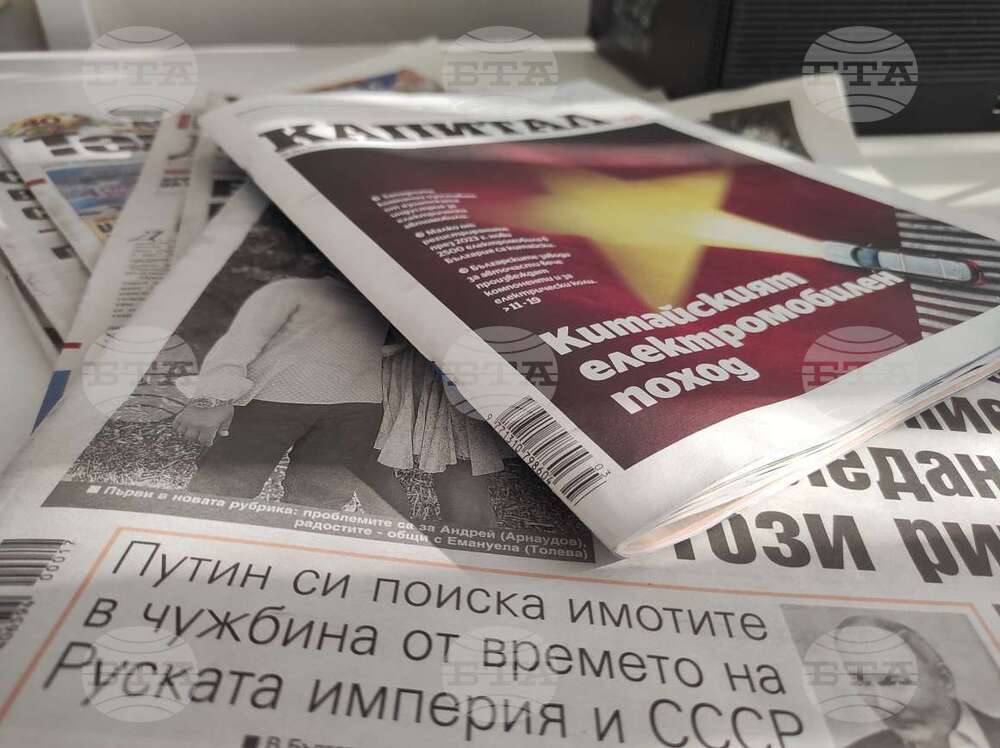
OVERVIEW
The 2026 State Budget, protests and the Financial Times report that a Bulgarian diplomat might head the post-war governance of Gaza are among the predominant topics as no single issue dominates Tuesday’s media.
FOREIGN POLICY: MIDDLE EAST PEACE PROCESS
Quoting a publication in the Financial Times all Bulgarian online media outlets, TV and radio report that Bulgarian diplomat Nickolay Mladenov is set to head the post-war governance structure for the Gaza Strip. As part of the post-war administrative structure for Gaza, an executive committee is expected to be established, to be chaired by Mladenov, former UN Special Coordinator for the Middle East Peace Process and former Bulgarian foreign minister, sources familiar with the preparations have said. The publication recalls that Mladenov has frequently acted as a mediator between Israel and Hamas. According to the Financial Times’ sources, Tony Blair was removed from consideration for a leadership role in the committee following objections from Arab and Muslim countries.
***
On bTV’s morning programme, Former Deputy Foreign Minister Milen Keremedchiev described this as great recognition. "Mladenov has made enormous efforts to achieve peace in Gaza, but this is still a long way off. At the moment, we know that Trump's latest 20-point plan, which was put on the table, is currently stuck on point two. The first point was fulfilled, the exchange of hostages, but the disarmament of Hamas has stalled, and not only that. There are currently accusations from Israel that Hamas has recruited 7,000 new members in Gaza, while Hamas has sent a letter to the US stating that the Israeli army is not complying with the truce and that they want to withdraw from it," Keremedchiev said.
2026 STATE BUDGET
Speaking on Bulgarian National Television (BNT), Venko Sabrutev, Continue the Change – Democratic Bulgaria (CC–DB) MP, criticized the new state budget, saying it is essentially the same as the previous one, “only worse.” He argued that key funding for doctors, young physicians, and nurses is missing, while salaries in the public administration remain nearly unchanged. According to him, the government is “saving money at the expense of medical staff,” while high-ranking officials continue to receive large salary increases. He said that under CC–DB governance, wage increases were balanced, but the new budget creates a “hyper-imbalance.” Sabrutev also warned that harmful measures remain in place, noting that the planned rise in social insurance contributions has only been postponed, not cancelled, and is explicitly scheduled to increase by 3% in 2027–2028. He criticized shrinking shares of GDP allocated to education and healthcare, arguing that this shows the government prioritizes “money for corruption” over healthy and educated citizens. Sabrutev also pointed to projections of a sharp rise in public debt to 36.6% of GDP by 2028, accusing the government of relying on unrealistic revenue assumptions. This, he said, will inevitably lead to tax increases. He condemned planned borrowing for 2025, claiming it is more than double what is necessary and comparing it to a household taking loans without knowing how to repay them, ultimately forcing higher taxes on citizens.
***
Medical specialist Daniel Kiprov, Trade Union of Employees in the Interior Ministry representative Vergil Hristov, and Bulgarian Entrepreneurial Association (BESCO) CEO Dobromir Ivanov on bTV’s morning programme agreed that although there have been changes to the first draft of the 2026 budget, there is lack of reform and strategic vision. Kiprov confirmed that medical specialists will join the big protest called on December 10, since the promised BGN 260 million for hospitals has disappeared from the budget, and the new BGN 30 million has been allocated without a distribution mechanism. The police representative insisted that police officers did not assist provocations during previous protests and assured that order will be guaranteed on December 10. The business community, represented by BESCO, considers the 10% increase for all public sector employees to be a mistake that ignores the actual shortage and surplus of personnel in various fields. According to them, the budget is excessively inflated, and the country is living "on credit", with the current decisions burdening citizens after 2027. There is a lack of structural reforms, and the measures adopted will expand the grey economy and push part of the business out of the country. What the three sectors have in common is a clear sense that the state continues to operate inefficiently, that corruption is undermining the systems, and that all efforts on the part of the government boil down to "patching holes" rather than consistent policy. The lack of reforms in healthcare and education remains an obstacle to the return of Bulgarians from abroad, and almost every sector feels disadvantaged.
***
Economist Georgi Vuldzhev from the Expert Club for Economics and Politics (EKIP) told Bulgarian National Radio (BNR) that the budget shows the government does not care if the country goes bankrupt. “It is clear that those in power are not seriously attempting to revise the budget, but rather to rush it through as quickly as possible, make cosmetic changes to satisfy demands, and thus hastily conclude the matter.” Vuldzhev added that "the budget forecasts that the national debt, which is 23% of GDP at the end of 2024, will rise to 36.6% in just four years. This is absolutely insane, given that we are not in recession at the moment, we have economic growth, and even those in power boast that we have one of the best economic growth rates in Europe. It is incomprehensible how you can boast about this when you are setting an increase by half of the public debt to GDP ratio. These people have shown that they really don't care if the country goes bankrupt."
PROTESTS
If students are out on the streets protesting, it means there is a huge problem, Ivan Lesov, a doctoral student at Neofit Rislki South-West University, told BNR, adding that "young people are the driving force of the country and should be free to express their views and discontent". As part of the National Representation of Student Councils, he announced that the topic of protests in the country will be discussed at the General Assembly. According to Martin Katsarski, a student at the University of Mining and Geology, young people have shown that they are the future of the country and will not allow problems with their future, and the future of their children and grandchildren. "Education must be supported so that young people do not have to choose between their education and giving it up to work in order to live a normal life," he said. It is time for "people who have the good of the people at heart, not just their own pockets" to form a new party or political project, the student believes. According to Lesov, for a party's term in office to be successful, it must take into account the conditions it offers to citizens.
***
Sociologist Boryana Dimitrova from the Alpha Research polling agency told BNR that the recent protests are unlikely to calm down and are instead growing. She argued that the government can no longer regain political legitimacy simply through budget changes. Many active social groups are protesting with basic political demands, mainly for their voices and participation to be respected. According to her, the protests will likely continue to push for the government’s resignation, and they cannot be contained through normal parliamentary means. The government will not resign before Bulgaria adopts the euro: "This is its understanding, its duty, and its responsibility. After that, a decision will be made, because in times like these it is difficult to predict how far the escalation will go." Dimitrova added that it is uncertain whether the strong energy on the streets will translate into votes in future elections. The protests, she said, have given significant momentum to the Continue the Change - Democratic Bulgaria political alliance, which now carries responsibility for channelling this public energy effectively. She added that President Rumen Radev’s positions are not reflected in the protests. The protests did not convey messages of ethnic or religious division, Dimitrova stated. "At no point did the protests convey a message of ethnic division. The counter-protests organized by Movement for Rights and Freedoms – New Beginning appear to be a provocation to the protests rather than having any moral or political basis. They will probably serve to unite MRF – New Beginning supporters, but also dangerously play the ethnic card in a situation where there is no basis for talking about ethnic hatred. This seems to be a dangerous game."
***
On Tuesday, a day before the announced protest against the 2026 budget and the government, the Movement for Rights and Freedoms (MRF) - New Beginning is holding counter-demonstrations in 24 cities across the country, under the slogan "No to hatred". bTV’s morning programme interviewed Guner Tahir, chairman of the National Movement for Rights and Freedoms, former deputy chairman of the Movement for Rights and Freedoms, and journalist Mehmed Yumer on the occasion. Yumer said that “it is clear that these peaceful rallies, which will be held in 24 regional cities, will demonstrate two things: first, that they are consolidated, united, and have the strength to demonstrate, but in a peaceful manner; and second, that they want to strengthen the government and continue with this cabinet.” Guner Tahir disagreed and added: "This is not about protecting the government, but rather about protecting Delyan Peevski personally, and this must be said clearly. Since he cannot rely on the people in the big cities, we know why – because they simply hate him, he uses the people in the regions, some of whom are not aware of what is happening in Sofia. The village mayor gets them together, but those who are dependent on the municipality are those who are gathered, they are the protest. It supports Delyan Peevski." When asked whether Delyan Peevski is among those who keep people dependent through the mayors of smaller towns, Mehmed Yumer replied: "Whether he controls them, I cannot say. In fact, the result is important, and it is the consolidation of MRF - New Beginning, based on what, perhaps everyone can easily draw their own conclusions."
ECONOMY
Duma daily’s front-page article, Mediapool.bg and Dnevnik.bg report extensively on Monday's presentation of an analysis by the Centre for the Study of Democracy on the market for undeclared fuel in the period 2020-2024, commissioned by the Bulgarian Petroleum and Gas Association and prepared with the assistance of the National Revenue Agency and customs authorities. The analysis shows that in 2024 about 624 million litres of fuel were consumed in Bulgaria without paying excise duties or taxes, causing an estimated BGN 578 million loss to the state budget, equivalent to about 90 illegal fuel trucks per day. Although this is an improvement compared to 2020, when losses exceeded BGN 780 million, contraband fuel still makes up about 11.8% of the market. Diesel accounts for the largest share of undeclared fuel, over 600 million litres, while methane misuse is also significant because many drivers fail to register changes in their fuel systems. Researchers say the main sources of illegal fuel are not duty-free stations or subsidized farm machinery, but likely a small Bulgarian refinery, whose name is not confirmed. "We have reason to believe that the major source is a small refinery, whose name I will not mention because we have no evidence," Tihomir Bezlov, from the Centre for the Study of Democracy said. According to experts, undeclared fuel is often funnelled through major gas stations and aided by manipulated cash registers, where sales are not reported directly to the revenue agency, as they should be. Lukoil Neftochim Bulgaria is the only refinery in Bulgaria that processes crude oil. Mediapool says that the other refinery is Insa Oil’s, owned by businessman Georgi Samuilov, who is considered close to the leader of the MRF – New Beginning party and sanctioned for significant corruption by the US and the UK, Delyan Peevski. The plant near Belozem does not actually process crude oil, but refines crude oil into gas oil, other fuels and petroleum derivatives, so according to customs authorities, it is not a refinery. Nevertheless, it is a fuel producer, and the company also has a chain of gas stations. "The fact that the main reason is the small refinery means that it enjoys protection. Some time ago, we had a bank with protection, then three insurance companies with protection," economist Krassen Stanchev from the Institute for Market Economics is quoted as saying. However, the company claims that it has been under the physical control of customs for months, declares all its quantities, pays its taxes, and that no one has the right to speculate with its name. Authorities propose tighter controls, including using toll-system cameras to track fuel trucks, adding GPS trackers, and possibly installing sensors in fuel station tanks. The Customs Agency reports that since introducing physical control at fuel tax warehouses in April 2025, excise and tax revenues have already risen by 6%. Industry and government officials argue that stricter oversight, from production to retail, is essential. The Finance Ministry reports rising tax revenues and is open to further measures to curb the grey fuel market. Other trends include a large increase in Bulgaria’s vehicle fleet since 2019 and a rise in foreign vehicles refuelling in the country, as well as Bulgarians increasingly buying fuel abroad.
***
Telegraf daily’s front-page article says that the price of sunflower oil has finally dropped by BGN 1, after the wholesale price fell. But the decrease is just a promotion and not a long-term lowering of the price. According to the Commission for Protection of Competition’s interim report from the sector analysis of the food market, markups formed as the ratio between the selling price and delivery without discounts vary between 13 and 64%. The article quotes State Commission on Commodity Exchanges and Wholesale Markets Chair Vladimir Ivanov saying that the price of the consumer basket has increased from BGN 99 to BGN 100 this week, as the wholesale food price index, which measures changes in wholesale food prices in Bulgaria, increased by 1.04%. The strike in Greece, which has caused some supply difficulties, has inflated the price of tomatoes and cucumbers, Ivanov said, adding that the differences are small and insignificant. As a tendency in the past month-month and a half only the price of eggs has risen substantially, at the beginning of the year they were sold at BGN 0.36, while this week their price is set at BGN 0.43 per piece.
***
24 Chasa’s front-page article says that according to an analysis of specialized publications and environmentalists in Europe, some hybrid cars are a big deception. Despite their growing popularity, the price of a battery costs many times more than the potential fuel savings. The article examines whether electric cars are more prone to malfunctions than ordinary cars, explaining that the main reason for malfunctions in electric vehicles is the defective starter battery.
EURO CHANGEOVER
In view of Bulgaria’s joining the eurozone on January 1, 2026, in an interview for bTV’s morning show former Prime Minister Sergei Stanishev (2005–2009) recalled the atmosphere surrounding Bulgaria’s accession to the European Union in 2007 and outlined the risks and hopes surrounding the introduction of the euro. Stanishev said that from the early hours of January 1, 2007, he remembers "the excitement of a dream come true for an entire generation," the celebrations in the centre of Sofia, but also the first disappointments. Just days after the celebrations, discontent erupted over excise duties on homemade rakia, the first sign that European rules bring not only opportunities but also challenges. According to him, people's main concern, price increases following the currency change, should be addressed, as there are no economic reasons for high inflation. He called for an end to speculative price increases. Stanishev welcomed the fact that the government is launching a more active information campaign, albeit belatedly. As a practical warning for the first hours after the currency change, he reminded people that ATMs would not be working on New Year's Eve, so they should have enough cash at hand.
***
Sega.bg reports that it is highly likely that banks will be reconfiguring their systems to the euro for a few hours on the night of December 31 to January 1. There will be interruptions to online services, so cashless payments will cause problems. To avoid them, traders are getting ready to accept only cash at that time. Each bank will inform its customers when exactly this will happen, with interruptions expected on New Year's Eve from 9 p.m. to 1 a.m. After that, card systems will switch to standard mode, and payments will only be made in euros.
HEALTHCARE
Trud daily’s front-page article focuses on Bulgaria’s plans to launch a national Electronic Health Insurance Card system in 2026, with EUR 40 million allocated in the new budget. The smart card will give patients and doctors secure access to each person’s electronic health record, including insurance status, basic medical information, and electronic prescriptions. Sensitive data will not be stored on the card itself but in protected systems; the card functions as a secure access key and is expected to reduce fraud such as fake hospitalizations and prescription abuse. The 2026 National Health Insurance Fund budget totals EUR 5.28 billion, a 9.2% increase, including EUR 2.3 billion for hospital care. Employer groups criticize the budget for prioritizing hospital treatment over prevention. Trade unions warn that problems with nurses’ salaries and staff shortages remain unresolved. A previously proposed EUR 260 million fund for young doctors has been removed; instead, only EUR 30 million is allocated for their support. The article also explains how Bulgaria’s electronic health system works: it stores digital records of medical visits, referrals, prescriptions, test results, and vaccinations, accessible through a web portal, with an electronic signature, or the eZdrave mobile app. The goal is a unified digital health record for every citizen, improving coordination, reducing paperwork, and making healthcare more efficient.
***
In a Nova TV interview, infectious disease specialist Trifon Valkov said that influenza has appeared earlier than usual across Europe. He said that an early flu wave is being observed, with a higher percentage of cases and more hospitalizations. According to him, this is the result of mutations in the circulating virus, but he stressed that the seasonal vaccine remains effective. The specialist explained that the current variant is covered by the vaccine and said vaccinated people can be reassured. Valkov reminded that vaccination does not fully prevent infection but significantly reduces the severity of the illness. Valkov also said that in recent years different subtypes had been dominant, leaving more people without immunity to the current influenza A H3N2 subtype. He added that a slightly different variant has now emerged, which he described as expected. Asked when the flu wave would reach Bulgaria, he said it is difficult to predict exactly when this will happen due to the constant daily movement of people by air and bus. He added that the virus is spreading more easily than usual and that morbidity is expected to be about 20% higher. Valkov again emphasized the importance of vaccination, calling it the most important form of specific prevention.
***
The epidemiological situation in the country at the beginning of December remains calm, and interest in flu vaccination is growing, Assoc. Prof. Lyubomir Kirov, President of the National Association of General Practitioners said in an interview for BNT’s morning programme. He also commented on the financial framework of the National Health Insurance Fund, "General practitioners were not included in the previous budget, there was no mention of those specializing in general medicine. I hope that now the payment will apply to absolutely everyone," Kirov said, adding that interest in the specialty has been growing over the past two years. Asked whether general practitioners insist on an increase in the user fee, he said: "We proposed it, and I think it is insulting to propose the same thing to the same people every 2-3 months. They should take note and think about it."
FOREIGN POLICY: US AND EUROPE
Commenting on the new US National Security Strategy in an interview for BNR, Ivaylo Ivanov, expert on national and international security, said that the only thing the US wants is to be a dominant power with no restrictions on the actions it takes, whatever the administration deems appropriate. "Nothing surprising. If we use a bit of dark humour, we could say that some of the points in the strategy may have been written in Moscow,” Ivanov said. "The text of the strategy makes it clear that US foreign policy will be subject to the will and whims of Donald Trump. And every action of this administration will be penultimate, because it is ready to change its position when a new entity appears that is willing to pay more, to switch sides and accept that deal." According to Ivanov, the separation of the US from Europe and the redirection of its attention to other regions of the world is a process that began under Barack Obama, but everyone hoped that this would happen in a negotiated manner and that the US would gradually relinquish its responsibilities, giving Europe time to take them on. "The worst-case scenario is unfolding, with the US pulling out abruptly. They are considering withdrawing from some NATO planning structures, which is worrying. This leaves deep holes in military capabilities that European countries can fill. This brings us dangerously close to war because there are circles in Russia that are eager to test whether Article 5 of the NATO treaty works. This official document gives Russia sufficient grounds to believe that now is the time to test NATO."
/RD/
news.modal.header
news.modal.text