Wrap-up
![Conference on Security in Balkans, Black Sea Region Held in Sofia]()
![Conference on Security in Balkans, Black Sea Region Held in Sofia]() Snapshot of the conference (BTA Photo/Minko Chernev)
Snapshot of the conference (BTA Photo/Minko Chernev)
site.btaConference on Security in Balkans, Black Sea Region Held in Sofia
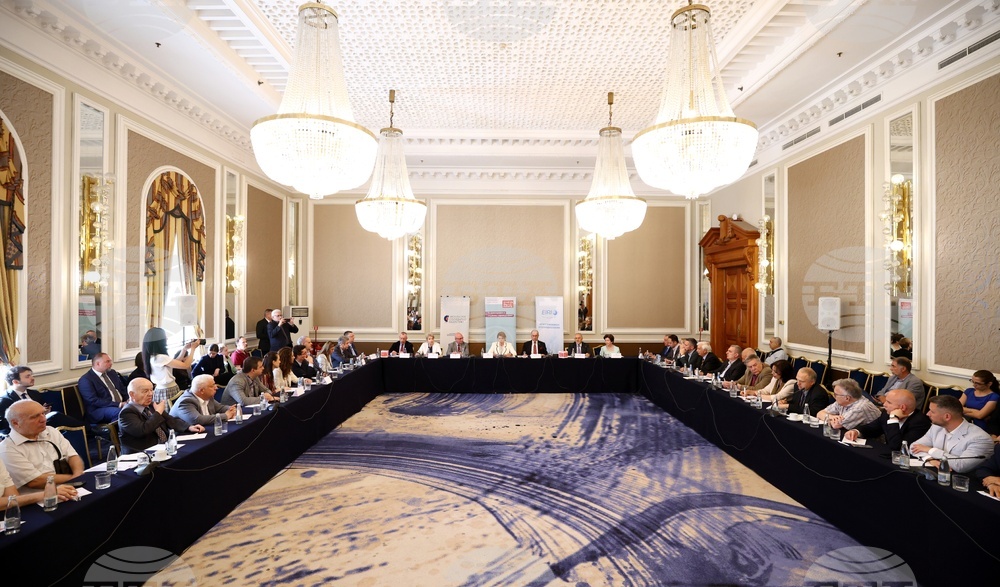
A conference on regional security in the Balkans and the Black Sea Region was held in Sofia on Monday. It was organized by the Friedrich Ebert Foundation and the Institute of International Economics Relations. The event was held in connection with Bulgaria’s Chairmanship of the South-East European Cooperation Process (SEECP). On June 10, President Iliana Iotova will host the SEECP Summit marking the initiative’s 30th anniversary.
President Iliana Iotova said that she firmly opposes viewing the Black Sea Region solely as a militarizing area, stressing that the sea is a major geographical and natural asset for Bulgaria. She added that developments in the region must be monitored carefully to avoid undermining tourism and the emerging industries along the Black Sea coast that provide livelihoods and income for local communities. The President said the international security architecture is undergoing unprecedented challenges, noting that the geopolitical fault line currently runs through Bulgaria, the Balkans and Southeastern Europe. Security can no longer be guaranteed by any single country, she argued, emphasizing the importance of cooperation within the European Union and NATO.
President's Foreign Policy Secretary Meglena Plugchieva said that EU's Multiannual Financial Framework for 2028-2034 will prioritize competitiveness, industrialization, defence, energy security and resilience to strengthen the bloc's strategic autonomy. Plugchieva said the new priorities will be implemented through national and regional partnership plans supported by integrated financing, with EUR 2 trillion allocated to the main objectives. According to Plugchieva, the new mechanism will fund major energy security projects. She said EUR 865 billion is planned for national and regional partnership plans, with a further EUR 18 billion allocated to military mobility. Plugchieva said the new priorities reflect the changed geopolitical environment and the EU's goal of achieving greater strategic autonomy.
Political analyst Marian Karagyozov from the Institute of Balkan Studies and Center of Thracology at the Bulgarian Academy of Sciences, argued that Bulgaria and the Balkans could serve, if not as direct mediators, then at least as a platform for dialogue with Russia. He stressed that Bulgaria and the countries of the region had a shared interest in advocating for compliance with international public law and in opposing double standards, which he described as one of the reasons for declining trust in European institutions. Karagyozov also said that, in recent weeks and months, the question of who should engage in negotiations with Russia had been raised in Europe for the first time. In his words, thanks to their diversified business ties, Bulgaria and the SEECP countries could play a constructive role in facilitating contacts along both East-West and North-South axes.
Hristo Georgiev, director of the Foreign Ministry's Southeast Europe Directorate between 2005 and 2008, said that the SEECP can serve as a productive platform for security in all its dimensions. According to Georgiev, the European Union is increasingly moving towards strategic autonomy, and the countries of Southeastern Europe could become part of this trend, with regional dialogue contributing to the shaping of European policies. At the same time, he warned that delays in the EU accession process of the Western Balkan countries could become a challenge for Europe. He also pointed to growing nationalist sentiments in the region.
Economics and International Relations Institute CEO Lyubomir Kyuchukov said that the Balkans are in a unique situation because conflicts surround the region but do not originate from it. Regionalization demonstrates that processes are no longer confined within the borders of individual states but increasingly unfold at regional and global levels, he said, adding that this trend unfortunately also applies to conflicts. According to Kyuchukov, the choice between being a neutral periphery and an active zone of confrontation should not be seen as the only option for the region. He stressed that the SEECP, which marks its 30th anniversary in 2026, remains a significant achievement at a time when dialogue and mutual trust have become some of the most scarce commodities in international relations.
PanEuropa Bulgaria EU Affairs Director Biserka Benisheva said that despite the European Union’s dominant role, geoeconomic rivalry can create risks to stability if it is transferred to the Balkans. She also stressed the need for more structured gradual integration and for promoting reforms. The accession perspective, the introduction of stricter reforms, regulations and EU standards, particularly in trade policy, competition and public procurement, as well as the location of the Balkans, attract the EU’s global competitors, Benisheva said.
/MR/
news.modal.header
news.modal.text