site.btaDecember 8, 1949: Panagyurishte Gold Treasure is Discovered
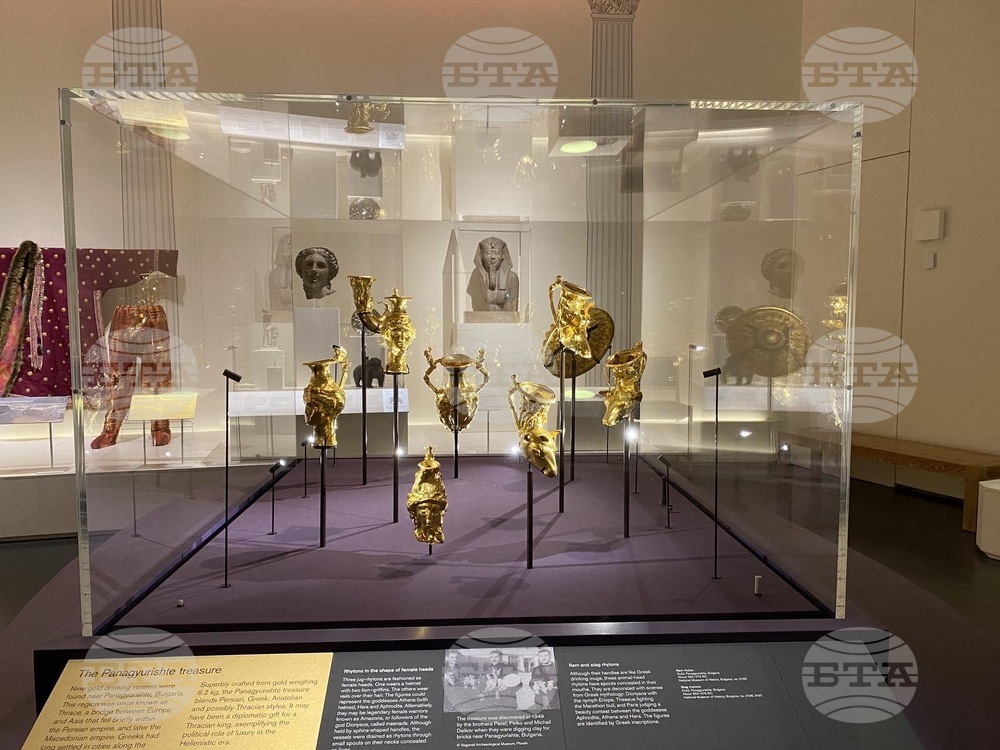
On December 8, 1949, the Panagyurishte gold treasure was discovered by three brothers, Pavel, Mihail and Petko Deikovi, during excavation work at a former tile factory in Panagyurishte. After cleaning the nine items, the brothers handed them over to the district governor at the time, Stefan Kalpakov. The nine items - one phiale (dish) and eight rhytons - weighing a total of 6.164 kg of 23-carat gold.
The treasure remained in Panagyurishte for several days so that all the town's residents could see it. Later, by government decision, it was moved to Sofia. Initially, it was kept at the National Archaeological Institute in Sofia and then at the National Museum of History.
According to the National Museum of History's website, all of the vessels were superbly crafted by highly skilled goldsmiths, who combined Hellenic motifs and stylistic techniques with Thracian and Achaemenid ones. The decorations consist of plant, zoomorphic (animal-like) and anthropomorphic (human-like) elements in high relief with exquisite detail. These include Greek mythological characters and scenes that were known in Thrace during the Hellenistic period.
The phiale is adorned with African heads in relief, arranged in concentric circles alongside acorns and palmettes. Two inscriptions show its weight in units used in the city of Lampsacus (modern-day Lapseki in Canakkale Province, Turkiye). The gold used to make this vessel differs in composition from that used for the other eight vessels.
One of the two rhytons, which is shaped like a deer's head, depicts the exploits of Theseus and Heracles. The other shows the mythological figure Paris seated between the goddesses Hera, Athena and Aphrodite. One rhyton, which ends in a male goat's head, shows a scene involving Apollo, Hera, Artemis and Nike, while another, which ends in a ram's head, depicts a Dionysian scene.
The largest vessel in this treasure is the amphora-rhyton. It has two spouts at the bottom and the scene on its body features seven armed men positioned on either side of a lavishly adorned gate.
This royal ritual wine-drinking set was found in an area once ruled by the Thracian king Sevt III, who founded his capital, Sevtopolis, nearby.
It is believed that the set belonged to an Odrysian (a Thracian tribe that lived in modern-day Bulgaria between 5th century BCE and 1st century CE) ruler from the late 4th and early 3rd centuries BCE, and was used for ritual ceremonies and religious rites. Nowadays, it forms part of the National Museum of History's collection and is kept under special conditions. It is periodically exhibited in Bulgaria and abroad under heightened security measures.
/NF/

news.modal.header
news.modal.text