site.btaBulgaria’s Credit Rating at Record High, Upgrade May Be Delayed, Expert Says
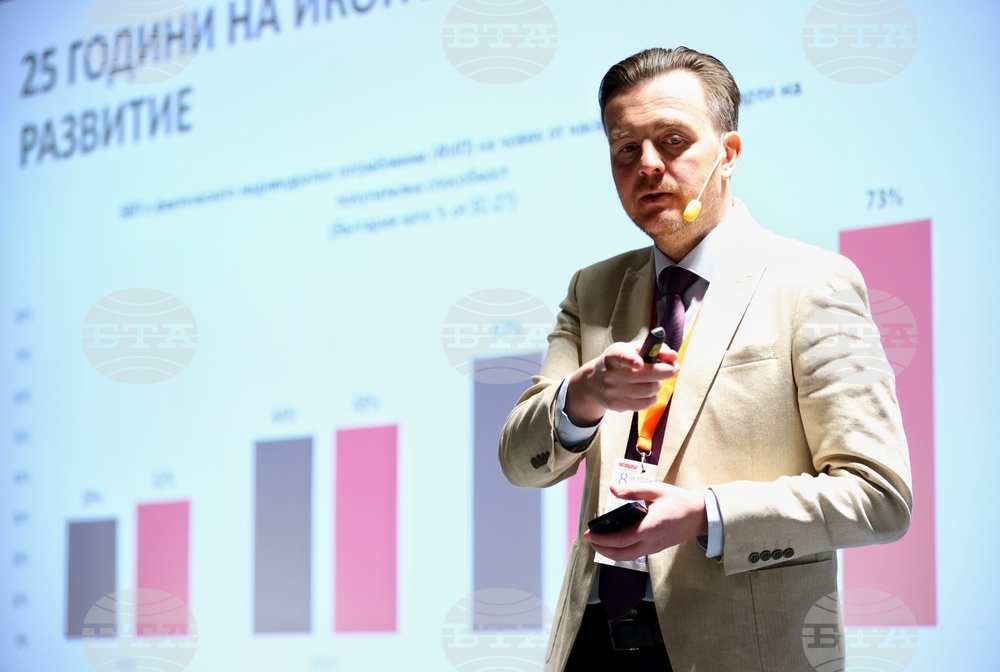
Senior researcher Petar Ganev from the Institute for Market Economics (IME) said that Bulgaria’s credit rating is currently at its highest level since records began, but its next upgrade may be delayed due to the absence of a regular government and an adopted budget, as well as the impact of two nearby wars. Ganev was speaking at the Eighth Annual Production and Trade Forum, organized by Manager magazine, which is being held in Sofia on Tuesday.
According to him, Bulgaria’s prospective membership in the euro area reflects 25 years of economic growth and convergence. He cited data showing that at the beginning of the new millennium, Bulgaria stood at 29% of the EU average in terms of GDP per capita. Since then, a steady convergence trend has been observed, with the country now reaching 66%. Ganev said that once data for 2025 becomes available, the figure is expected to reach 68–69%. He emphasized that countries in Central and Eastern Europe range between 75 and 90%, meaning Bulgaria is gradually catching up and could reach those levels within two to three years.
“This is most clearly visible in demographics, when a country is at 30% of the European average, people tend to leave; at 66%, they begin to return,” Ganev said, adding that this shift has direct implications for both consumption and production.
Ganev added that over the past three years, economic growth has slowed both in Europe and Bulgaria. According to him, even before the situation in the Middle East, there were already numerous risks to growth.
He noted that about half of the output of industrial enterprises is destined for export, meaning that Bulgaria’s industry largely depends on external demand, primarily from Europe.
Citing recent data, Ganev said that exports remain stable in recent years, they are not declining but have remained broadly unchanged. This suggests that current growth is being driven mainly by domestic demand.
At the beginning of 2020, companies were spending around EUR 1.5 billion on wages, whereas this figure now exceeds EUR 3 billion. This more than doubling in wage expenditure has occurred while the number of employees has remained largely unchanged, Ganev noted.
He also said that since 2015, cumulative inflation has reached around 40–45%, with most of the increase occurring after the pandemic. The most noticeable price rises have been in restaurants and hotels, as well as in food and non-alcoholic beverages.
Ganev noted that the introduction of the euro has proceeded more smoothly than he had expected.
/RY/
Additional










news.modal.image.header
news.modal.image.text
news.modal.download.header
news.modal.download.text
news.modal.header
news.modal.text