site.btaIvaylo Nachev Says Bulgarian Antarctic Radio Station Among Few Officially Recognized
DXer Ivaylo Nachev told the Bulgarian News Agency (BTA): "There are contacts with Antarctica in different regions, but those stations are not recognized by the system as Antarctic stations. Our station, our call sign, is officially recognized as an Antarctic station."
Nachev, an engineer, is a chief assistant lecturer at the Faculty of Telecommunications of the Technical University of Sofia. He is currently in Antarctica under a joint project with the Institute of Astronomy at the Bulgarian Academy of Sciences and the Nikola Vaptsarov Naval Academy to build a LOFAR radio telescope. A specialist in radio communications and telecommunications technology, he also heads the university's DXer club. Since 2007, Nachev has served as the first radio operator of the St Kliment Ohridski Bulgarian Antarctic Base, maintaining its radio channel this season.
"During the early Antarctic expeditions, radio was the base's sole link to the outside world. The on-site radio operator handled communications with logistics companies in South America, received meteorological data, since there was no internet and satellite services, and coordinated with nearby Antarctic bases during joint operations. The operator also relayed information on ship arrivals, supplies and departures, and enabled regular, usually weekly, contacts between expedition members and their families.
"It was almost a ritual. Families would gather at the Technical University's DX club, the console provided the link, and the radio operator organized weekly, or almost weekly, windows for the expedition members to speak with their loved ones," said Nachev.
This system remained in place until 2007, after which technological advances removed the need for a dedicated radio operator. No such radio links were made again until the current 34th expedition.
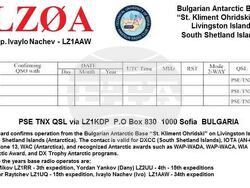
"DXers confirm contacts using QSL cards, standard paper cards. The Bulgarian base's call sign, LZ0A, is unique and highly sought after because it represents an Antarctic station in the South Shetland Islands, specifically Livingston Island. There is huge interest; it is probably among the top 50 most desired destinations for radio contacts," Nachev said.
The QSL cards list all radio operators of the expeditions over the years. Yordan Yankov is the most widely known radio operator of the Antarctic base, having served from the 4th to the 15th expedition.
"We now have over 1,500 contacts across different bands. This season, the station has logged more than 12,000 contacts across multiple bands, mainly with DXers in North and South America, with strong interest also from Europe, including Bulgaria, France, Slovakia, Czechia, Germany and Belgium. The total could reach 13,500 by the end of the expedition.
"DXers worldwide contact the Bulgarian Antarctic station, most often to ask about weather conditions and ongoing projects. Teachers also reach out, eager to tell their students they have spoken directly with Antarctica," said Ivaylo Nachev.
The Bulgarian naval research vessel Sv. Sv. Kiril i Metodii (RSV 421) departed for Antarctica from Varna (on the Black Sea) on November 7, 2025. After a month-long voyage across the Atlantic Ocean, the ship arrived at the Argentine naval base in Mar del Plata on December 13.
BTA has had a national press club on board the ship since 2022 and another on Livingston Island since February 2024. BTA Director General Kiril Valchev said they exist thanks to the generous support of RSV 421 and Bulgaria’s St Kliment Ohridski Base, which provide the necessary facilities. These two press clubs are added to the news agency’s other 41 national press clubs (33 in Bulgaria, seven abroad in neighbouring countries and in nations with large Bulgarian communities, and one mobile National Book Press Club).
The news items of BTA's special correspondents on RSV 421 and Antarctica are freely available in Bulgarian and English on the agency's website. They can be used free of charge by all media, with attribution to BTA. Valchev recalled that thanks to its correspondents, the news agency appears among the top results on Google when searching for the phrase “Antarctica correspondent”.
/DD/
Additional


news.modal.image.header
news.modal.image.text
news.modal.download.header
news.modal.download.text
news.modal.header
news.modal.text