site.btaMedia Review: February 2
POLITICS
Bulgaria’s President Iliana Iotova will begin consultations with parliamentary parties on Tuesday, after which she is expected to announce her choice for caretaker prime minister, bTV reports.
Last week it became known that of the ten individuals invited to the President’s office, five indicated their willingness to head a caretaker government.
The candidates are: Bulgarian National Bank Deputy Governor Andrey Gurov, Deputy Ombudsman Maria Filipova, Bulgarian National Audit Office President Dimitar Galchev, and his two deputies, Margarita Nikolova and Silvia Kadreva.
According to the Constitution, President Iotova must first consult with parliamentary groups, then announce the candidate who will lead the caretaker cabinet, issue a decree appointing the government, and simultaneously schedule new elections within a two-month period.
The procedure will begin on February 3.
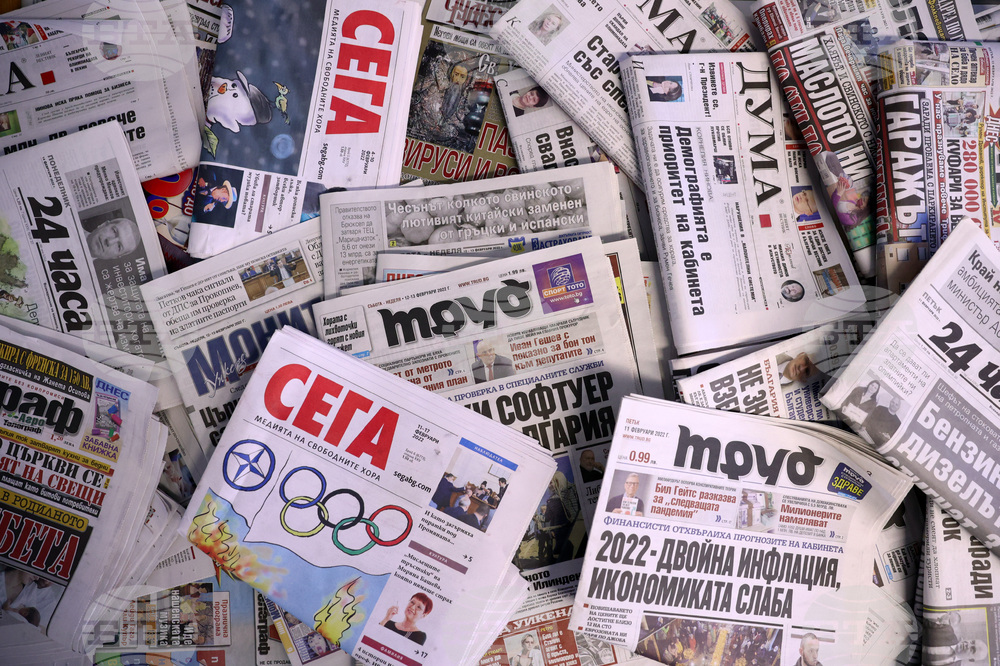
The topic is covered by the major media outlets.
***
In a signed commentary for the daily 24 Chasa, journalist Evgeni Petrov argues that the next parliamentary elections in Bulgaria are shaping up as a leadership-driven contest between two dominant figures—Boyko Borissov and President Rumen Radev - heading two broadly centrist but differently oriented political projects.
Petrov compares the pre-election atmosphere to the moments before a Formula 1 start, with Borissov and Radev emerging as the clear favorites. While Borissov relies on long political experience and a broad “catch-all” party model, Radev is portrayed as a newcomer to party politics who will seek victory through ideological flexibility, populist messaging, and appeals across a wide range of social groups.
According to the author, Radev is likely to pursue a politically “all-encompassing” strategy, avoiding hard geopolitical or ideological extremes while emphasizing patriotic and left-leaning themes. Petrov expects a battle for first place between a center-right GERB and a center-left party led by Radev, with smaller parties acting as power brokers in the formation of a governing majority.
The commentary concludes that Bulgaria has returned to a form of leader-centered bipolar politics, where coalition partners will play the decisive role - and demand a high political price—with the possibility of another early election as soon as July.
***
The Bulgarian Socialist Party (BSP) should not be lumped together under a common label when it comes to talk of mafia and oligarchy, as this would be cynical, BSP MP Atanas Atanasov said in an interview with Bulgarian National Radio.
He added that neither BSP ministers nor the party as a whole had been involved in corruption schemes or scandals over the past year, referring to BSP’s participation in the now-resigned Zhelyazkov cabinet.
“For us, [former] President Rumen Radev’s entry into the party political arena is the greatest challenge, given that he was nominated and elected twice with the support of Bulgarian socialists. In elections, all parties are competitors and opponents,” Atanasov said.
He also announced that the party would nominate President Iliana Iotova [who was Vice President before Radev resigned from the post] in the upcoming presidential election scheduled for later this year.
“In less than a year, our President Iliana Iotova will need a strong BSP to nominate her and ensure her election. We have a moral duty to her and a historical duty to the Bulgarian public,” the socialist lawmaker said.
Asked about concerns that BSP could fail to clear the parliamentary threshold, Atanasov said such a scenario was not on the table, although the party was aware it would suffer electoral losses.
“We will regain support among left-wing voters when we show that we have learned our lessons,” he said.
At the party’s upcoming congress, a sober assessment will be made of BSP’s participation in the government, including discussions on whether the party should have withdrawn earlier, Atanasov announced.
According to him, BSP had taken the correct and statesmanlike decision by joining the government, but once the governing majority began to change, there was no longer a place for the party in it.
Atanasov also rejected claims of a generational conflict within BSP, stressing the need to find an appropriate party leader to guide it through a difficult period. “There is no way Bulgaria can remain without a left-wing party in parliament,” he said.
Commenting on recent changes limiting the number of voting sections abroad, Atanasov noted that he and some members of the parliamentary group had voted against the amendments, while others voted in favor. He added that the group had agreed that changes to the Election Code should not be made at the last minute.
“No last-minute change can increase trust in the electoral process. The Election Code must be amended in a calm environment, when no elections are imminent,” he said.
***
A statement BSP MP Atanas Atansasov, published by the party’s newspaper Duma, has sparked renewed debate over historical memory and political symbolism in Bulgaria. It came following recent incidents in which a communist-era monument and the BSP headquarters were splashed with red paint. The newspaper fails to mention that this happened on the Day of Gratitude and Homage to the Victims of the Communist Regime, observed on February 1, when in 1945 the then recently established communist regime carried out the largest spade of executions in Bulgarian history. The Bulgarian Socialist Party is the successor of the totalitarian Bulgarian Communist Party. Following is Atanasov’s Facebook post:
“History must not be rewritten, and we should not be ashamed of the people who believed that the state could be fair, that labor has value, and that tomorrow would be more secure than today,” wrote BSP–United Left MP Atanas Atanasov in a Facebook post.
His comments were prompted by recent incidents in which the Alyosha monument in Plovdiv and the BSP headquarters were splashed with red paint. According to Atanasov, such acts represent an attempt at symbolic rewriting of history and a substitution of genuine public debate with provocation.
“Thirty-five years later, we are living in an absurd transition that has turned out not to be a path forward, but an endless circling in place. Slogans and heroes have changed, but the model has not. Today we have ‘anti-communism’ without vision, ‘democracy’ without social justice, and politics reduced to spray paint and symbolic wars,” he wrote.
Atanasov also addressed the topic of nostalgia, which he said is often mocked. In his view, this nostalgia is not for a specific political regime, but for security, for a state with backbone, and for the feeling that tomorrow one will not be considered unnecessary. He added that while some wage battles against monuments, “their heroes” have turned Bulgaria into a country without memory, without a long-term strategy, and without a clear direction for development.
“The most frightening legacy of the transition is not the past, but today’s political impotence. History will not change with paint. But the future can — with courage, social policy, and a state,” Atanasov concluded.
SCIENCE
bTV has a story about Bulgarian scientist who develops an RNA-based drug to halt cancer and metastases.
Assoc. Prof. Dr. Zdravka Medarova, a Bulgarian oncologist and Harvard Medical School researcher, has developed an experimental RNA-based drug that halts tumor growth and targets metastases in multiple organs. Preclinical trials in animals have shown promising results, and the treatment has been administered to 16 patients in an early human study.
While tumors have not shrunk, the drug has successfully stabilized cancer in 44% of patients for seven months or more, with one patient remaining on therapy for 13 months with no disease progression. The therapy is designed to detect and act on tumor cells as well as invisible metastatic cells, potentially allowing traditional treatments to become more effective.
The drug’s design uses double-stranded RNA molecules delivered via nanoparticles to target cancerous genes, inspired by Medarova’s early research with roundworms. Early lab studies demonstrated that treated mice remained healthy and tumor-free, while control animals developed widespread tumors.
Phase 2 clinical trials will begin within 2–3 months, testing dosage escalation and safety. Medarova expects the drug to be ready for wider use by 2031–2032, contingent on continued success in clinical trials. She emphasizes cautious optimism, noting that many early-stage therapies fail despite initial promise.
Medarova, whose father died of cancer, describes the work as a personal mission: to prevent the suffering she witnessed and provide a rational, gene-targeted approach to cancer therapy.
WORLD – US FOREIGN POLICY
Capital leads with a story about how the Trump administration has begun 2026 with a more assertive foreign policy under the so-called “Donroe Doctrine,” an extension of the Monroe Doctrine aimed at strengthening US national and energy security by expanding American influence in the Western Hemisphere. Goldman Sachs Research describes this shift as a move from “America First” to “Americas First.”
According to the bank, the new approach increases geopolitical risk and could lead to tensions in relations between the United States and Europe, as Washington seeks a more dominant regional role while recalibrating its global commitments.
Analysts do not expect major economic spillovers from developments in Venezuela to the rest of Latin America, but note that a potential recovery of the country’s oil sector could benefit large US energy companies.
Venezuela holds around one-fifth of the world’s proven oil reserves, yet restoring production to about three million barrels per day would take up to a decade and require substantial investment.
Experts warn that rising geopolitical uncertainty—linked to US ambitions in Greenland, strained transatlantic relations, and broader global realignments—could have lasting consequences for security, energy markets, and the global financial system.
***
Trud: US President Donald Trump sees the United Nations as his “successor” in ending global wars in the future, Politico writes.
“When I am no longer here to settle wars, the UN can do it. It has enormous potential—simply enormous,” Trump said.
The US leader also described the UN as an irreplaceable institution, particularly given that his own role on the global stage is supposedly nearing its end.
“I think the UN will not leave New York and will not leave the United States,” the US president added.
At the end of December, Trump accused the United Nations of inaction in relation to global conflicts, particularly the war in Ukraine.
“The UN has provided very little help in resolving various global conflicts, including the catastrophe currently unfolding between the Russian Federation and Ukraine. The UN must begin to take an active role in the cause of world peace,” the US president stressed.
It was also reported earlier that the UN is on the brink of a financial crisis, as the organization’s budget could be exhausted by mid-year. The main factor behind the instability is said to be unpaid membership contributions from the United States.
The core source of the problem is Washington’s refusal to pay its mandatory dues. The country traditionally covers about 22% of the UN budget. As of the end of January, the United States reportedly owed the organization around USD 1.4 billion. Instead of paying regular contributions, the US administration has focused on financing individual initiatives.
MILITARY
Mediapool: Romania plans to use the EU’s SAFE preferential loan instrument to finance a comprehensive security system, including highways and hospitals with dual civilian and military use, while Bulgaria is focusing exclusively on the acquisition of military equipment.
The European Commission launched the Security Action for Europe (SAFE) instrument to provide urgent funding for strengthening member states’ defense capabilities following Russia’s military aggression against Ukraine. The facility amounts to EUR 150 billion, with discussions already under way on its possible extension, offering loans with a 15-year grace period and repayment of up to 40 years.
Bulgaria has received approval for EUR 3.2 billion in loans and is preparing nine projects, including the acquisition of 3D radars and howitzers. Due to the army’s continued reliance on Soviet-era equipment, Bulgaria is using SAFE funds solely for military products. However, the ongoing political crisis and the lack of an approved state budget threaten to delay implementation.
In contrast, Romania is prioritizing dual-use projects and has made substantial investments in modernizing its armed forces in recent years. The Romanian projects are also characterized by greater transparency, including clearer financial parameters.
Romania is set to receive EUR 16.68 billion, the second-largest SAFE loan in the EU after Poland. One of the key SAFE requirements is joint public procurement among member states. While Bulgaria expects to purchase equipment such as 3D radars from France, there is a serious risk that the country may fail to fully utilize the mechanism due to political instability and the absence of a regular government and budget.
Bulgarian military experts quoted by Mediapool also warn that procurement procedures must be handled carefully, cautioning against compromising on required equipment specifications in the interest of speeding up joint purchases.
ECONOMY – FUEL PRICES
Bulgarian National TV: Fuel prices in Bulgaria remain stable, with no immediate changes expected, despite international oil markets reacting to tensions between the U.S. and Iran, according to Svetoslav Benchev, Chair of the Bulgarian Oil and Gas Association. He noted that short-term market fluctuations generally do not affect domestic fuel prices, which require sustained changes over 10–15 days to impact retail costs.
Benchev highlighted a significant gray market issue: around 17% of diesel in Bulgaria (approximately 690 million liters annually) is sold without paying taxes or excise, resulting in estimated losses of EUR 350 million. He stressed that some operators manipulate electronic reporting systems, and systemic reforms are needed to address the problem.
The average gasoline price in Bulgaria is EUR 1.23 per liter. Consumers should be aware that fuel sold at unusually low prices may compromise quality. Benchev also noted that export restrictions remain, preventing the sale of fuel outside Bulgaria, even though domestic demand is fully met and refineries are operating optimally.
SNOWFALL
The snowfall on Sunday night into Monday morning is covered by the media.
NOVA TV: All major roads in Bulgaria are passable under winter conditions, with more than 1,200 snowplows and sanding vehicles deployed overnight, the Road Infrastructure Agency (RIA) reports. Priority is given to highways, heavily trafficked first- and second-class roads, and mountain passes connecting northern and southern Bulgaria.
Drivers are urged to exercise caution, maintain distance, adjust speed, and avoid overtaking snow-clearing vehicles. Temporary closures may occur on some stretches due to strong winds, snowdrifts, or low visibility.
Heavy truck traffic remains restricted on several routes, including Devin–Mihalkovo, Batak–Dospat, Ardino–Kardzhali, and the passes Rozhen, Prevala, and Troyan.
RIA continues round-the-clock road maintenance with sanding and snow removal. Temporary restrictions are also in place on the Montana–Dimovo road due to stalled trucks.
/MY/
news.modal.header
news.modal.text