site.btaBTA Conferences Trying to Revive Knowledge of April Uprising

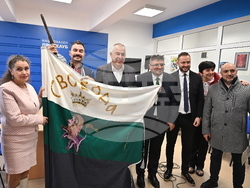
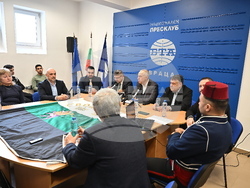
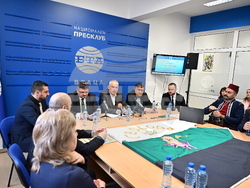
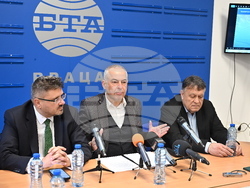
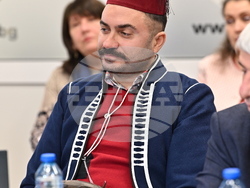
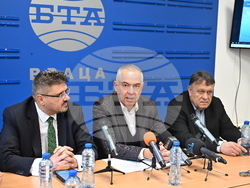
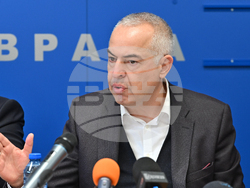
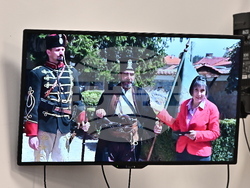
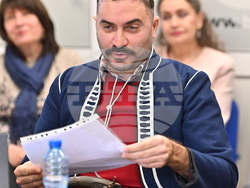
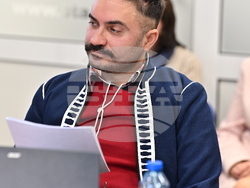
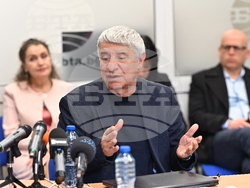
With conferences organized by Bulgarian News Agency (BTA), it is trying to revive knowledge of the glorious page of the April Uprising as part of Bulgarian history, BTA Director General Kiril Valchev said at the opening of а conference dedicated to the 150th anniversary of the 1876 April Uprising in the BTA National Press Club in Vratsa (Northwestern Bulgaria) on Thursday.
Valchev emphasized that a people without knowledge is a people without a future, citing Saint Sophronius of Vratsa, author of Nedelnik, the first printed book in the New Bulgarian language. "Therefore, knowledge is more valuable than any treasure, even the greatest Thracian treasure, the Rogozen treasure, kept by the Vratsa Regional History Museum," Valchev noted.
Similar forums to the one in Vratsa will be organized at BTA press clubs in the centres of the remaining revolutionary districts of the April Uprising - Veliko Tarnovo, Sliven, and Panagyurishte, Valchev pointed out, recalling that BTA started the programme in December 2025 with a conference at the BTA National Press Club in Ruse to mark the decision by the Giurgiu Revolutionary Committee in 1875 to declare the uprising. The most interesting parts of the conferences will be included in the April issue of BTA´s LIK magazine, Valchev said, adding that it will be dedicated to the 150th anniversary of the April Uprising.
Valchev commented that the Bulgarian National Television (BNT), BTA and the Bulgarian National Radio (BNR) launched the 14 Centuries of Bulgaria in Europe programme in May 2025 to mark anniversaries in Bulgarian history of importance for common European history. The initiative will mark anniversaries until 2032, when 1,400 years will be marked since the founding of Old Great Bulgaria. The initiative is supported by the Bulgarian Academy of Sciences.
Regarding the role of Vratsa in the Bulgarian Uprising, Valchev noted that the Bulgarian lands were divided into four revolutionary districts in 1876, the third being Vratsa with the chief revolutionary Stoyan Zaimov and assistants Nikola Obretenov, Georgi Apostolov and Nikola Slavkov. A real uprising did not break out in Vratsa, and the preparations were crushed, Valchev pointed out, arguing that from the failed April Uprising in Vratsa Bulgaria can learn at least three important lessons.
The first lesson is that the failure of an undertaking should not be a reproach to the people who do not want to participate in it, but a reminder of the responsibility of the leaders. "The indecision of the local leaders is what was wavering the Bulgarians in Vratsa. And combined with fear, betrayals, a strong Turkish military presence and arrests the uprising failed," he claimed.
The second lesson according to Valchev lies in the example of the power of the self-sacrifice of the true leader with the attempt to support the uprising by the Botev detachment. "Because Hristo Botev decided to support the uprising precisely in Vratsa Region and therefore on May 17, 1876, the detachment disembarked from Radetzky near Kozloduy with the aim of reaching the Vratsa Balkan and raising a revolution. But the population did not rise up, the detachment remained isolated and after heavy fighting Botev died on May 20, 1876, or according to the new style, on June 2, 1876,” Valchev recalled.
The third lesson is that Bulgarians must learn to see the bigger picture of the events around them and try to find progress in the failures, because the failed uprising in Vratsa still lead to a European echo, the Russo-Turkish War and the Liberation of Bulgaria, Valchev emphasized. He noted that another lesson can be learned concerning today's media. "The responsibility of the media is not to amplify the empty talk of the leaders and the fears of the people, but to show the big picture of the events and examples that give courage", he said.
The conferences is part of the joint initiative of BTA, Bulgarian National Television, and Bulgarian National Radio, titled 14 Centuries of Bulgaria in Europe. The initiative aims to commemorate anniversaries of Bulgarian historical events that have had an impact on shared European history.
/MR/
Additional
























news.modal.image.header
news.modal.image.text
news.modal.download.header
news.modal.download.text
news.modal.header
news.modal.text