site.btaParliament's Rejection of President's Euro Adoption Referendum Proposal Was Not Unconstitutional, Court Rules
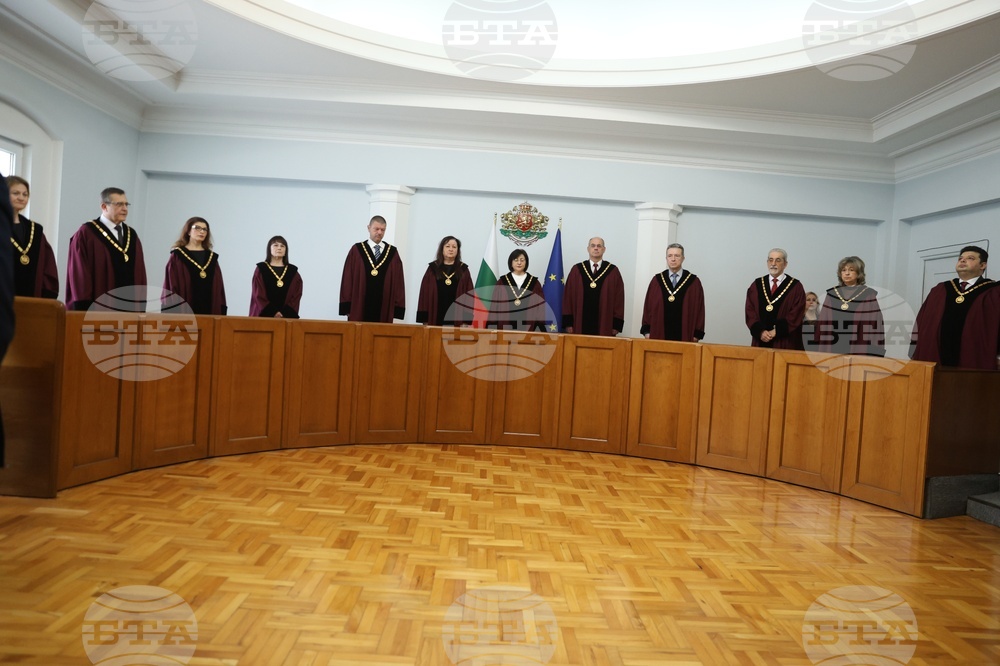
Bulgaria's Constitutional Court has declined a petition to declare unconstitutional a National Assembly resolution refusing to resolve on the conduct of a national referendum on a postponement of the adoption of the euro by Bulgaria, the Court said on its website Friday.
The Court was petitioned by 51 MPs of the 51st National Assembly, who challenged the constitutionality of the resolution in question that passed, 81-135 with three abstentions, on December 3, 2025 and was gazetted on December 5. Parliament then rejected a proposal tabled by President Rumen Radev on May 12, 2025 for holding a national referendum in which Bulgarians would be asked whether they agree to the introduction of the euro in Bulgaria in 2026. The petitioners also asked the Court to determine whether the proposed referendum question was compatible with the Constitution, the Treaty on the Functioning of the European Union, and the Direct Citizen Participation in State and Local Government Act.
All constitutional judges participated in the session. The ruling was adopted unanimously. It was signed with observations by judges Yanaki Stoilov and Sasho Penov.
The reasons to the ruling point out that in the case at issue the National Assembly resolution that is contested boils down to a refusal to pass a resolution on holding a national referendum with a question whose response cannot entail legal consequences because one possible answer (that Bulgaria should not introduce the euro in 2026) may not revisit a decision that is not made unilaterally by the Republic of Bulgaria, whereas the legal consequences of the other possible answer (that Bulgaria should introduce the euro in 2026) have not even occurred.
On the same considerations, a National Assembly resolution on holding a referendum with the question as proposed would not be capable of producing the legal effect sought by the referendum proposal, and namely to decide whether the euro should be introduced in 2026.
Therefore, the constitutional dispute at issue is not a matter fit to be proceeded with before the Constitutional Court, and the petition under consideration is inadmissible in this part, the ruling points out.
Regarding the second part of the petition, the Constitutional Court ruled that it cannot possibly assess the constitutionality of a question contained in a national referendum proposal separately from ruling on the compatibility with the Constitution of the National Assembly resolution on the proposal to hold a national referendum with the said question, regardless of whether Parliament resolved in favour of holding a referendum or to reject the proposal.
A separate examination of the petitioner's second request, beyond an assessment of the admissibility of the contestation of the National Assembly resolution, is therefore unfounded, the Court added.
The Constitutional Court pointed out that, for the above reasons, the petition may not be admitted to examination on the merits.
Radev's referendum proposal was reintroduced on the legislature's agenda after the Constitutional Court issued an interpretative decision in November 18, 2025 according to which the National Assembly Chair is not competent to determine single-handedly whether a national referendum is permissible and to reject a proposal made by an authority vested with power by law. The Court acted on a May 23, 2025 petition from the President to nullify an order of National Assembly Chair Nataliya Kiselova of May 13, 2025 refusing to include his referendum proposal on Parliament's agenda. Kiselova argued that the proposal was inconsistent with the Constitution, the Treaty on the Functioning of the EU, Bulgaria's EU Accession Treaty, the Act concerning the conditions of accession, and the Direct Citizen Participation in State and Local Government Act.
/LG/
news.modal.header
news.modal.text