site.btaSerbia in 2025: Mass Anti-Government Protests, US Sanctions and Stalemate on Road to EU
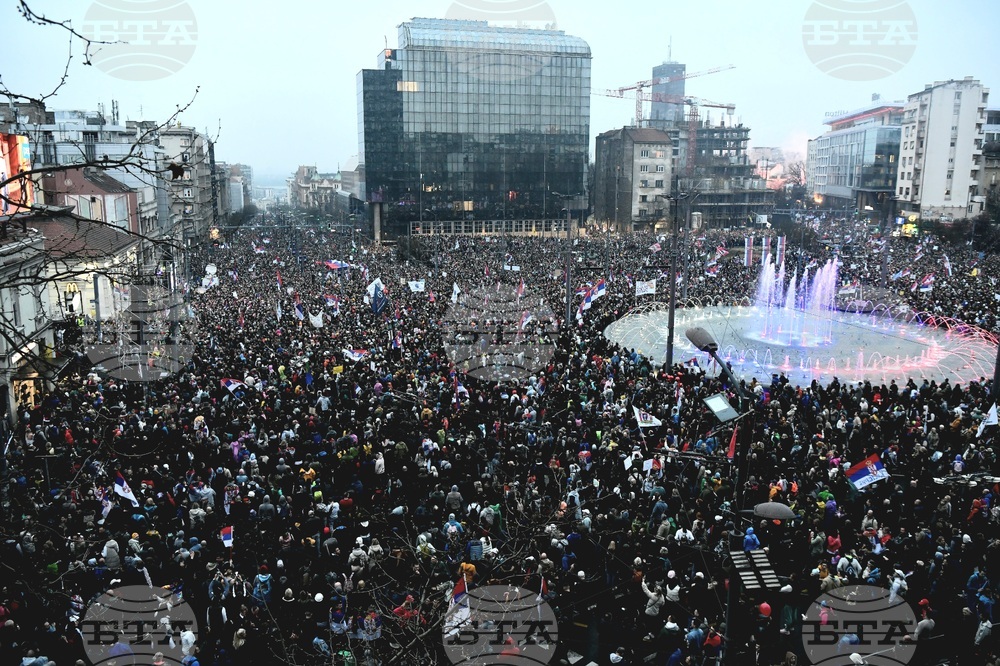
Serbia is seeing out 2025 shaken by mass anti-government protests, facing the risk of a fuel crisis due to sanctions imposed by the US government on the country’s sole national oil company, NIS, while EU Member States have refused to give it the “green light” to continue its accession process and to open Cluster 3, “Competitiveness and Growth”.
GOVERNMENT FELL, BUT PRESIDENT DID NOT CALL SNAP ELECTIONS
At the end of January, the government of Milos Vucevic resigned following an incident in the northern Serbian city of Novi Sad, where supporters of the ruling Serbian Progressive Party attacked a group of protesting students with batons, leaving one of them requiring craniofacial surgery due to a fractured bone.
Street pressure against the authorities intensified in the first days of January following an incident on November 1, 2024, when a concrete canopy at the recently renovated railway station in Novi Sad collapsed, killing sixteen people and seriously injuring one.
On the same day, citizens and political activists spontaneously gathered in protest, while the first large organised protest in Novi Sad on November 5 led to clashes with police and mass arrests.
At the end of November, students blocked more than 60 faculties across the country in solidarity with the victims’ families and took the lead in the protests, raising anti-corruption demands.
In December, university lecturers, teachers and secondary-school students across the country joined the protests, while students called for a general strike.
On January 24, hundreds of thousands of people did not go to work in the Serbian capital Belgrade and in many other cities across Serbia.
On that day, a young woman was injured when a car drove into the crowd during a march in the Novi Beograd borough of the capital.
On the same day, Serbian President Aleksandar Vucic announced the creation of a new supra-partisan movement which, he said, anyone could join.
Protests and blockades, with students travelling on foot or by bicycle, began to take place daily across the country, while protesters repeatedly rejected invitations for dialogue from the authorities, including from President Aleksandar Vucic.
“You are not competent!” students chanted at the head of State, insisting that judicial institutions identify and punish those responsible for the tragedy in Novi Sad.
Political analyst Dr Boban Stojanovic said that since October 5, 2000 — the day former Yugoslav leader Slobodan Milosevic stepped down — 2025 has been “the most democratically charged year for Serbia”.
“Many, many major things happened. The goal has not been achieved, but a serious foundation has been laid for what needs to be done when a change of government comes. I would say that as a society we experienced a kind of generational shock that will fundamentally determine both our attitude towards democracy and what the conduct of future politicians leading this country should be,” Stojanovic told regional television channel N1.
On March 15, a massive protest was held in Belgrade. During a minute of silence for the victims in Novi Sad, participants dispersed, reporting that they had heard a sound resembling an approaching aircraft and had experienced headaches, panic and disorientation.
The opposition accused the authorities of illegally using a sonic weapon against protesters, which the authorities denied.
On April 16, the National Assembly elected a new government, headed by a non-party prime minister — 62-year-old endocrinologist Djuro Macut, who has no political experience.
“Serbia is tired of protests!” Macut told MPs in a speech filled with patriotic quotations from prominent Serbian figures.
The new cabinet was elected on the mandate of the ruling Serbian Progressive Party, founded by President Aleksandar Vucic.
On May 5, students involved in the blockade of more than 60 faculties demanded snap parliamentary elections, but President Vucic refused to call them.
Students said they would not take part directly in the vote but would support a list of candidates for the National Assembly who enjoy public authority and have not previously been involved in the country’s political life.
On June 28, Vidovdan, another massive protest was held in Belgrade, issuing an ultimatum that by 9 p.m. local time the government should propose to the President that snap elections be called.
The ultimatum was not met. The protest escalated into acts of civil disobedience, clashes with police and mass arrests, with protesters accusing law enforcement of excessive use of force.
On the same day, June 28 — a date laden with historical symbolism for Serbs — President Vucic appeared at a camp of his supporters, set up in tents between the Presidency and the National Assembly, declaring that the protest had failed and that “the winners are those who oppose blockades, who are fed up with everything and want to live normally and peacefully in Serbia”.
The entire summer passed under high social tension in Serbia, and in August protesters vandalised and set fire to party offices of the ruling party in Belgrade, Novi Sad and other Serbian cities.
AUTUMN AND THE POLITICAL LEGACY OF ALEKSANDAR VUCIC
With the arrival of autumn, social tension in the country persisted, despite students not resuming faculty blockades and sitting exams.
Meanwhile, President Vucic repeatedly announced that Serbia would hold snap parliamentary and presidential elections, but once again did not set a date.
Vucic, who is serving his second presidential term in office and is constitutionally barred from running again, said he already feels like a political veteran and is working to preserve his political legacy.
From September 2 to 4, Vucic visited Beijing for celebrations marking the 80th anniversary of the end of the Second World War, and in May attended a military parade in Moscow marking the same occasion — continuing Serbia’s long eastern turn, which increasingly distances the former Yugoslav republic from the European Union and the West.
“Steel” — this is how Vucic described the friendship between Serbia and China in July, when the EU hardened its tone and warned China that while the European market is open to Chinese goods, it does not see corresponding reciprocity from Beijing.
In September, following a meeting with Vucic, Chinese President Xi Jinping also used the word “steel” to describe relations between the two countries.
In Beijing, Vucic met with more than a dozen Chinese companies, thanked them for their investments and urged China to continue doing business in Serbia.
Serbian authorities said China was Serbia’s largest investor in 2025, with investments totalling EUR 7.2 billion, while bilateral trade reached EUR 8.5 billion.
According to official data, several Chinese state-owned companies were involved in the renovation of the Novi Sad railway station, where the concrete canopy collapse on November 1, 2024 killed sixteen people.
During his visit to China, Vucic included former Serbian president Tomislav Nikolic in his delegation — a proponent of Serbia joining a Russia–Belarus alliance.
According to the Serbian President’s press office, Nikolic joined the delegation in his capacity as chair of the National Council for Coordination with the Russian Federation and the People’s Republic of China. Vucic and Nikolic are co-founders of the ruling Serbian Progressive Party, with Nikolic its first leader.
During the visit, Vucic said for the first time that he intends to step down from power and hopes that when that moment comes, he will work alongside his daughter, who plans to open a sociological research company in Serbia after graduating.
“One day someone will come after me who is not as independent, who is more polite and better accepted by Europe,” Vucic said, commenting on intensified criticism from Brussels after he referred to Members of the European Parliament who attended an anti-government protest in Novi Sad as “the lowest European scum”.
US SANCTIONS AND/OR A DEAL FOR NIS
On October 9, US sanctions against Serbia’s sole oil company NIS came into force, after being postponed eight times following Washington’s demand on January 10 — due to the war in Ukraine — for the complete withdrawal of Russian capital from the company.
Only at the end of November did the Russian side announce its readiness to sell its stake, with Hungarian oil company MOL expressing interest in acquiring part of the Russian shareholding.
The Serbian state owns 29.9% of NIS, while the main shareholder remains Gazprom Neft with 44.9%. At the end of September, the St Petersburg-based company Intelligence, linked to Gazprom, acquired an 11.3% stake in Gazprom, the parent company.
As a result of the sanctions, Serbia faces the risk of a fuel crisis, though the authorities say the country has sufficient reserves and has tripled fuel imports.
“So far, we have done everything our Russian friends asked, and exactly how they asked,” President Vucic said, giving the Russian side 50 days to sell its assets.
After that deadline — expiring on January 15, 2026 — the Serbian state intends to buy out the Russian stake and introduce state management of the company.
Vucic said this would not be “nationalization”, though Serbia’s 2026 state budget includes funds earmarked for the purchase of the Russian share in NIS.
In autumn 2025, Serbia encountered another energy-related obstacle, as expectations of signing a new gas supply contract with Russia in October and November were not met.
Against this backdrop, Russian security services twice during the year published detailed reports accusing Serbia of selling weapons to Ukraine and “stabbing Russia in the back”.
At the end of December, Vucic announced that Serbia had reached a short-term agreement for Russian gas supplies until March 31.
He confirmed reports that Hungary’s MOL is among the candidates for the Russian stake in NIS.
As early as November, Hungarian officials said MOL was interested, but only in 11.3% of the Russian shareholding.
Hungarian Prime Minister Viktor Orban, who faces parliamentary elections in April 2026, discussed the deal with Russian President Vladimir Putin during a visit to Moscow focused on securing long-term low-price contracts for Russian oil and gas supplies to Hungary.
Besides MOL, another interested buyer for the Russian stake in NIS is an oil company from the United Arab Emirates, though details of the negotiations remain unknown.
Recently, Serbian Foreign Minister Marko Djuric said he expects the issue of NIS’s operating licence — blocked by US sanctions — to be resolved positively within weeks, with the Russian majority stake sold.
ON THE ROAD TO EUROPE, SERBIA HAS BEEN STANDING STILL FOR FOUR YEARS
Serbia’s European integration entered a “dead end” in 2025, after EU Member States once again failed in December to agree on opening Cluster 3, “Competitiveness and Growth”. Serbia last opened a negotiation cluster at the end of 2021.
The EU welcomed the fact that European integration remains a strategic goal for Serbia, but stressed that Belgrade must demonstrate this orientation more clearly through concrete actions and political messages, according to conclusions adopted at the EU General Affairs Council in Brussels on December 16.
The document notes Serbia’s progress so far, with 22 of 35 negotiation chapters opened and two provisionally closed. The Council recalled the European Commission’s assessment that Serbia maintains its level of preparedness under the initial criteria for Cluster 3, but stressed that its opening would only be reconsidered after significant further progress in the rule of law and in the normalisation of relations with Kosovo — a key factor for the pace of negotiations.
Regarding the domestic political situation, the Council referred to protests following the Novi Sad railway station incident, noting that while freedom of assembly is generally guaranteed, additional efforts are needed to strengthen it and ensure journalists’ safety. Reports of violence and excessive use of force require impartial and thorough investigations, the conclusions said, calling on Belgrade to de-escalate tensions and promote inclusive public dialogue involving all stakeholders, including civil society.
The Council again underlined the importance of protecting fundamental rights — including media freedom and freedom of expression, protection of vulnerable groups and non-discriminatory treatment of minorities — and called for the swift and transparent appointment of the Council of the Regulatory Authority for Electronic Media. Ministers welcomed amendments to the Law on the Unified Electoral Register, but stressed the need for their full and proper implementation, as well as compliance with remaining OSCE recommendations.
On economic criteria, the Council assessed that Serbia is well prepared for a functioning market economy, but encouraged further efforts to boost competitiveness within the EU. It also stressed the need to strengthen good neighbourly relations, regional cooperation, work on war crimes, and full cooperation with the International Residual Mechanism for Criminal Tribunals.
The conclusions welcomed Serbia’s gradual increase in alignment with the EU’s Common Foreign and Security Policy, but stressed the expectation that Belgrade fully align, including with EU restrictive measures against Russia and Belarus over the war in Ukraine. The Council also reaffirmed its full support for the EU-facilitated Belgrade–Pristina dialogue on normalising relations.
Hours after the Council’s conclusions, President Vucic announced he would not attend the EU–Western Balkans summit in Brussels.
“For the first time in the past thirteen or fourteen years, neither I nor anyone else from Serbia will attend this intergovernmental conference. No one will represent the Republic of Serbia, so the Western Balkans will be without Serbia,” Vucic said, adding that Serbia would continue on its European path while he remains president — “and after that, we shall see”.
Serbia has been an EU membership candidate since 2012, and President Vucic recently said he expects the country to become a full member before 2030.
Vucic’s mandate — his second and final one under the constitution — expires in 2027.
Two years before the end of his term, the Serbian head of state faced the greatest challenge of his long political career for the first time: the twelve months of the outgoing year, 2025.
/MR/
news.modal.header
news.modal.text