site.btaElectric Mobility in Bulgaria: Policies, Challenges and Good Practices
Electric Mobility in the European Union: Statistics and Trends
The transition to cleaner transport is among the EU's key policies aimed at reducing emissions and modernizing mobility. The promotion of clean and energy-efficient road vehicles is enshrined in Directive 2009/33/EC, later amended by Directive (EU) 2019/1161, which introduced minimum national targets for the public procurement of clean vehicles. These targets are defined as a minimum share of clean vehicles in the total number of contracts awarded by public authorities and certain public transport operators in the Member States.
In 2025, 1,880,370 electric vehicles were registered in the EU, accounting for a 17.4% market share, according to the latest data from the European Automobile Manufacturers' Association (ACEA), published at the end of January. In December 2025, compared to the same month of 2024, new registrations of battery-electric vehicles increased, while petrol car registrations fell by 18.7% in 2025, with all major markets reporting declines.
In Bulgaria, 2,420 fully battery-electric vehicles were registered in 2025, a 62% increase compared to 2024, according to ACEA. Hybrid and plug-in hybrid vehicles also recorded growth, albeit at a lower share.
Delayed Transposition and Sanctions
The amendments introduced by Directive (EU) 2019/1161 were to be transposed into national legislation by August 2, 2021. However, in Bulgaria the transposition was completed only on January 5, 2024.
Following several warnings, on March 20, 2025, the Court of Justice of the European Union ordered Bulgaria to pay a lump sum penalty of EUR 1,593,000 for missing the deadline. The European Commission had sent a letter of formal notice in September 2021 and a reasoned opinion in April 2022 due to the lack of notification of full transposition.
The Court rejected Bulgaria's arguments citing political instability and the COVID-19 crisis. The funds to cover the sanction were allocated by the Council of Ministers in May 2025.
Key Challenges for Bulgaria
According to Bulgaria's Transport Ministry, one of the main challenges is the higher price of electric vehicles compared to conventional cars. Consumer concerns about driving range, charging time and long-term battery reliability also remain significant.
Although charging infrastructure is developing rapidly, its geographical distribution is uneven. Major cities and highways are relatively well covered, while smaller towns and rural areas face shortages due to lower demand and high grid-connection costs.
MEP Andrey Novakov (EPP/GERB), speaking in BTA's "EU Lex BG" podcast, said he had repeatedly voted against certain European Parliament requirements, arguing they are anti-market and interfere with consumer choice. He advocates incentives rather than bans, and stresses that electrification must go hand in hand with energy security and a balanced power system.
Development of Infrastructure and Legal Framework
In 2025, Bulgaria had 28,433 registered electric vehicles out of a total 3,851,776 vehicles, or about 0.7% of the fleet, according to the Transport Ministry. As of February 2026, some 2,868 charging stations at 1,955 locations were registered in the "VsichkoTok" online platform.
The legal framework is shaped by Directive 2014/94/EU and, since 2023, by Regulation (EU) 2023/1804 on alternative fuels infrastructure, which is directly applicable. In 2025, Bulgaria drafted an updated National Policy Framework for Alternative Fuels, currently under coordination with the European Commission.
Under the Transport Connectivity Programme 2021-2027, six contracts have already been signed for fast-charging hubs along the core and comprehensive Trans-European Transport Network, with a total value of nearly EUR 1.4 million.
The Role of Sofia Municipality
Sofia has introduced multiple measures to promote green mobility. Electric vehicles have been allowed to park free of charge in paid parking zones since 2012. Charging stations are included in new infrastructure projects, such as the planned reconstruction of Hristo Botev Blvd.
At the terminal stations of Metro Line 3 extensions, park-and-ride facilities with charging stations are being developed. Charging points have also been installed in municipal car parks managed by the Centre for Urban Mobility.
According to unofficial data cited by the Municipality, around 20,000 electric vehicles from across the country circulate in Sofia.
Good Practices Nationwide
In 2019, Kazanlak became the first Bulgarian municipal centre with a fully electrified public transport system. In February 2025, another project under the National Recovery and Resilience Plan was completed, making public transport in the municipality entirely electric. Passenger numbers exceeded 3 million over the past year, according to municipal operator Balkaninvest.
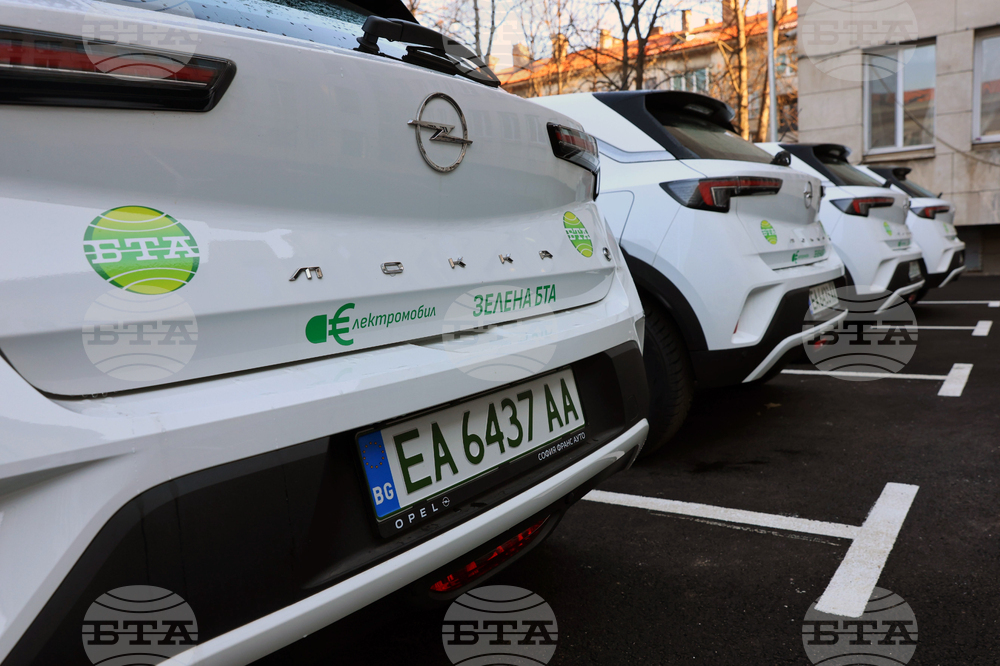
Among the positive examples is also the Bulgarian News Agency (BTA), which in late 2023 purchased 30 electric vehicles for use by its reporters and correspondents nationwide. Three charging stations have been installed at BTA's headquarters in Sofia.
Through its "EU Lex BG" section, BTA continues to present coverage of the transposition and implementation of European legislation in Bulgaria.
/RY/
news.modal.header
news.modal.text