site.btaBTA and System for Agro-Market Information Agree on Partnership Deal
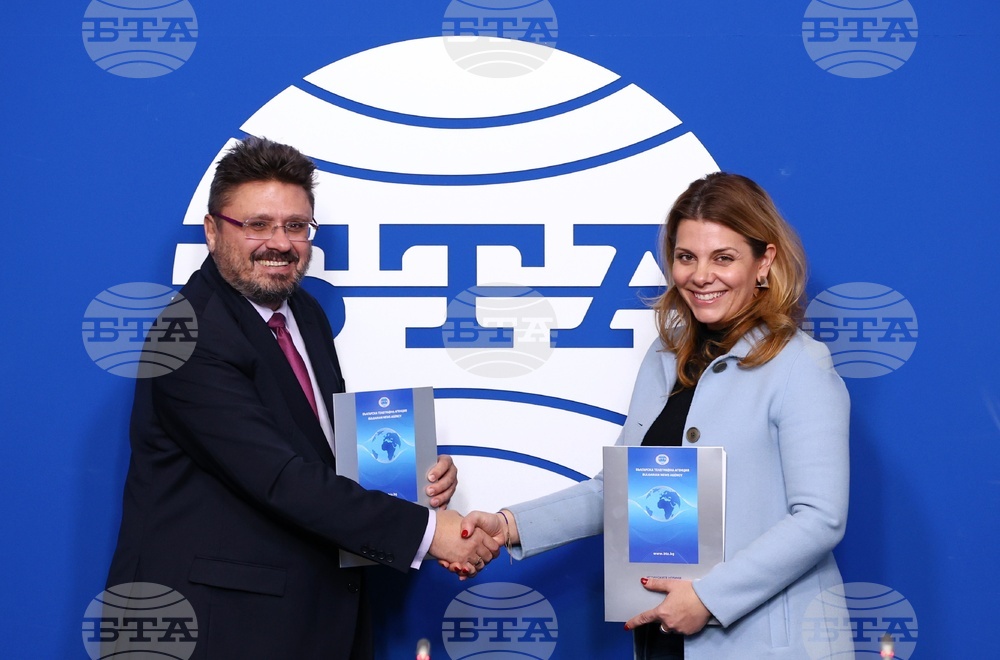
The Bulgarian News Agency (BTA) and the System for Agro-Market Information (SAPI) signed a partnership agreement on Monday. The agreement was signed by BTA Director General Kiril Valchev and Head of SAPI Madlen Zhekova.
Valchev described the partnership with SAPI as particularly useful for providing more information in Bulgarian media related to national retail prices of food products. He noted that the System for Agro-Market Information is a limited liability company solely owned by the Ministry of Agriculture and Food, established in 1994.
“Their information has been present in the BTA archives since 1997,” Valchev said, and he gave Zhekova an excerpt from the BTA archives containing publications of the company’s information related to food prices in Bulgaria.
He added that this information was far from systematic, with some years having only one news item. “Since we started discussions with your team about such an agreement, last year there were already seven, but the big goal is to make visible the statistics that you process virtually every week and for which you have quite good information on a monthly, quarterly and annual basis,” Valchev added.
He noted that with the signing of the agreement, in addition to systematic information, BTA would receive by Friday each week national statistics on the retail prices of the five food product categories with the largest price rises and the five with the largest price falls from the previous week. Once a month, by the second Friday of each following month, BTA would also receive and publish SAPI analyses of price movements along the food supply chain and market trends. When there are seasonal campaigns, SAPI would also send information on purchase prices of seasonal food products.
“In this way, our Economy desk will have another very accurate and reliable source of information in addition to the commodity exchange, from which we also publish weekly information, and these stories can be freely used by all Bulgarian media, and not only Bulgarian media, but also by our partners abroad,” Valchev said, adding that BTA would produce infographics to accompany the publications. He also said that SAPI monitors almost 1,000 products, not only at central level in Sofia but also in all regions of the country.
Zhekova said the partnership was not just a formal act but a joint commitment to build trust through facts, regularity and transparency, rather than interpretations and noise. She explained that SAPI recorded agro-market information weekly and turned it into structured price monitoring and analysis. “Our job is not to comment on the market, but to measure it consistently, methodically and comparably over time,” Zhekova said.
She added that SAPI supported the work of the Ministry of Agriculture and Food, municipalities and other State institutions, including by preparing and providing price references for procedures and tenders under the Public Procurement Act.
Zhekova said one of SAPI’s strengths was the regularity of its data. “Every week we collect price information from all our offices in the country, which are eight. We also collect price information from 28 regional cities and publish weekly bulletins and a weekly grain bulletin, which is sold on our website,” Zhekova said. She added that these products helped guide not only public institutions but also the real economy: producers, processors, traders and financial organizations.
Zhekova said the partnership with BTA added value by creating a trust mechanism, as the data would not only be collected but also delivered to the public through a national channel with high standards.
Asked how SAPI’s data differed from the Sofia Commodity Exchange’s, Zhekova said the exchange tracked wholesale prices, while SAPI collected price data across the entire food supply chain, from producers and resellers to supermarkets and small shop networks. She added that each institution used a different methodology. “In practice, the National Statistical Institute (NSI) also collects price information, but from purchased products, while we track products that are on shop shelves,” Zhekova said.
Valchev said that, at a time of strong public sensitivity about prices during the transition from the lev to the euro, the information BTA would receive from SAPI and publish would help provide an objective view of the prices of the food products, that are of utmost importance to Bulgarians.
/PP/
news.modal.header
news.modal.text