BTA exclusive
![Euro Adoption in Slovakia Opened Door to Reforms - Eximbanka Deputy CEO]()
![Euro Adoption in Slovakia Opened Door to Reforms - Eximbanka Deputy CEO]() Igor Barat, Deputy CEO of Eximbanka (BTA Photo)
Igor Barat, Deputy CEO of Eximbanka (BTA Photo)
site.btaEuro Adoption in Slovakia Opened Door to Reforms - Eximbanka Deputy CEO
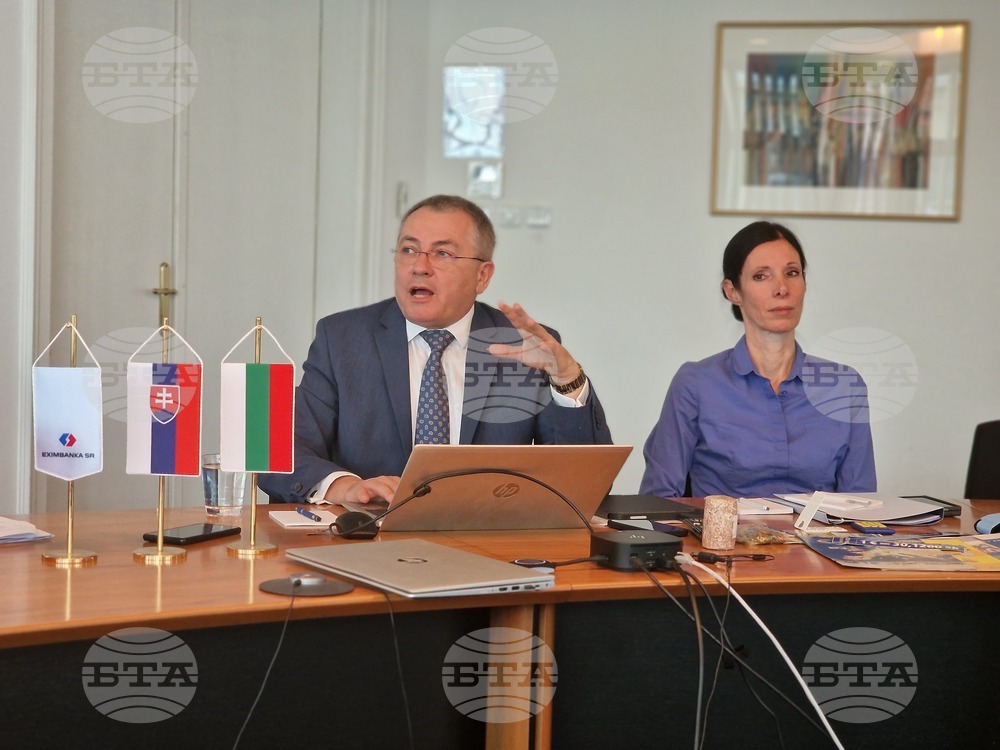
The adoption of the euro in Slovakia opened the door to other reforms that were not carried out directly because of the single currency but for which the euro created the conditions needed by the economy and society, Igor Barat, Deputy CEO of Eximbanka, said in an interview with the Bulgarian News Agency.
Igor Barat is an economist with a long career in banking, as well as a journalist who worked for Slovak Television. He was responsible for communications at Slovakia’s central bank related to preparations for the euro changeover. When the country joined the euro area in 2009, Barat was the government’s plenipotentiary for the euro’s introduction and the public face of the campaign for the new currency, which is why he was often referred to as "Mr. Euro".
"Our team and the entire organizational structure, since hundreds of people were involved in the process, were responsible for helping businesses understand what they needed to do to ensure a smooth transition from the [Slovak] koruna to the euro in terms of IT, statistics, accounting, and so on. All these issues were covered in a comprehensive law, and measures were taken to protect consumers and to regulate business conduct so that there would be no negative impact," Barat said.
Recalling the information campaign for the euro, Barat described it as "probably the most complex in the country’s history," as it had to reach every citizen.
As part of the euro introduction campaign, information was aired on television and radio, instructions were published in newspapers and magazines, and CDs were produced, including in the Romani language. Information brochures and a small calculator programmed with the fixed conversion rate of 30.1260 Slovak korunas per euro - the rate at which the country entered the euro area - were sent by mail to all 1.9 million households in the country.
All of this was done mainly over about 18 months - from mid-2007 to the end of 2008 - and for a little more than six months after the euro was introduced, when prices were still displayed in both currencies, Barat said.
Asked whether there had been a public debate in Slovakia about the new currency, he noted that such discussions began six years before the country joined the euro area.
For such a small economy, where most exports and even imports go to or come from the euro area, the euro would bring far greater benefits because transaction and exchange-rate costs are eliminated, price transparency improves, and so on. This conclusion was also incorporated into the national strategy for adopting the euro, drafted by the Slovak authorities back in 2003, he added.
Asked about the development of investment in the country after adopting the euro and the practical advantages it brought, Barat noted that when an investor is considering where to invest, they always take into account many factors, and being in the euro area is a very important one.
As for natural persons, the single European currency helps people not only travel but also stay abroad more easily, pay their expenses - such as for education, holidays, vacations, and online purchases of goods and services - at a very transparent price, he added.
"Still, we have to say that the euro is not a panacea. It is simply a tool. It is just better fuel for your engine. You still have to continue reforms and improve the business environment and the legal environment. This is a never-ending process, but if you stop at the introduction of the euro, the effect will be close to zero," Barat noted.
Asked about potential issues surrounding Slovakia’s first euro-denominated budget, adopted in 2008, he said that there were none and clarified that the notion that the euro has anything to do with the state budget is mistaken.
/IV/
news.modal.header
news.modal.text