site.btaApril 1876 Uprising: Backgrounder
The April 1876 Uprising that broke out 150 years ago on Monday was the largest of over 40 large insurrections, rebellions and organized attempts by Bulgarians to extricate themselves by force from the control of the Ottomans who conquered their state in 1396. It was also the only one that ultimately succeeded - if not militarily, then politically.
The rising came in the context of the Great Eastern Crisis, unleashed by a June 19, 1875 rebellion in Nevesinje, Herzegovina, by Christian Serbs against unbearable taxation and repression by Ottoman landowners. The crisis gradually escalated and spread to all Balkan possessions of the empire.
In Bulgaria, the insurrection was initiated and organized by a committee of 12 young, resolute and seasoned revolutionaries (called "apostles") who sat in Giurgiu, Romania (on the Danube) between November 15 and December 25, 1875. The Giurgiu Committee set up four revolutionary districts, with headquarters in Tarnovo, Sliven, Vratsa, and Plovdiv (shifted to Panagyurishte), and planned for a massive-scale revolt to take place in that part of Central Bulgaria in May 1876. While the nominal propaganda purpose of the attempt was the country's liberation, there is evidence that the more realistic objective was to bring the Bulgarian question to the notice of the Great Powers and reinforce Bulgaria's claim for freedom even at the inevitable cost of heavy loss of life, suffering and devastation.
Triumph and Tragedy
The organizers crossed into Bulgaria in January 1876. Vigorous preparations went forward, with funds being raised, weapons procured, ammunition made, and future insurgents drilled.
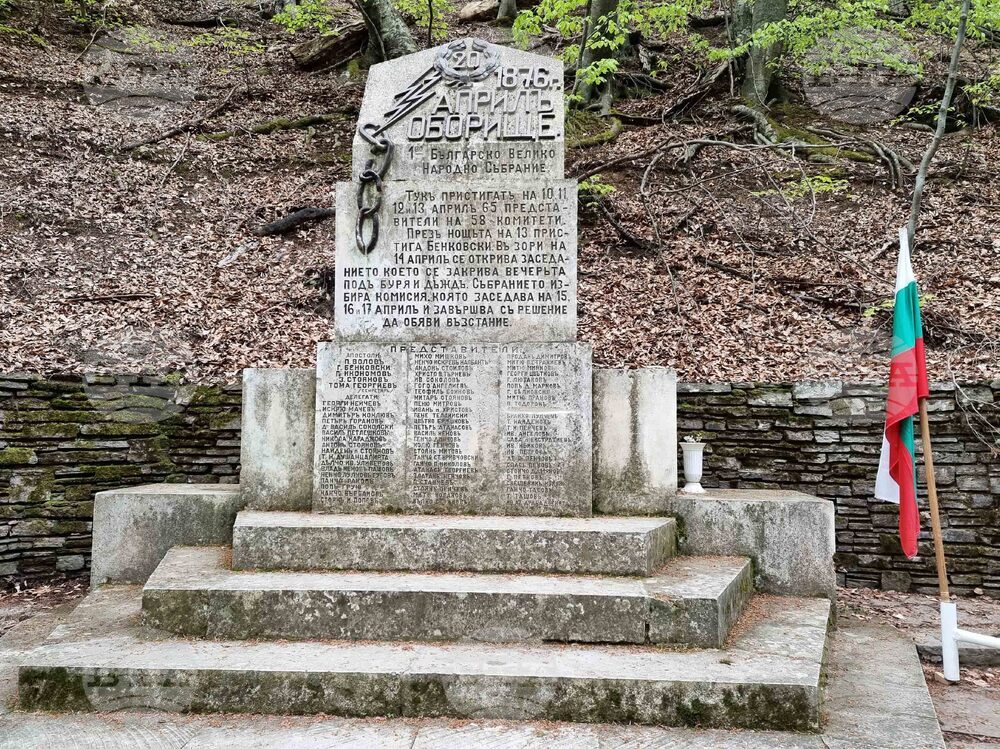
In the best-organized Panagyurishte District, 65 delegates of local committees in 58 settlements met in a wooded ravine called Oborishte on April 14 and elected a commission which decided that the uprising will be declared on May 1. A territory between the Balkan Range, Sredna Gora and the Rhodopi Mountains was supposed to be freed and held until the intervention of the Great Powers and the neighbouring Balkan states. Plovdiv, Pazardzhik and Adrianople were to be set on fire so as to disrupt the Turkish garrisons there, but peaceful Turkish civilians were not be harmed in any way whatsoever.
After a delegate betrayed these arrangements to the authorities, the insurrection broke out prematurely in Koprivshtitsa on April 20 (New Style May 1), 1876. The insurgents captured the konak (seat of local government) and killed a couple of police officers. Notified of this emergency, Panagyurishte, Klisura, Strelcha, Mechka, Poibrene and other villages in the area rose before the end of that day. Bratsigovo followed suit on April 21, Batak on April 22, and Perushtitsa on April 23. A Provisional Government assumed power in Panagyurishte.
The Bulgarian lands were too near to Constantinople and the Straits, so any such disturbance had to be addressed urgently. In a matter of days, 10,000-20,000 regular troops with artillery, including reservists, were rushed to the insurgent area, where they were reinforced by 80,000-120,000 bashi-bazouks (irregular soldiers recruited as volunteers from the local Muslim population). Scenes of fierce fighting included Klisura (April 26), Panagyurishte (April 28-30), Bratsigovo (April 28-May 6), Batak (April 29-May 2), the Dryanovo Monastery (April 29-May 6), a fortified camp on Eledzhik Peak (May 1), Perushtitsa (April 27-May 2), Kravenik (May 1-9) and Novo Selo (May 4-10).
The authorities took about a month to quell the rising, mopping up small insurgent groups that had retreated in the mountains. Heavily outnumbered and outgunned, the 8,000-10,000 Bulgarian rebels, inexperienced, badly commanded, undersupplied and poorly armed with old flintlock rifles and home-made cannon from cherry trees bound with metal hoops, suffered a crushing defeat. Most of their leaders, who were not arrested and imprisoned in a parallel crackdown, were killed in battle or from ambush, apprehended and executed, or committed suicide. The very few who survived escaped abroad.
Bulgarian Horrors
The actual number of those killed during the April uprising might never be determined with certainty. Estimates vary widely. Still, there is broad agreement that the overwhelming majority of casualties were Bulgarian civilians. Based on field inspections of destroyed villages and massacre sites, conducted in 1876 shortly after the events, the US Consul in the Ottoman capital, Eugene Schuyler, reported that 15,000 Bulgarians had been killed, while Sir Walter Baring, Second Secretary to the British Embassy in Constantinople, put the number at 12,000. Some later 19th c. consular estimates mention as many as 25,000-40,000 Bulgarian civilian deaths (including unrecorded or indirect deaths). The Batak massacre casualties present the largest discrepancy by source: from 1,000 to 8,000. Some modern Turkish and Western scholars argue that the bashi-bazouks there were provoked by the local Bulgarians killing indiscriminately innocent unarmed Muslims. The same historians question the accounts of Schuyler, Irish-American journalist Januarius A. MacGahan and British correspondent Edwin Pears as inflated, biased, untrustworthy, and deliberately ignoring non-Bulgarian testimonies.
Modern mainstream Western and Bulgarian scholars tend to converge on 15,000 to 30,000 Bulgarian casualties of the uprising as the most widely accepted range.
Estimates of Ottoman (Muslim) victims are 115 (including civilians) per Schuyler, 100-200 per other contemporary observers, and approximately 500 per official Ottoman claims. Most neutral contemporary observers agree that Muslim civilian casualties were relatively small compared to Bulgarian losses.
Far higher figures of Muslim deaths are given by some later revisionist historians, such as 1,000-plus, or "more Muslims than Christians were killed". These views are heavily disputed and often criticized as politically motivated or methodologically selective.
Apart from those killed, 10,000 Bulgarians were imprisoned by September 1876, 80 towns and villages had been burnt to the ground and 200 others sacked, and more than 300,000 head of cattle and sheep were stolen. Torture, rape and looting were rampant in the aftermath of the rebellion.
Reaction
The news about the atrocities committed during the suppression of the April Uprising provoked outrage in Europe, Russia and America. The subject was covered in over 3,000 articles, dispatches, news items, cables, letters, reports and other materials that appeared in nearly 200 most authoritative, most read and trusted newspapers in England, France, Italy, Germany, Austria-Hungary, Poland, Serbia, Montenegro, Romania, Greece and Russia. The shocked public demanded a quick and radical solution to the Bulgarian Question, as did opinion leaders like William Gladstone, Charles Darwin, Victor Hugo, Giuseppe Garibaldi, Otto von Bismarck, Leo Tolstoy and Dmitri Mendeleyev. European governments were compelled to send diplomats and journalists to enquire into the reported massacres on the spot.
The Sublime Port, too, initiated its own investigation into the matter, dispatching officials to Adrianople (Edirne) and Plovdiv. The resulting reports claimed that far fewer Bulgarians had been killed, fewer houses burnt and many of them had been reconstructed under European pressure.
Assessment
The over 100,000 Bulgarians who were involved in the April Uprising cut across the social spectrum of the period. While peasants (whether landless, smallholders or large landowners) were the basic driving force, accounting for more than two-thirds of the participants, the lower and upper middle class were also prominently represented: craftsmen, traders, owners of inns, taverns and wine cellars, small cattle dealers, shopkeepers, etc. Teachers, priests, librarians, book sellers and other intellectuals were a crucial ingredient. Educated mostly abroad, they had embraced the ideas of the Enlightenment and the French Revolution and spearheaded the project in close interaction with a group of professional revolutionaries.
The settlements where the uprising took hold were economically prosperous and culturally advanced, and home to the greatest number of revolutionary émigrés to Romania.
With the April Uprising, Bulgarians' struggle for national liberation reached its pinnacle. It was essentially an attempt at a bourgeois democratic revolution against the Ottoman feudal system, intended to clear the way for the country's capitalist development. Due to the brutal suppression of the uprising, the Bulgarian question became a European concern, depriving the pro-Turkish governments in Europe of arguments to back the Ottoman Empire and making it possible for St Petersburg to declare war on Constantinople in 1877 that resulted in the restoration of Bulgaria's statehood a year later.
The uprising proved the Bulgarian people socially and politically mature and morally virtuous, self-reliant and worthy of respect. April 1876 is an integral part of the Europewide process of national emancipation and liberation in the 19th century. It is an uplifting source of self-confidence and national pride, a foundational national tragedy and heroic sacrifice at the core of Bulgarians' nation-building narrative.
/LG/

news.modal.header
news.modal.text