site.btaMedia Review: April 27
OVERVIEW
No single topic dominates Monday’s media.
POLITICS
The candidate backed by Progressive Bulgaria will have the best chance of becoming president, political scientist Prof. Milena Stefanova told Bulgarian National Radio in an interview on Monday morning. "There is very little time left until the fall for voters to regroup. But this majority-vote election will require much more charisma and display of leadership, a lot of smiles. [Caretaker PM Andrey] Gurov is not that kind of person, unless he is presented in a different light. The right is making some moves to unite behind a common candidate. It will be an interesting and fierce battle." The 52nd National Assembly has a chance to begin its work quickly, "there is a majority that can elect a speaker. We must watch very closely how the political groups position themselves in their statements at the opening of the session." Stefanova added, "what Progressive Bulgaria declared during the campaign will be difficult to fulfil. It is one thing to criticize from the pulpit of the presidential office; it is another to sit in the prime minister’s chair and organize things in such a way as to push your policies through. This broad outreach to various groups in society, which was pure populism during the campaign, could also backfire on those in power, because they cannot meet all expectations." It will likely take six months to elect a prosecutor general, which may discourage the average person to some extent. 160 votes are needed to elect members of the Supreme Judicial Council. Progressive Bulgaria will need support. "I assume that support will be provided immediately by Continue the Change - Democratic Bulgaria (CC-DB). But there are risks, because to guarantee this support, these members will have to be allocated according to some quota. The entire system is currently set up in such a way that judicial reform will not end with this." Asked whether the oligarchic model in Bulgaria will be dismantled, Stefanova said, that "Progressive Bulgaria's campaign was extremely expensive. This government will also not infringe on the interests of big business, because there are enough of its representatives who supported Radev’s campaign." Stefanova said she is absolutely convinced that Radev will not become the Bulgarian Orban. "He won’t dare take radical actions regarding NATO and the EU." GERB has shown that it can function in opposition, but the loss it suffered in these elections is quite significant. Some of the party’s top experts were elected to this National Assembly, but nothing will depend on them. [Movement for Rights and Freedoms leader] Delyan Peevski will not play the role of a balancer. "I wonder if he will stop going to work again." The Bulgarian Socialist Party (BSP) will have to go through some sort of cleansing period. But it is too early to predict whether it will return to the National Assembly as an independent party. "I have the feeling that both CC and BSP have been working in Radev’s favour all these years. It’s as if they were rolling out the red carpet for him. Maybe one day they’ll even decide to merge," Stefanova said.
***
According to journalist Lyudmil Iliev and political analysts Tsvetanka Andreeva and Teodor Slavev, speaking on bTV’s morning programme, the budget and the new composition of the Supreme Judicial Council are the priorities of the future new government. "Judging by what several key figures in Progressive Bulgaria are saying in the media, the ideological mishmash continues there. However, while this might work during a campaign, it would be impossible once the government is formed, because decisions must be made that will affect the interests of one group, and benefit another," Slavev said. He gave an example: "Progressive Bulgaria is against neoliberalism, yet at the same time it maintains the tax system as it is." "They claim to be a left-wing party, yet at the same time they don’t seem particularly concerned about what will happen to workers in the military-industrial complex. They look to Europe, yet at the same time they are open to the East. They criticize the EU, but the funds from the Recovery and Resilience Plan will be key," the political analyst added. According to him, the names of the ministers will indicate the direction the political party will take in major public spheres. According to Andreeva, Progressive Bulgaria will seek to share power and will include figures close to the Alliance for Rights and Freedoms. "There is talk that the social minister will remain the same. Possibly, there will also be some collaboration with CC-DB at the executive level," Andreeva said. "When tough reforms are implemented during difficult times, popularity can be lost very quickly, and that is the major risk. It could happen that this party, even before it has begun to function as an entity, will suffer a loss," she added.
***
An alliance between Yes, Bulgaria, Democrats for Strong Bulgaria (DSB), and Continue the Change is possible, Yes, Bulgaria co-chair Ivaylo Mirchev said in an interview for Bulgarian National Television’s morning programme. According to him, one of the steps under discussion is the signing of a coalition agreement and the establishing of a clearer political entity with a common structure. Mirchev said that an alliance between the parties is possible, but only with the consent of all parties and an analysis of the results. "When we don’t even have a coalition agreement that functions at the necessary level, it’s difficult to expect anything more than those over 60,000 additional votes, for which we are grateful, of course, but it’s clear that this isn’t enough given the situation the country is in," Mirchev added. He placed strong emphasis on judicial reform and its impact on institutions. "We will be a very clear opposition to this government," Mirchev said, citing the elimination of the so-called "Peevski-Borissov model” as a goal. In his words, parliament must seize the opportunity for real change. "The Bulgarian people have given us the chance to have 160 MPs who are outside the Peevski-Borissov sphere. I assume there is a genuine will within Progressive Bulgaria to ensure that no one else takes their place." Speaking about the upcoming presidential elections, Mirchev said, "We must have a joint presidential candidate. I am certain that our community will put forward an exceptionally strong figure as a presidential candidate." He did not mention specific names or comment on whether the name of caretaker Prime Minister Andrey Gurov is being considered.
***
Talks with Continue the Change are forthcoming, and the main goal should be to ensure clearer representation of voters, Yes, Bulgaria’s other co-chair Bozhidar Bozhanov said in an interview on bTV’s morning programme. "Our goal is not to take the political spectrum and use a pencil to mark where everyone stands, but to think about the voters, how to bring them together and ensure they are convinced they are voting where they will be most effectively represented," he added. According to Bozhanov, the election results show that the current model of working within the coalition has not yielded sufficiently good results. Yes, Bulgaria insists on a coalition agreement that would resolve controversial issues in advance, including the order of candidates on the party lists, the joint campaign headquarters, and strategic campaign planning.
***
We are very far from becoming one party with Yes, Bulgaria, former prime minister and deputy leader of Continue the Change (CC) Nikolay Denkov said on Nova TV’s morning programme. He added that they share common goals with Yes, Bulgaria, but differ in the ways they think those goals should be achieved. "Two alternatives are being proposed, both of which seem very extreme. One is to create a common party at the proposal of Yes, Bulgaria, and the other is that we should divorce and stop speaking to each other," Denkov said. "We are not talking about a divorce, but about the fact that we can work together while each side develops its own strengths," he said, adding that the parties have signed an agreement regarding the presidential elections. This is a process in which we nominate a joint presidential candidate, Denkov said. On the question whether it is possible for CC and Yes, Bulgaria to form two separate parliamentary groups, Denkov replied that this would be for the MPs to decide when they convene.
FOREIGN POLITICS
Dnevnik.bg runs an article in which the author says that there are growing signs of investigations and political shifts in Hungary ahead of Peter Magyar’s government office takeover on May 9, challenging the long stay in power of Viktor Orban. Authorities and institutions appear to be launching probes into alleged abuses, including possible illegal AI-based surveillance of citizens; misuse of social welfare systems; questionable business activities linked to people close to Orban, including family-owned companies. State institutions and media, previously aligned with the government, are beginning to shift tone and investigate past actions, suggesting an attempt to adapt to the coming political change. Additional cases include corruption allegations, missing public funds (the disappearance from the budget of HUF 650 billion, EUR 1.7 billion, from the National Bank of Hungary, linked to a number of officials) and politically connected appointments. There are also arrests (of Fidesz Mayor of Kalazstelek) and regulatory investigations targeting local officials and businesses tied to the former ruling elite.
ECONOMY
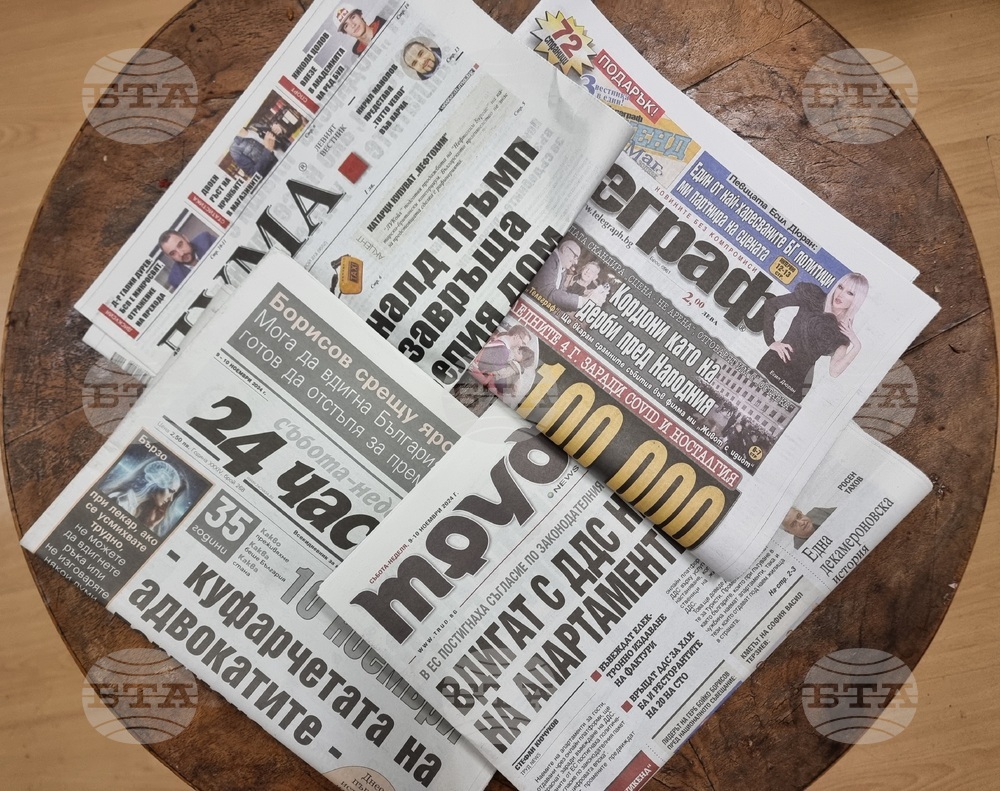
Trud daily’s front-page article says that summer holidays on Bulgaria’s Black Sea coast are expected to become up to 30% more expensive, mainly due to rising food and fuel costs. Hotel prices will increase more moderately (up to about 15%), but overall vacation expenses will still rise significantly. Many hotels may not open this summer because of high operating costs, staff expenses, and uncertainty about filling enough rooms. A major issue is the cost of hiring foreign workers (e.g., from Kazakhstan), including visas, travel, and accommodation. Food prices have risen sharply (30–40%), making it difficult for hotels to maintain profitability, all-inclusive packages may decline in quality, higher-end hotels are shifting toward a la carte dining with fresher, made-to-order meals. Tourist demand is weaker than last year, around 30% of previous booking levels, with fewer visitors from Germany, the UK, and Scandinavia. Some growth is seen from Polish tourists. External factors like conflicts in the Middle East have increased fuel prices and reduced travel demand. Despite early bookings, many hotels are now offering discounts and promotions to attract tourists, as demand has dropped. The season is also expected to start later and be shorter than usual, Veselin Nalbantov, Deputy Chair of the Bulgarian Hotel and Restaurant Association and hotel owner in the Sunny Beach resort, said. "Seventy percent of the tourism industry is concentrated in Sunny Beach. Nothing is being done about the infrastructure, and unless we put a stop to this reckless construction, this resort has no future, nor do resorts in general. Yet we have the most beautiful natural surroundings, including geothermal springs in several places within the resort," Nalbantov added. Additional cost increases include flights and transport, due to fuel surcharges; restaurant prices, already up 10%; apartment rentals, up at least 10% due to stricter tax rules; parking fees in resorts, now significantly higher. All of this makes the outlook for the summer tourist season in Bulgaria uncertain.
***
Segabg.com has an article on Bulgaria’s plans to introduce a national deposit system for plastic bottles and metal cans. A small deposit fee will be added to the price of drinks and refunded when consumers return the empty packaging at designated collection points. The refund will not require making a new purchase. This is the country’s second attempt to implement such a system, aiming to improve recycling rates and meet EU requirements. A national operator, not the state alone, will manage the system, and retailers will be required to participate and accept returns. The deposit amount will be set to encourage returns without discouraging purchases. It will not apply to drinks consumed on-site in restaurants. The reform is necessary because Bulgaria currently has very low recycling rates and lacks effective waste separation. The new system is seen as the only realistic way to significantly increase collection of plastic and metal packaging and align with EU targets.
***
24Chasa daily’s front-page article says that the Bulgarian Industrial Capital Association is urging the government to reduce the number of days off for public holidays, currently 15, as every additional day off costs at least EUR 90 million. Losses might reach EUR 120 million, calculations of the Association show, according to a letter urging the government to discontinue the practice introduced in 2017. In 2026, Bulgaria has a total of 12 official holidays, which are non-working days under the Labour Code. There will also be three additional ones - May 25, September 7, and December 28 - because Sts Cyril and Methodius Day, Unification Day, and the last day of Christmas fall on a Sunday. The topic of public holidays and the resulting loss to the state became particularly relevant a few days ago when a proposal was submitted to amend the Labor Code to make April 20, the day of the April Uprising, an official holiday. At the same time the European Commission has recommended that we work from home for at least three days to save fuel, the article adds. The Confederation of Employers and Industrialists in Bulgaria pointed out that the measure is not feasible for industry, transportation, and energy - the sectors most severely affected by fuel prices, yet which require physical presence. The Bulgarian Industrial Capital Association noted that despite investments in technology, productivity when working remotely often does not increase at the same rate, which is risky in times of economic crisis. Even in the IT sector, companies do not seem enthusiastic about implementing widespread home office arrangements, mainly because EU regulations adopted in the meantime require employers to cover employees’ utility costs, electricity, water, internet, when they work from home.
AI
Mediapool.bg runs an article titled the Architecture of Bulgaria’s AI Revolution in which the author says that the global tech race, especially in artificial intelligence, will shape future power, currently dominated by the US and China. The EU and Bulgaria are making deliberate efforts to achieve AI sovereignty, meaning control over their own data, infrastructure, and technologies. A key issue is dependence on foreign (mainly American) cloud providers: most European data is processed by non-European companies, limiting control and raising legal and security concerns, Petar Kirkov, expert and former cybersecurity national coordinator, said. Since data and energy are the fuel of AI, this dependence weakens Europe’s digital independence. To address this, the EU is investing in AI through cohesion funds and major infrastructure projects, including a network of AI factories built around supercomputers. Bulgaria is among the first countries selected, with its BRAIN++project (worth EUR 90 million), developed by INSAIT and Sofia Tech Park. At its core is the upgradedDiscoverer++ supercomputer, designed for advanced AI tasks. Bulgaria aims to become a regional leader in AI by supporting research, industry applications, and innovation. A major step is BgGPT, the first open large language model in Bulgarian. It allows sensitive sectors, like government, banking, healthcare, and energy, to use AI without sending data abroad, strengthening national control. Although BgGPT is small compared to global models, it is strategically important for Bulgaria’s digital sovereignty and local innovation.
CRIME
The headline of Telegraf daily’s front-page article says that paedophiles prey on children on social media. According to the story, kids are instigated to write personal messages in four apps. The paedophiles look for victims on Kik, Roblox, Snapchat, Instagram chat, where the minors play and have fun. They pretend to be youngsters to start off a conversation. The General Directorate for Combating Organised Crime (GDCOC) warn kids to be vigilant while having fun, because not everyone has good intentions and some may pose as someone else entirely. Just a few days ago, the Cybercrime Division arrested a man who had been storing and distributing child pornography. Over 6,000 photos and more than 300 videos were found on his phone. Every week, computer experts from the Cybercrime Division apprehend at least one paedophile. These operations take place throughout Bulgaria. The profile of this type of sex offender is typically a man over 30 with a high school education, though increasingly, there are also university graduates. Their professions vary widely, there are lawyers, doctors, even a paediatrician, construction workers, businessmen. Most often, they collect and distribute files with obscene content, but there are also those who produce it. Anti-mafia investigators work primarily with US agencies, which provide alerts that a paedophile has been located on our territory. There is also close cooperation with Europol. The platforms themselves also cooperate to prevent such cases. The goal of paedophiles is, once they’ve targeted a child on the apps, to get them to start a private chat. They pretend to share the same problems, to empathize with the teenager regarding a certain situation, and begin to close the distance until they’ve gained their trust. After some time, they start asking for nude photos. If they receive even one, they begin blackmailing the child for more. The General Directorate for Combating Organized Crime reported that 12 people have been arrested so far this year, and over 3,000 files containing child pornography have been seized. Those detained are primarily members of private groups on mobile apps, where admission is by referral, as well as through special access codes for identification, according to GDCOC. Last year, anti-mafia investigators carried out 44 special operations and initiated 45 pre-trial proceedings. Over 80,000 obscene photos and videos were removed from various websites and platforms.
/RD/
news.modal.header
news.modal.text