site.btaMedia Review: March 31
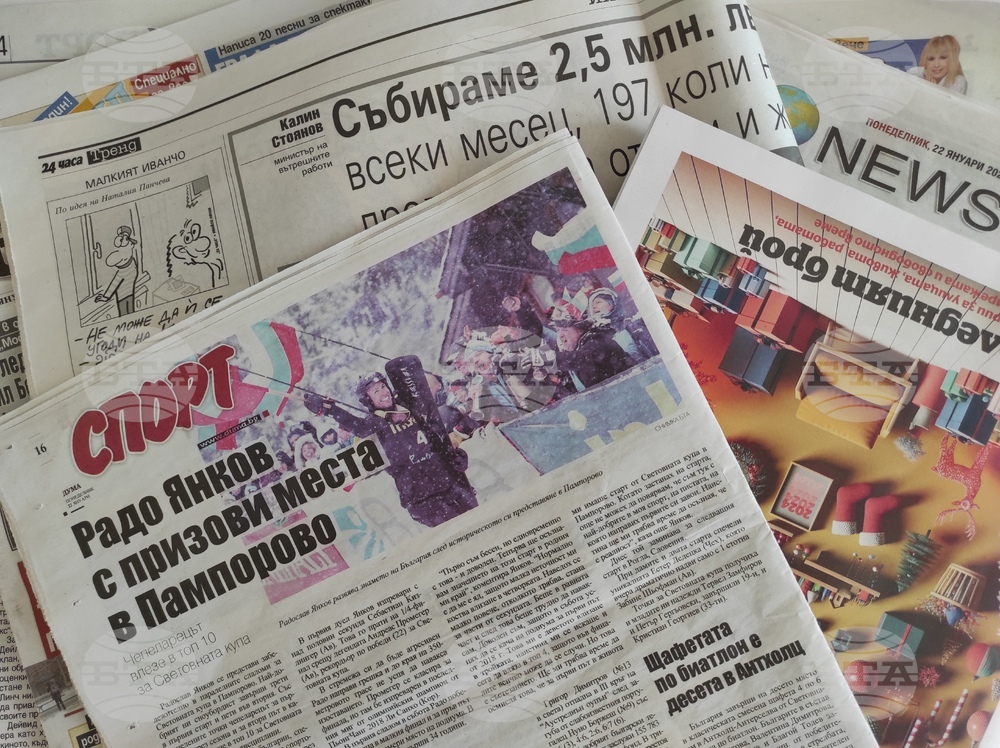
The topic of rising prices of food and fuels in Bulgaria dominates Tuesday's news media.
ECONOMY
Trud’s front-page story reads that the prices and the inflation rate are jointly going up. One in three retailers expects retail prices to go up over the next three months, according to a survey of business managers conducted by the National Statistical Institute, with such expectations reaching their highest level in three years. In both the manufacturing and services sectors, managers also expect selling prices to rise over the next three months. The article goes on to list price changes in various sectors, including food, clothing, construction, and services, noting that Bulgarian manufacturers have increased their prices for the domestic market but not for exports.
24 Chasa reports on its front page that after a meeting with President Iliana Iotova, the Commission for Consumer Protection (CCP) and the National Revenue Agency begin large-scale price checks for Easter. As early as April 1, traders from big markets to small shops can expect checks for inflated prices of eggs, lamb meat, and other products that Bulgarians usually eat on this holiday.
Telegraph’s front-page article focuses on the quality of the food for Easter, warning of high amounts of nitrates.
Bulgarian National Television's (BNT) morning show is themed "Who, how and why is raising the prices?" Commission for Consumer Protection Chair Alexander Kolyachev commented that when talking about rising prices, one needs to clearly distinguish what exactly has gone up in price - goods or services. Regarding the food products the CCP monitors, there has been no significant price increase since the introduction of the euro, he emphasized. "Where we have noticed such price increases, we have immediately intervened in the market and taken all measures provided for by law. We have conducted over 8,000 inspections, 1,200 of them jointly with the National Revenue Agency, and have issued 825 reports, totalling over EUR 1 million in fines. We are not seeing an increase in the prices of basic food products, but that does not mean there is no increase in certain sectors such as the restaurant industry, the service sector, the tourism sector, and the transportation sector," he explained. Petar Ganev, chief researcher at the Institute for Market Economics, commented that there is no need for drastic measures due to rising fuel prices; mild measures could be used directed at those most affected by the appreciation - what the caretaker government is doing, more or less - but Bulgaria will still be dependent on a global conflict that could go out of control. According to Georgi Vuldjev, an economic expert at EKIP, the issue of fuel prices and the economic situation is being somewhat dramatized. "For now, we are still experiencing a short-term shock. The problem is that we do not know if it will turn into a long-term one, because that depends directly on how the military operations unfold. In that sense, what the government is doing is heading in the right direction," Vuldjev noted.
On Nova TV's morning show, Petar Ganev, a senior researcher at the Institute for Market Economics, and economists Rumen Galabinov and Shteryo Nozharov commented that the measures the caretaker government is taking to address rising fuel prices are more social in nature than anti-inflationary, and are aimed at calming public anxiety. Ganev argued that if anyone expects the government to cap fuel prices, that is not its role. "The measures we are seeing right now are rather mild and relatively conservative. The package of measures should be targeted at specific sectors. If you give to everyone, it becomes very expensive, but when the measures are targeted at transportation or food production, you can achieve more with fewer resources. The point is, if things get out of control, then there should be other measures that come into effect,” said Ganev. Nozharov argued that there is a heightened perception of inflation, partly due to Bulgaria’s membership in the eurozone, and one of the three causes of inflation is always psychological. "The fact that the government acted so swiftly was primarily to calm psychological inflation, because it can quickly become self-perpetuating if not addressed in time. With a small package of measures, but one introduced quickly, the government reassured the public that it is monitoring the situation and responding, and this should bring it under control and prevent hoarding,” Nozharov commented.
24 Chasa has an interview with economist and former deputy prime minister Nikolay Vassilev, who talks about the state budget in today’s insecure world of crises, pandemics, and wars. According to him, giving money left and right should stop, as the State has become a feeding trough for everyone. The next cabinet must immediately cut all automatic pay raises and eliminate 9,000 vacant positions in the administration. “Every time we get a new government - the eleventh in five years - I remember a fortune slip I received with my cup of coffee: ‘It is not the millions of breaths that matter, but the moments that take your breath away,’” he notes. If a worst-case scenario with 5% inflation becomes a reality, measures still should not be taken; they will be necessary if the rate hits double digits, he argues. There should be no increase in direct taxes; in fact, a reduced 9% tax on profits and income is a better idea. “Better no budget than pre-election wedding-style bidding wars. A regular budget - from a regular cabinet. The problem is, we do not know if this one will not be even more wasteful than the previous ones,” Vassilev tells the daily.
***
Mediapool.bg writes that in 2025, the National Employment Agency admitted a total of 49,179 citizens from 87 non-EU countries to the Bulgarian labour market through all procedures related to the employment of foreign nationals. Their number is 42% higher compared to 2024, when there were 34,720, according to data provided to the e-zine. According to official statistics, workers from third countries are primarily employed in manufacturing and the processing industry as seasonal workers, professional drivers, and construction workers. This applies to those coming from Uzbekistan, who constitute the largest group of foreign workers in Bulgaria. The same applies to those from Nepal, India, and Kyrgyzstan. A quiet debate is underway between employer organizations and economists over how big the labour shortage is. According to some economists, the official data suggest that the shortage is smaller than what the business sector estimates. Some consider the integration of the 120,000 to 150,000 non-working young Bulgarians as a priority over the import of personnel from third countries. At the same time, the business community is pushing for a higher quota for foreign workers, up to 50% in large companies. Economists explain that with third-country workers costing less for employers than Bulgarian workers, but employer organizations deny it, noting the deficit of workforce in Bulgaria.
POLITICS
Duma writes on its front page that the Bulgarian Socialist Party (BSP) is against the visit of caretaker Prime Minister Andrey Gurov to Ukraine, because the caretaker cabinet’s main function is to organize fair elections, not make geopolitical demonstrations. Gurov and five ministers visiting Ukraine does not look like an effort for peace but a show for a domestic political goal; it will not contribute to a lasting and just peace but will case reactions of division in pre-election Bulgaria, reads a position of the BSP Executive Bureau on Monday’s unexplained visit to Kyiv.
***
Segabg.com writes in an analysis that during election season, the political elite invariably seizes upon the issue of exorbitant salaries in State-owned companies and at various management levels within the administration. Once in power, however, the elite stops talking and quietly pockets the very same sums they had previously complained about. This year was no exception. With the arrival of the caretaker government, outrage began to pour in over salaries at one State-owned company or another, as if the money had only started being handed out yesterday. And all it takes to fix this perennial issue is to change a few lines and a table or two. With the new minimum wage effective January 1, compensation for board members of State-owned companies has once again increased. Unlike the salaries of all public sector employees, where a 5% increase is stipulated, the jump in State-owned companies is equal to the minimum working wage, 12.6%. This leads to increases of over BGN 2,000 per month in the compensation of the CEO, even at the most struggling companies. In other words, the increase is completely undeserved in some companies. Sega goes to explain how this trick work thanks to a formula no one dares change.
***
Capital.bg has an interview with Dr. Johanna Deimel, a German political analyst from the Munich-based Southeast Europe Association, who talks about her expectations of the April 19 snap parliamentary elections. According to her, former president Rumen Radev will win with his Progressive Bulgaria, but in order to govern, he will in any case need support - either in a minority government or in a coalition with one or two other parties. The big question is to what extent Radev will actually be able to distance himself from Boyko Borisov (GERB) and Delyan Peevski (MRF-New Beginning) and oppose their deep penetration into the economy, politics, the judiciary, and the social fabric. Voter turnout will also play an important role, the German analyst believes. The BSP is particularly anxious, but so is Ahmed Dogan’s current Alliance for Rights and Freedoms, which for decades has left a significant mark on Bulgarian politics. And There Is Such a People, Velichie, and MECh are clearly out of the running. In any case, the National Assembly will look different, because Progressive Bulgaria’s lists will bring in a motley kaleidoscope of politically inexperienced new MPs. Initially, and perhaps in the medium term as well, this does not paint an optimistic picture for well-functioning parliamentary work after the elections, Deimel argues.
***
Bulgarian National Radio interviewed Assoc. Prof. Hristo Hristev, a lecturer of European law at the St Kliment Ohridski University of Sofia and Andrey Gurov's attorney in his cases in Bulgaria [Gurov has brought an action against the Anti-Corruption Commission over its claim that he was incompatible with his position as deputy governor of the Bulgarian National Bank (BNB) due to still holding shares in a business company upon taking office. Gurov has also challenged the subsequent decision of the BNB Governing Board to suspend him as BNB deputy governor. The decision was put on hold, pending an answer from the EU Court of Justice to eight questions that the Bulgarian court referred to it for a preliminary ruling, but in the meantime Gurov was appointed caretaker prime minister because he was eligible to the post as BNB deputy governor]. According to Hristev, Gurov's term in office as caretaker prime minister is not in question. This situation cannot be changed, regardless of the outcome of the proceedings before the EU Court of Justice and the Bulgarian court, because at the time President Iotova made her selection for caretaker prime minister from among the list determined in the Constitution, Gurov held the position of BNB deputy governor and was thus on the list. This selection was made in a fully legitimate and lawful manner, Hristev argued.
***
bTV's morning show hosts an election debate on Bulgaria's economic policy, inflation, and incomes between Venko Sabrutev of Continue the Change – Democratic Bulgaria, Vladimir Marinov of BSP – United Left, Petar Dilov of There Is Such a People, and Ivelin Mihaylov of Velichie.
HOME AFFAIRS
Trud has an interview with Bulgarian Drivers' Association head Hristo Radkov, who says that the Ministry of Interior is not working to promote road safety, but rather as a revenue-generating agency. Despite the Ministry’s claims that the number of road traffic victims has been reduced compared to 2020 and the number of established traffic violations has increased, in 2025 Bulgaria was first in the EU with 71 road traffic victims per 1 million population. The issue lies in that people who have no knowledge of the system are taking the decisions, ignoring the experts’ proposals. The measures taken are populist and not aimed at solving the real reason for the high number of traffic accidents and victims: the poor condition of Bulgarian road infrastructure, Radkov argues.
/DS/
news.modal.header
news.modal.text