site.btaMedia Review: March 13
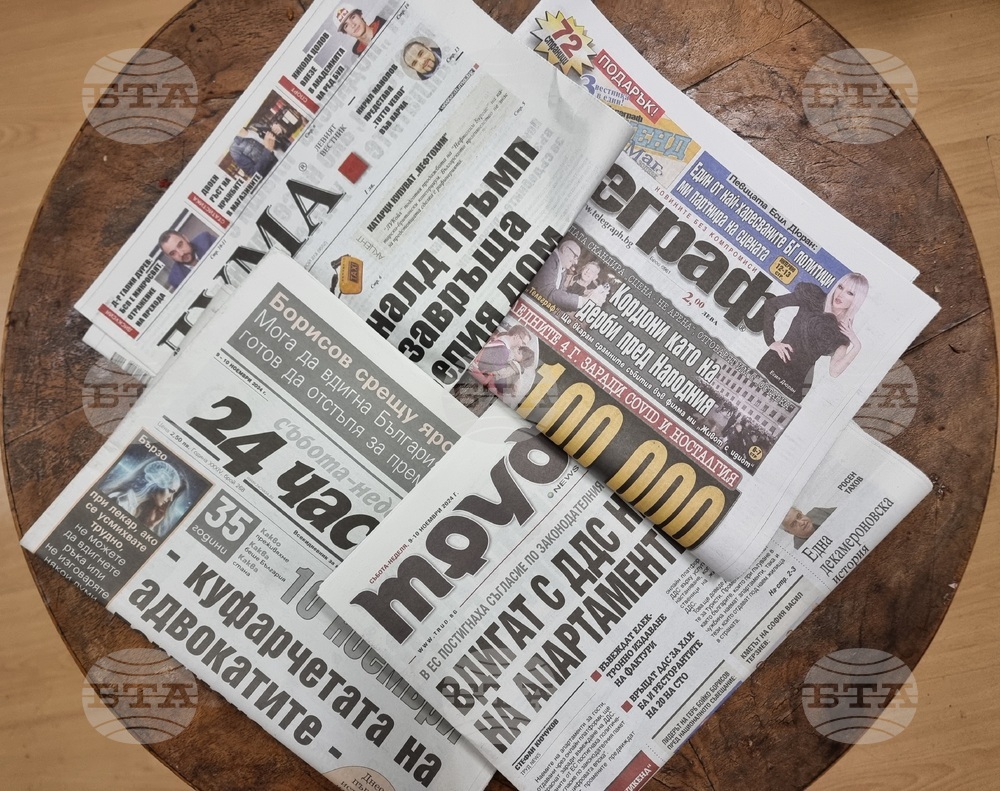
HEADLINES
Trud’s top story is about measures the Cabinet plans to introduce to soften the impact of rising fuel prices on low-income individuals. 24 Chasa also covers the issue on its front page.
Duma leads with the headline “There Is No Matter That Can Be Solved Through War,” quoting Krum Zarkov, leader of the Bulgarian Socialist Party (BSP), who made the remark on Thursday. The daily adds that BSP MPs disrupted sessions of the parliamentary Committee on Foreign Policy that were meant to ratify Bulgaria’s membership in US President Donald Trump's Board of Peace.
24 Chasa highlights an interview with caretaker Agriculture and Food Minister Ivan Hristanov, who says he is ready to hold talks with traders, producers, distributors, and processors in order to agree on lower prices for 150 food products.
Telegraph’s lead article quotes the Varna Chamber of Tourism as forecasting losses of between EUR 50 million and EUR 70 million for the sector because of the war in the Middle East, particularly due to cancelled bookings by Israeli tourists.
This week’s issue of Capital focuses on the introduction of the multi-fund model in supplementary pension insurance.
POLITICS
Mediapool.bg reports that the BSP has attempted to block a push by Delyan Peevski, the Magnitsky-sanctioned leader of Movement for Rights and Freedoms – New Beginning, to have Parliament swiftly ratify Bulgaria’s accession to the controversial Board of Peace, created by US President Trump as an alternative to the United Nations. The media outlet recalls that on January 22, then-outgoing Prime Minister Rosen Zhelyazkov signed Bulgaria’s accession to the initiative. Peevski immediately called for the agreement to be ratified without delay, but GERB never formally submitted the document for a vote in the National Assembly. In the final working days of the current Parliament, Peevski has remained the main driving force behind advancing the procedure. According to speculation, he hopes that by doing so he might gain Trump’s favour and have the sanctions against him lifted, Mediapool.bg writes. On Thursday, BSP MPs managed twice to sabotage meetings of the parliamentary Committee on Foreign Policy by failing to attend and thereby preventing a quorum. Later, Peevski’s proposal was approved by the parliamentary Committee on Defence, chaired by Hristo Gadzhev of GERB. At present, both GERB and There Is Such a People support Peevski’s initiative, though it remains unclear whether GERB MPs would vote as a united bloc in Parliament, the outlet writes.
*
In an interview with Bulgarian National Radio, caretaker Minister of Electronic Governance George Sharkov defended his role in overseeing election technology, denied wrongdoing or undue influence, and stressed that transparency and technical verification mechanisms are in place.
*
Bulgarian National Television's (BNT) morning programme features an interview with Sergei Stanishev, a member of BSP's Executive Bureau, who described BSP as an institutional and predictable party that has always been willing to change and assess its own weaknesses and mistakes. He recalled that Krum Zarkov was elected by the party congress with a mandate for radical reforms. “The most important message is that the BSP will pursue an independent policy. That is his line and it should be given a chance. I am convinced that the BSP’s presence in the next Parliament may prove key to forming an honest and stable government based on clear rules,” Stanishev said. He noted that his party does not believe Europe’s militarization is the answer to the threats facing the European Union, warning that it could instead create additional risks. “Our country must be extremely active on the European stage, defending our interests and seeking partners - first and foremost Greece and Romania, as the countries closest to us,” he said.
ECONOMY
Print dailies report that salaries for employees in public transport, BDZ Passenger Transport, the National Railway Infrastructure Company, and Bulgarian Posts will be increased by 5%. The announcement was made Thursday by caretaker Finance Minister Georgi Klisurski at a news briefing with caretaker Transport and Communications Minister Korman Ismailov at the Council of Ministers, following talks with trade union representatives.
*
In an interview with 24 Chasa, Agriculture and Food Minister Ivan Hristanov says he aims to crack down on corruption schemes, including the siphoning off of subsidies, smuggling, and the import of fruits and vegetables declared at prices that have nothing to do with actual market levels. He notes that the prices of milk and dairy products are “unbearably high,” while farmers’ incomes are “unbearably low,” and says solutions will be sought. “Once we finish the working group on milk and see what experience we gain from it, we will set up direct working groups for 150 key food products. My ultimate goal is for retail chains, traders, producers, distributors, and processors to reach a national agreement on lower prices. If such an agreement is signed by all sides—with mutually controlled margins and a consensus—there will be no need to change the law or introduce price caps,” he says. He cites Spain as an example of a country that has signed such an agreement, adding that it works very well.
*
Trud writes that dental services in the country have become 25–30% more expensive over the past three months—from December to the end of February—citing a comparative analysis of price lists from dental practices across Bulgaria. The daily quotes Bulgarian Dental Association President Borislav Milanov as saying: “The increase in prices is linked to inflation, to all the changes taking place in our country, and to the requirements and conditions under which we practice our profession. But there is absolutely no question of prices doubling.”
*
Speaking on the morning programme of Nova TV, economist Georgi Angelov said the public sector is expanding while the population is shrinking. Since 2019 alone, Bulgaria’s population has fallen by about half a million people. For every two people employed in the private sector, there are now three in the public sector plus pensioners. By the end of last year, the average gross salary in the public sector was 9% higher than in the private sector. According to Angelov, 26.3% of all workers are now employed in the public sector, a share that has been rising in recent years. In his view, it would be “normal” for fewer than 20% of workers to be employed in public administration and state structures, as was the case around seven or eight years ago. He argued that the private sector cannot continue to bear an ever-increasing tax burden, especially as the number of workers in it is declining.
*
Capital Weekly writes that the introduction of the multi-fund model in supplementary pension insurance is the most significant pension reform in Bulgaria in a quarter of a century. The change expands the investment opportunities for the retirement savings of 4.2 million people. The aim is that a combination of better returns and lower fees will result in larger savings in individual accounts and more adequate supplements to the state pension. The success of the new model will depend on how pension companies use these opportunities and how effectively the regulator exercises oversight.
FUEL PRICES
bTV recalled that on Thursday the government announced it is preparing measures to support the poorest households in order to offset part of the pressure on family budgets. Instead of a general price reduction, the Cabinet is discussing targeted assistance for people with the lowest incomes if the upward trend in fuel prices continues.
Speaking on bTV’s morning programme, Dimitar Hadzhidimitrov of the Association of Bulgarian Fuel Traders, Manufacturers, Importers and Carriers described the caretaker government’s measures as a mistake and as populist.
“EUR 30 million will be spent in a situation where resources are limited. The aid will be distributed so thinly among those people,” he said. “Such assistance will not stop inflation; rather, it will help it continue rising.”
In an interview on Nova TV, energy experts Elenko Bozhkov and Ivan Hinovski both called on the State to publish the production cost of fuels at Lukoil Neftohim Burgas, so that it becomes clear where distortions in fuel prices are occurring. Hinovski noted that “for 20 years Bulgaria has been governed by Lukoil Neftohim because of its monopoly position,“ noting that 90% of the country’s fuel reserves are stored by the same producer.
DEFENCE
24 Chasa reports that Greece’s F-16s are already helping protect Bulgaria’s airspace. The aircraft also took part in joint exercises with Bulgarian MiG-29 fighter jets on Thursday to improve coordination during cross-border operations and air policing missions.
In an interview on the morning programme of bTV, former head of the State Agency for National Security and former interior minister Tsvetlin Yovchev said that “the F-16s would be virtually useless in the event of an attack with ballistic missiles,” adding that the country does not have sufficiently strong protection. He noted that Turkiye's defence capabilities also contribute to regional security. Yovchev stressed that Bulgaria has long underinvested in its own air defence systems and added that the country’s defences against drones remain limited.
EDUCATION
Telegraph carries an interview with Diyan Stamatov, head of the Union of Employers in the Public Education System in Bulgaria, who comments on challenges facing the education sector, staff shortages, and the introduction of artificial intelligence (AI) in schools. Stamatov criticizes the delayed legal regulation of the ban on mobile phones in classrooms. He says the largest shortage of teachers is in physics, followed by mathematics and chemistry. Regarding the use of AI, he stresses the need for clear rules for its ethical use, pointing to the widespread practice of using other people’s photos to create videos - something he says must be stopped.
CRIME
Telegraph reports that the Sofia City Court has upheld the first-instance ruling to keep Adrian Galabov, an officer from the cybercrime unit of the General Directorate for Combating Organized Crime, in custody. Galabov was arrested on March 5 on suspicion of abuse of office.
/IV/
news.modal.header
news.modal.text