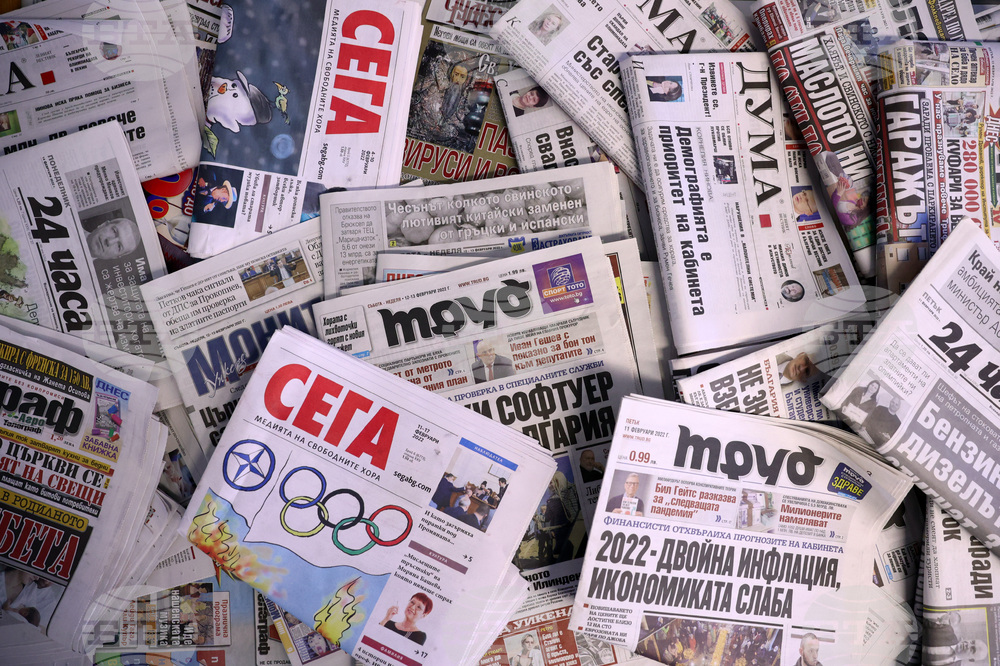
site.btaMedia Review: February 17
PETROHAN
Mediapool reported that a group of 10–12 men on ATVs were in the area of Petrohan lodge hours before the deaths of three of its residents, citing testimony from Deyan Iliev, the man who found the bodies, “confirmed by the media outlet’s sources.” He spotted them in the nearby village of Gintsi and informed the group living in the lodge, after which he received responses resembling farewells. It turns out that the Interior Ministry has already identified and questioned the people on the ATVs, according to materials available to Mediapool. The men were on an off-road tour organized by a person who often rides in the area. “This only becomes clear two weeks after the bloody tragedy, around which so many contradictory versions have circulated, none of them substantiated or proven. And regardless of the widespread conspiracies and question marks surrounding ATVs and jeeps seen near the hut before the deaths of its residents and the burning of the building, investigators have so far not officially announced what information they have on the case,” the article reads. According to the media outlet, on February 1 the people on the ATVs were riding along forest roads in the area, and around 2:30 p.m. headed toward Petrohan, shortly afterwards stopping at the point where the road to the hut branches off. There they passed a dirty black jeep carrying two men. The group then set off toward the hut, but via a different route. When they reached the turnoff to the hut itself, they saw that the road was completely snow-covered and that there had been no traffic along it. Shortly afterwards, the terrain became so impassable that even the ATVs began to get stuck in the snow. The group therefore decided to turn back. On the way back toward the hut, they again noticed no signs of movement, but shortly afterwards they passed a second jeep. It is not clear who was inside it, as the vehicle had tinted windows. It also had no front license plate. According to various sources, Iliev and his wife, who is Mexican, may have left the country. Relatives of the victims said they have been unable to contact them for days. There is no official information on this matter. As far as is known, Iliev is only a witness in the case, i.e. there are no grounds or reasons to impose any restrictions on him and he is free to travel.
Trud features an interview with psychologist Ivan Igov, who commented on the Petrohan case. “Here we have all the elements of a sect,” he said. The psychologist expressed doubt that the group had been engaged in forest protection and added that its members were “obviously homosexual”: “There are no women around them, they have no families or children. There is nothing wrong with that, I am not a homophobe, on the contrary. Each of us knows at least one homosexual person and that does not interfere with our relationships or connections, it is simply who these people are,” he added.
A report on bTV’s morning show includes an interview with a local resident of the village of Bulgari, where police teams searched the house of Ivaylo Kalushev, the man believed to have led the group. He said he did not know Kalushev and had not seen him, as the group would pass quickly by car without greeting anyone. “I only once saw a small child and a woman. The child – maybe 10–12 years old,” the local resident said.
On Nova Television’s morning show, Center for the Study of Democracy Security Program Director Atanas Rusev stressed that the Petrohan case reveals many dysfunctions in Bulgarian institutions. “What we are observing in terms of communication is disastrous. The way communication has been handled from the very beginning is extremely unprofessional. The victims’ families were literally allowed to be publicly lynched, which is far from any notion of professional conduct,” he said. According to Rusev, the authorities clearly could have handled the situation much better. “From the leaked information and testimonies, it became clear that the General Directorate for Combating Organized Crime invited one of the witnesses to validate his testimony by bringing in another eyewitness. That does not sound logical - is it his job to look for other victims? Many people have gone through their ‘adventure’ school. And in the end, the witness has to prove his own report,” he pointed out.
On Nova Television’s morning show, Continue the Change – Democratic Bulgaria Co-Floor Leader Nikolay Denkov commented on the Petrohan case. According to him, around the tragedy there has been a “fierce and cynical attack” with two goals - to strike the political formation ahead of the elections and to divert attention from the institutions directly responsible for what happened over the past one or two years. Denkov noted that over the past year it became known that there had been a check by the prosecution service which was subsequently halted. He also commented on claims by journalist Viktor Ivanov from 24 Chasa that there was information about links between some of the deceased and the State Agency for National Security. “I do not know the victims, I have not seen them. None of the people around me, nor anyone from the leadership of Continue the Change, knows them,” Denkov said. He stressed that public trust in the investigation has been lost and that is why Continue the Change – Democratic Bulgaria insist on the inclusion of international experts from countries trusted by Bulgarian citizens, such as Germany and France. Denkov also criticized acting Prosecutor General Borislav Sarafov and again stated that the scandal is being inflated ahead of the elections in order to influence the vote. Regarding the domestic political situation, Denkov underlined that it is extremely important for society to have trust in the caretaker prime minister, and that Boyko Rashkov is the only interior minister who has significantly reduced controlled and vote-buying practices in high-risk polling stations. Commenting on opinion polls, Denkov noted a decline in support for GERB, which he said was expected. He pointed out that according to survey data, a significant portion of the party’s supporters have not given a clear answer as to whether a decisive fight against corruption should be waged. Denkov also commented on attitudes toward a potential exit of Bulgaria from the EU, stating that the majority of Bulgarians oppose such a step, while supporters of former president Rumen Radev are “in favor.”
POLITICS
On bTV’s morning show, political scientists Rumyana Kolarova and Elena Darieva, as well as sociologist Mariya Pirgova, commented on the potential members of the upcoming caretaker cabinet. The media outlet listed the most likely composition of the next caretaker government. It is known with a high degree of certainty that Rumyana Bachvarova will serve as deputy prime minister. She has previously held this post in Boyko Borissov’s cabinet and has also headed the Interior Ministry. Emil Ganchev, a former deputy interior minister, is being mentioned for the Interior Ministry. For the Justice Ministry, the name of Emil Dechev, a former deputy minister in Kiril Petkov’s cabinet, is being discussed. For Defence, it is claimed that the choice of the future caretaker prime minister Andrey Gurov is Boyko Noev, a former defence minister under Ivan Kostov. The Foreign Ministry will be headed by a woman, whose name will become clear by Thursday at the latest. It will be either another former minister under Ivan Kostov, Nadezhda Neynski, or a former minister under Simeon Saxe-Coburg-Gotha – Gergana Passy. In the Economy Ministry, the choice is also between two former ministers – Traycho Traykov under Boyko Borissov and Daniela Vezieva under Stefan Yanev. The Education Ministry will be taken over by former deputy minister Natalia Miteva. One minister is expected to retain his post in the “Gurov” cabinet – Borislav Gutsanov at Labour and Social Policy. Former deputy mayor for finance and current deputy minister Georgi Klisurski is expected to take over the state treasury. More former ministers are also returning – Asena Serbezova in healthcare, Yulian Popov in environment, Ivan Shishkov in regional development, Alexander Nikolov in energy, and Milena Stoycheva in innovation. “If these names do indeed enter Gurov’s cabinet, this would signal that diversification is being sought, as they come from across the political spectrum. The aim is to calm public sentiment, which is currently, to put it mildly, inflamed. One thing is clear – Gurov has oriented himself toward selecting professionals who can immediately enter the ministries and start working from day one,” Darieva commented. “The possible appointment of Rumyana Bachvarova shows that this prime minister has neither the administrative nor the political experience to hold this position. It will turn out to be a completely fragmented caretaker government, with neither responsibility nor direction. They may be good professionals, but some of them are far removed from politics – who will hold them accountable when they are done?” Kolarova said. Pirgova supported the thesis that the caretaker authority will be fragmented: “Gurov’s concept is to select professionals who will not allow the caretaker government to become a period of administrative stagnation, but instead to function. He will unite this team of ambitious professionals who will want to prove themselves. In my opinion, Ms Bachvarova has changed her attitudes from previous years and is ready to approach this task professionally – fair elections.”
In an interview with the Bulgarian National Radio, political scientist Hristo Panchugov said that people should have moderate expectations of this caretaker government. “In this extremely complex situation, the likelihood of finding people who are not already tied to certain political formations and who are willing to accept the position offered to them is probably not very high. I would be truly surprised if a large part of them do not already have political biographies or have at least gravitated around certain political forces,” he added. Panchugov stressed that responsibility for trust in the upcoming elections and for the decisions to be taken until the vote is shared between the caretaker government, the Central Election Commission, and every MP and party.
***
On Nova Television’s morning show, the “Lie Hunters” segment discussed myths about voting machines in the country’s elections. Claims that voting machines in Bulgaria are so-called “Maduro machines” are a myth and a form of disinformation, Ivan Radev explained. The name comes from elections in Venezuela, but contrary to the insinuations, the machines there did not help Nicolas Maduro win; on the contrary, their protocols showed that he lost the vote. It was precisely the machine receipts that exposed the manipulation after the official authorities refused to publish results from all polling stations. In Bulgaria, voting machines always leave a paper trail that allows verification and control. Radev stressed that disinformation about machine voting undermines trust in the electoral process. The biggest loser from such insinuations, in his view, is democracy, because people’s refusal to vote increases the weight of controlled and vote-buying practices.
***
24 Chasa features an article on what will happen to members of the outgoing government. The daily notes that 13 of the ministers were MPs, and of them only Temenuzhka Petkova will not return to Parliament after the appointment of the caretaker cabinet. The reason is that the Constitutional Court redistributed mandates following the entry of Velichie into the National Assembly. One third of the returning ministers will remove women from Parliament – two each from GERB-UDF and BSP – United Left. Ivan Peshev and Miroslav Borshosh were municipal councillors in Sofia before being sworn in as members of the government, but seats in municipal councils are not reserved by law, unlike those of MPs, the media outlet writes.
ECONOMY
In an interview with the Bulgarian National Radio, National Real Estate Association Board President Dobromir Ganev commented on the housing market in the country. Last year was very weak in terms of the production of new housing units. In Sofia, construction of new homes declined by 25–30%, and in Varna by 25–39%, with the weaker supply driving the pace of price growth, Ganev pointed out. According to him, in periods of change, even when the outlook is expected to be positive, investors tend to be conservative and prefer to hold back production. Rents are rising more slowly than property sale prices. They are significantly influenced by inflation, and in recent years especially the larger markets have been “refreshed,” the expert noted. Ganev also said that the banking sector does not expect an increase in interest rates and forecasts that this year there will be no hikes that would worry those planning to purchase property. He also cited statistics on property price growth in major cities in the third quarter of 2025: 16.2% in Sofia, 19% in Varna, 9.9% in Burgas and around 12–13% in Plovdiv, compared to the same period in 2024. Growth in Burgas is the lowest, as there has been a significant increase in new construction there.
***
On bTV’s morning show, financier Levon Hampartzoumian and the chief economist at the Institute for Market Economics, Lachezar Bogdanov, commented on the current economic situation in the country. “The transition to the euro went more smoothly than it could have. Various risks did not materialize,” Hampartzoumian said. “The world has been in an inflationary situation for quite some time. And in one way or another - Bulgaria is part of the world, so this has an impact,” he noted. Asked whether there is hidden inflation from rounding up prices following the adoption of the euro, Bogdanov said that this rounding effect has a very small contribution. “We are observing processes that did not begin in January. We see that in non-tradable services, meaning those you cannot import from somewhere else and where global market competition cannot appear, there has been serious price growth for months - starting with restaurants and establishments, moving through personal services, hair salons, beauty salons, dental services, even paid medical examinations and all related healthcare services. All of these have recorded quite significant price increases,” he commented. According to him, one of the reasons is the lack of competition. “We cannot expect anything different when we have had at least six or seven consecutive years of double-digit wage growth. Last year the budget data came out. In the public sector - and we are not talking only about administration, but the entire public and budgetary sphere - we saw a 20% increase in personnel expenses. All this money has been poured by the budget into salaries, bonuses, etc. for people working in the public sector,” the economist said. “There was 11% wage growth in the private sector with inflation at 3.5%. Few countries in the European Union have wage growth above 10%,” he added.
SOCIETY
Telegraph features an article exploring the behavior of Bulgarian book readers on Google. The keyword “book” is most frequently searched in late autumn and early winter, with the daily noting that this is when people often visit Christmas bazaars. The second peak coincides with exam preparation in the spring, while in the summer “users shift their attention from heavy literature to entertaining content for the beach.” Fiction remains firmly in the top position. However, within this category a process has been underway for some time, redirecting readers’ interest toward hybrid genres. In 2025, these genres recorded the strongest growth, particularly the combination of romance and fantasy. This is not a random spike but a sustained trend driven by communities such as BookTok (the literary segment of TikTok), the media outlet writes. “When we analyze Google Trends data for 2025, we cannot overlook the title that managed to break the dominance of translated literature. Mamnik by Vasil Popov is an emblematic example of how a contemporary Bulgarian story can generate interest comparable to global blockbusters,” the article states. The Bulgarian consumer is changing in a pragmatic way. Searches related to practical and applied literature have also seen significant growth.
/MR/
news.modal.header
news.modal.text