site.btaMedia Review: January 23
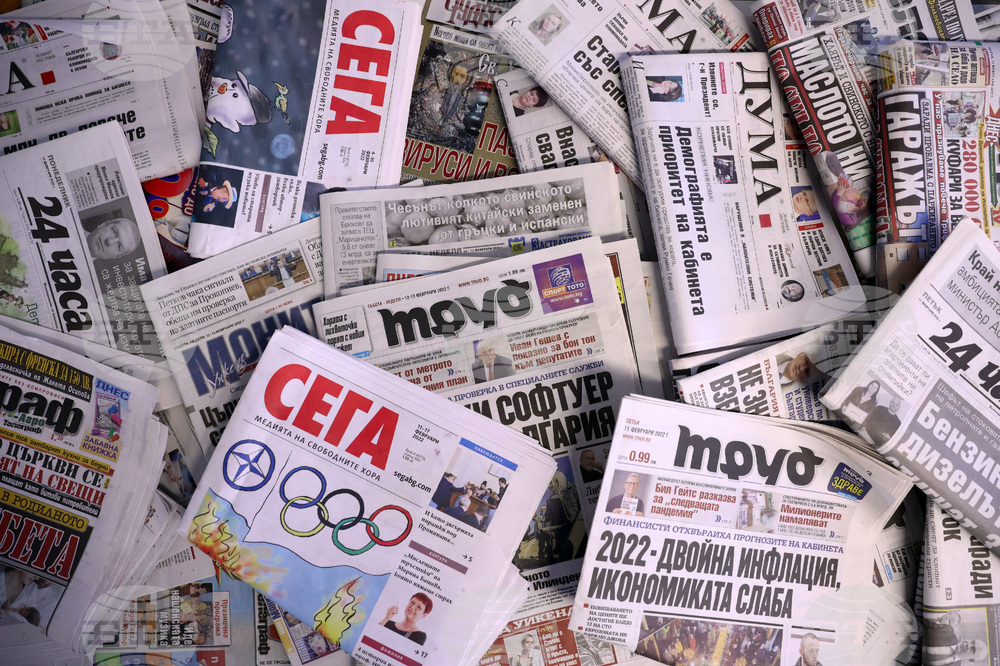
The topics of Bulgaria joining President Trump’s Board of Peace, President Rumen Radev’s potential new party, and Election Code amendments dominate Friday’s news media.
BULGARIA JOINS TRUMP’S BOARD OF PEACE
24 Chasa’s front-page story highlights three major reasons for Bulgaria to join US President Donald Trump’s Board of Peace. On Thursday, outgoing Prime Minister Rosen Zhelyazkov signed the Board of Peace charter on behalf of the country. Bulgaria and Hungary are the only EU Member States to have officially joined the project, which US President Donald Trump said he expects to evolve into a “new United Nations”. 24 Chasa says that Belgium is in as well but the country has denied that. According to the daily, if Bulgaria were to decline the invitation, it would have missed the opportunity for Bulgarian companies to benefit from the reconstruction of Gaza, where rough estimates put investments at between USD 70 and 100 billion, mainly in construction. Diplomatic channels have reportedly suggested that the founding members of the Board of Peace would enjoy preferential access to these projects. In addition, Bulgaria is counting on the political goodwill generated by its participation to help secure an extension of the derogation for the Lukoil refinery, as well as a more favourable stance by the US administration on lifting visa requirements for Bulgarian citizens.
A key factor behind the decision is the appointment of Bulgarian diplomat and former foreign minister Nikolay Mladenov as the Board’s Supreme Representative for Gaza, tasked with overseeing reconstruction efforts, according to the story. Addressing the ceremony, Trump said the Board had the potential to become one of the most significant diplomatic bodies ever created and warned that Hamas would be destroyed if it refused to cooperate for peace. Mladenov said that the conflict in Gaza had gone on for too long and called on members to focus on practical steps, stressing that “the future of two million Palestinians is at stake.”
Duma also covers the topic, reporting that the outgoing government’s decision to join the founding members of the Board was made at the last minute on Wednesday, just before Zhelyazkov’s departure for Davos. The decision was not announced officially and was taken without any consultations, not even with Parliament, the future president Iliana Iotova, or expert committees. The daily publishes a commentary by journalist Yuri Mihalkov, who describes Bulgaria’s inclusion in Trump’s Board of Peace as a “bolt from the blue.” He criticizes the timing and approach, arguing that the decision defies normal political logic and responsible statecraft. He notes that President Rumen Radev had rejected the invitation, arguing that such a major geopolitical decision should not be made in the final hours before an election. Mihalkov compares the Cabinet to a poker player acting blindly, without calculating potential consequences. He warns that the move smells of semi-legitimacy, arbitrary action, and opportunism. He speculates that GERB leader Boyko Borissov and MRF-New Beginning leader Delyan Peevski may have political or personal motives, and that Zhelyazkov could have business interests, pointing to potential deals with Trump related to future investments in Gaza. Finally, Mihalkov criticizes the lack of any serious analysis of pros and cons, the risk of excessive obligations for Bulgaria, and the perception that Bulgaria is acting as a “satellite state”, participating in a self-aggrandizing structure meant to rival the UN.
Speaking on the morning programme of the Bulgarian National Television (BNT), former caretaker defence minister Velizar Shalmanov commented that since 2004, Bulgaria’s foreign policy priorities have included the European Union, NATO, and strategic partnerships with the US and other key allies within NATO and the EU. “In this context, in my view, joining the Board of Peace, given all the uncertainties surrounding it, does not align with these priorities. Bulgaria may even be the only country that is simultaneously part of both the Coalition of the Willing and the Board of Peace, which raises several questions,” Shalmanov said. He added that this appears to be a short-term, opportunistic decision, and that its true implications will only become clear after parliamentary debate.
Political analyst Georgi Harizanov also commented on BNT the seeming contradiction between Bulgaria’s participation in the Coalition of the Willing and the Board of Peace. “It is strange that we live in times when a Board of Peace somehow creates tension with the Coalition of the Willing, because ultimately the goal of both is undeniably the same: to stop Russian aggression in Ukraine, to bring peace there, to end daily attacks on civilians, and to halt war crimes,” Harizanov said. He noted that the world is experiencing polarized times, with strong sympathies and antipathies toward certain political leaders, creating conflicts that would not arise under normal circumstances. “The Coalition of the Willing aims to stop the war in Ukraine without losing territory or resources; the Board of Peace aims to achieve peace. It started as a 20-point plan for Gaza and has since expanded its ambitions, but its purpose remains peace,” he explained. Harizanov added that issues like this should be addressed through the UN.
Speaking on NOVA TV’s morning programme, former foreign minister Nadezhda Neynski said that the European Council has not issued an official position on the Trump’s Board of Peace initiative, neither endorsing it nor condemning it. The European Parliament has also remained silent, likely due to the unclear legal status of the initiative. She noted that for an international treaty, ratification by the US Senate would be required, “which clearly has not happened.” Additionally, the provision for lifetime chairmanship conflicts with the US Constitution. Neynski explained that the document Bulgaria signed is likely a “sole executive agreement,” which does not require Senate approval and is not considered part of international law. Such agreements allow lifetime chairmanship, unlike formal treaties, which are subject to constitutional and international law restrictions. Neynski also commented on the appointment of Nickolay Mladenov as High Representative for Gaza, emphasizing that he was selected in a personal capacity, not as a representative of Bulgaria. She questioned the purpose and benefits of Bulgaria’s participation in the Board and the potential consequences. “The striking aspect of the Board is that it seems the pre-election campaign and the competition between Dondukov 1 [the Council of Ministers] and Dondukov 2 [the President's Administration] have already begun. The invitation initially went to Rumen Radev, who appears to have used it for publicity. It also raises the question of why the Ambassador did not inform the Foreign Ministry, as the Ministry reportedly learned about the invitation from Radev,” she added.
DEADLOCK IN PARLIAMENT OVER BALLOT SCANNERS
24 Chasa runs an article reporting that a split within the parliamentary group of the Bulgarian Socialist Party (BSP) has broken the majority backing fast-track amendments to the Election Code, including the introduction of paper ballot scanners as early as this spring. Socialist MPs were allowed to vote “according to conscience”, which led to the failure to secure quorum and halted the second reading of the draft amendments, prepared after a 13-hour sitting of the parliamentary Committee on Constitutional and Legal Affairs. The breakdown occurred when eight BSP MPs voted with the opposition against including the Election Code on the day’s agenda and later helped block quorum by refusing to register, while three other BSP MPs were absent. BSP officials argued that making major electoral changes just two months before elections was inappropriate. Former National Assembly Speaker Nataliya Kiselova said that BSP had proposed postponing the scanners until 2027 and criticized plans to base voter lists on 2021 census data, warning of inaccuracies due to deaths, migration and newly enfranchised voters.
24 Chasa outlines sharply divided positions: MRF-New Beginning and There Is Such a People (TISP) insist on immediate introduction of scanners; GERB and BSP favour postponement; and the opposition supports either full machine voting or retaining the current system. According to the daily, it is increasingly likely that the next elections will be held under the existing rules - machine voting with paper ballots.
In a commentary, Capital.bg argues that the overnight changes to the Election Code reveal an attempt to manipulate the electoral process rather than improve it. According to the analysis, the ruling parties first ran a misleading campaign against the existing voting machines, portraying them as unreliable, only to later propose ballot‑scanning devices. The commentary stresses that this does not constitute genuine machine voting, as voters still cast paper ballots, which preserves well-known vote-buying schemes such as photographing ballots, ballot substitution, and voting with someone else’s ID - practices that were previously limited by safeguards that have now been removed.
The article further highlights decisions that disproportionately affect voters abroad. The number of polling stations outside the EU has been capped at 20 per country, sharply reducing their total compared with previous elections, most notably in Turkiye, the UK and the US. This move targets groups unlikely to support certain political actors. The final and most controversial change concerns voter lists, which will be based on the 2021 census. The commentary notes that only about 85% of the population was counted, that hundreds of thousands of people have died since then, and that younger voters were not included, creating conditions for mass supplementary registration at polling stations. The overarching goal is to suppress turnout, lower the effective electoral threshold, and allow established parties to retain power, the commentary concludes.
Trud also covers the topic, describing the vote on the Election Code amendments as a “decisive match” between supporters of ballot scanners and their opponents. According to the daily, the camp backing scanners includes MPs from TISP and MRF–New Beginning, with more reserved support from GERB and BSP, while Continue the Change – Democratic Bulgaria (CC-DB), Vazrazhdane, Velichie and MECh oppose the changes. Trud cites Bozhidar Bozhanov from Yes, Bulgaria (affiliated with the CC-DB coalition), who argued that optical scanners are no less complex than the current machines and dismissed claims they would be easier or more transparent. Petar Petrov from Vazrazhdane questioned the lack of clarity about how paper ballots would be handled once scanned, while MECh MPs criticized the absence of technical details about devices that MPs had not yet seen. On the other side, TISP led the defence of scanners, insisting that there is still enough time before the elections to lease or purchase the devices. According to Trud, expectations in Parliament point to a “technical victory” for retaining the current hybrid system - machine voting with paper ballots.
RADEV’S PARTY: POTENTIAL GAME-CHANGER
In an interview on Bulgarian National Radio (BNR), political scientist Prof. Evgenii Daynov commented on President Rumen Radev’s political strategy, suggesting that Radev is aiming to create a wave similar to the one generated by Simeon Saxe-Coburg-Gotha (King of Bulgaria from 1943 to 1946) in the 1990s. Daynov said that if the protests on the streets truly match the scale of 1997, in terms of turnout, participation of a new generation, and visible anger, this could translate into high voter support for CC–DB, the party leading the movement against “mafia-like governance.” He noted, however, that Radev lacks the time to build a serious party with structures, collective organs, and detailed platforms. Daynov warned that the government appears unwilling to relinquish either symbolic international power or real domestic authority, and predicted campaigns aimed at discrediting the elections, including messages like “why vote, it will be the same” or “better stick with the familiar.” He also stressed that voters expect transparent governance in the public interest. On electoral prospects, Daynov said that small parties risk failing to cross the parliamentary threshold amid higher turnout, while established parties with less popular support could lose hundreds of thousands of votes. He predicted that MRF–New Beginning, would win fewer votes than expected, noting the party lacks a genuine base.
In a story on the topic, Capital.bg says that the Rumen Radev’s future party will shape the majority in the new Parliament along two main axes: judicial reform and geopolitical positioning. Although the party’s programme and candidate list have not been officially announced, political figures and formations are already gravitating toward it, seeking influence in the next government. The party is expected to structurally disrupt the parliamentary balance. GERB may lose its status as the leading party, while forming a working majority will require careful coalition-building. Radev’s likely allies include СС-DB and potential cooperation with GERB remains a complex matter. The future party has the potential to mobilize a broad electorate, including non-voters, supporters of smaller parties, and those dissatisfied with established political forces such as GERB and MRF-New Beginning. The new formation could influence parliamentary dynamics, potentially reshaping majorities needed for judicial reforms and the selection of the Supreme Judicial Council. Analysts also caution that key policy positions, including economic strategy, tax policy, investment climate, and alignment with the EU, remain unclear. Observers see Radev’s move as both a short-term disruptor of the current party landscape and a possible long-term shift in Bulgaria’s political system, with the party’s alignment on European democratic values versus anti-EU, pro-Russian models likely shaping coalition-building and governance.
Rumen Radev's political future is at the centre of Capital's cover story ("Game Change").
In an interview for Capital.bg, political science professor Milen Lyubenov of St. Kliment Ohridski University of Sofia warns that Radev's entry into the elections could trigger a significant transformation of Bulgaria’s party system, reducing fragmentation. He expects higher voter turnout than the peak figures in the April 2021 elections, when around 3.3 million people voted. Smaller parties and the Bulgarian Socialist Party (BSP) could lose support, as Radev’s new formation is expected to attract not only non-voters but also parts of the existing electorate. While the electoral impact may be substantial, Lyubenov expresses skepticism about a real improvement in democratic quality, citing Radev’s previous inaction on judicial reform and rule-of-law initiatives. He also notes that oligarchic circles around the presidency could influence Radev, raising the risk that Bulgaria’s entrenched power structures will simply change faces.
Lyubenov predicts that Radev’s party will draw mainly middle-aged and older voters, while younger voters may favor pro-European forces like CC-DB or nationalist-oriented movements. The party’s potential is high, possibly securing over 100 seats, with early polls expected to be a key indicator of its strength. If Radev surpasses 30% support in initial surveys, the formation could achieve a full or near-full parliamentary majority, shaping the government. He cautions that pursuing a second early election, possibly combined with presidential elections to support Iliana Iotova, would be riskier, with outcomes dependent on actual voter turnout.
ECONOMY
In a story headlined "Lego N-plant: Units 7 and 8 of Kozloduy N-Plant Make Slow Progress", Capital Weekly writes that in the coming weeks, Bulgaria is expected to submit a notification request for state aid to the European Commission. This step is crucial for making a final decision on the project’s implementation. The final cost is still unclear, but it is expected stay dynamic over the course of the project, the story says.
In another story, (EUR 1 Bln in Revenue: Is the State Profiting from the Toll System?), the weekly says that the revenues from the toll system are increasing, but costs for road repairs, maintenance, and new infrastructure are rising even faster. The Road Infrastructure Agency (RIA) is obliged to pay substantial fees for system maintenance - the new contract with contractor Kapsch amounts to EUR 62.5 million - because the software is owned by the company, not the State. Only two companies continue to hold licenses to sell vignettes and tolls, which costs RIA hefty commissions, reaching EUR 35 million over the past year.
"Closing Kronospan: Fast and Furious" is a story on the closing down the Kronospan chipboard maker in Veliko Tarnovo over environmental issues. According to Capital Weekly, the Regional Inspectorate of Environment and Water in Veliko Tarnovo ordered the immediate shutdown of the chipboard production line at the factory due to an unmeasurable factor - odor emissions. Recent inspections of pollutants did not reveal any exceedances of regulatory limits, nor any risk to the health of local residents. The administrative pressure threatens 170 workers and businesses throughout the sector’s supply chain, the story says.
/DD/
news.modal.header
news.modal.text