site.btaMedia Review: December 17
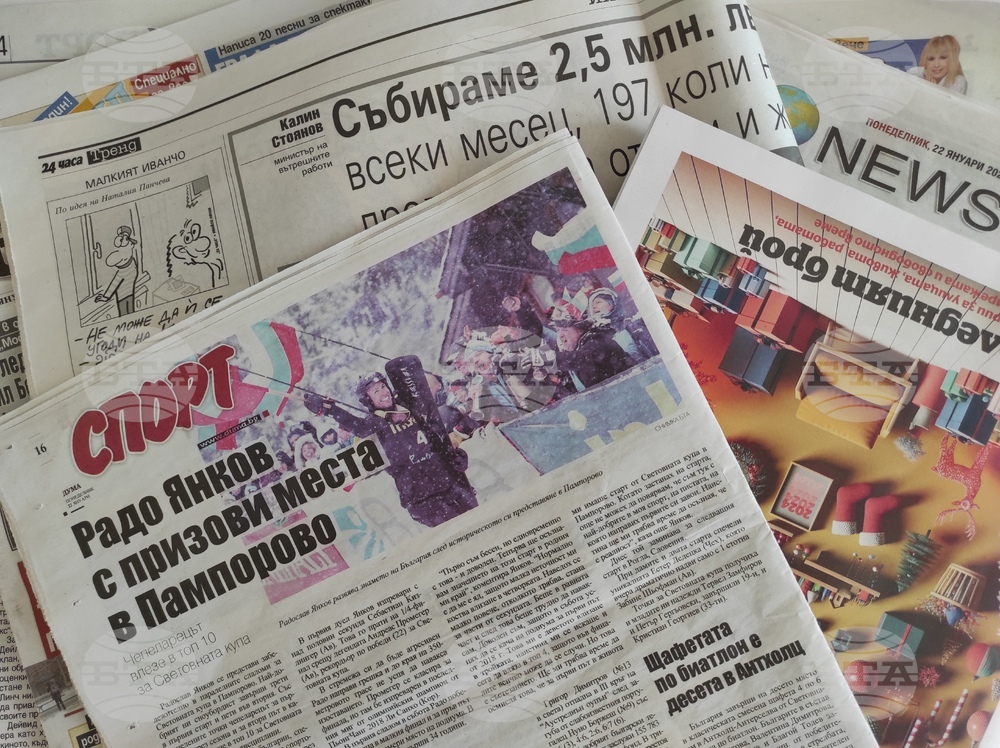
The topic of early snap elections dominates Wednesday's news media.
POLITICS
24 Chasa's front-page story is about the upcoming snap parliamentary elections. The daily writes that March 22 or 29 is the most likely date for the vote. The political forces seem to agree on these two dates. Some of them assume that there will be another extraordinary vote for MPs in 2026, but it is unclear whether the parties will wait until the regular presidential vote to merge it with theirs. Also in the realm of predictions is President Rumen Radev's intention to let Bulgarians rest peacefully between Christmas and New Year's Eve. The name of the caretaker prime minister will also be clear in the first days of 2026. Therefore, perhaps on January 5, 2026, when the banks open and the State starts working, one of the 10 possible persons according to the Constitution will be invited to take over the government until the elections in March. According to a poll by the daily, most of the ten will refuse, and two of the most likely candidates have either already distanced themselves from their parent parties, or Radev does not trust their political forces. The election campaign is set to begin with a series of changes to the Election Code, the daily notes.
Trud reports on its front page that the upcoming parliamentary elections will use the voting machines that had been used in the previous ones. This is because a year or more is needed for the current voting machines to be replaced and a lack of electronic scanning and counting equipment. According to Trud, the current machines have an expired warranty which makes maintenance costly and sufficient storage space for the machines has not yet been provided. The article goes on to lay out the positions of the different political parties regarding machine voting. Those in favour include MRF-New Beginning, who called the current machines "Madurovki" after the Venezuelan President who has been accused of election irregularities, Vazrazhdane, who want guarantees that only the ballots printed by the machines will be counted and that voter rolls across the country will be audited, the Continue the Change - Democratic Bulgaria (CC-DB) coalition, and President Rumen Radev himself. Those against electronic voting are GERB-UDF who are sceptical about their effectiveness. Trud quotes GERB Deputy Floor Leader Denitsa Satcheva that work on amending the Election Code will continue in January. The positions of other parties regarding this topic have not been noted in the article.
24 Chasa has an analysis on the upcoming election campaign by Adrian Nikolov from the Institute of Market Economics. According to him, the main topics on which the formations will focus their campaign are taxes, fiscal policy, and the overall vision on the country’s economic development. There has been an evolution in the key topics in the public debate, which have been changing quite fast in the last years mostly because of the unstable environment. At the start of the century, the division line was the healthcare policy and anti-pandemic measures. The war in Ukraine and the eurozone entry debate brought the topic of pro-EU or pro-Russia to the forefront. All these topics are now in the background, having given way to economic policy and incomes, Nikolov argues.
Trud interviewed Prof Mihail Konstantinov, Director of Electoral Analysis and Forecasting at Gallup International Balkan, about the resignation of the Zhelyazkov cabinet, possible changes to the Election Code and reformatting of the political landscape. When asked about the resignation of the Zhelyazkov cabinet last week and who benefitted from it, Konstantinov stated that GERB-UDF are pleased that a heavy burden had been lifted from their shoulders. Meanwhile, their allies from BSP-United Left and There Is Such a People (TISP) were dismayed while MRF-New Beginning seemed unconcerned. According to him, much now depends on President Radev, who is in zugzwang, a chess term referring to a situation where there are no useful moves available. The problem for him is how and when he will jump into the political quagmire with not much time left to decide. Konstantinov also forecast that discontent and anger are likely to arise from the turmoil surrounding the introduction of the euro which is difficult with a caretaker government. When asked about the proposed changes to the Election Code, he said that voting machines should be scrapped once and for all, as they have been in Germany, the Netherlands, Ireland and many other countries. However, it should be noted that machines like the ones in Bulgaria are still used for voting in Brussels and the surrounding villages.
On Bulgarian National Television's morning show, Yes, Bulgaria leader Ivaylo Mirchev commented that for early snap elections to be fair, there must be 100% machine voting. "The hard part is yet to come. The commitment to the people who were in the square is enormous. And we have to do our job," he said. Mirchev called for the removal of security for MRF-New Beginning leader Delyan Peevski and all members of Parliament. Yes, Bulgaria, which is part of the Continue the Change - Democratic Bulgaria parliamentary group, proposes that no MP should enjoy privileges. Peevski has more security than the President and the Prime Minister, Mirchev argued. GERB leader Boyko Borissov and Peevski run the country, as well as the elections. Machine voting will make fair elections possible, Mirchev argued.
On bTV's morning show, the leader of Democrats for Strong Bulgaria (member of the Democratic Bulgaria coalition), Atanas Atanassov, said that elections are coming, because the 51st National Assembly, with a 5% approval rating from the public, cannot possibly form a majority that can govern. "Five years of back and forth, stalling. It is high time this ended. It is up to the people to push politicians to make a change. There is a risk that the status quo will regroup, there must be no turning back," Atanassov commented. According to him, civic pressure must be exerted on the status quo in Parliament in order to change the Election Code and introduce machine voting fully. He pointed out that Continue the Change - Democratic Bulgaria has prepared bills on the subject, which will be submitted to the National Assembly. "Without fair elections, what has happened so far will happen again. As the opposition force that organized these protests, we listened to the people. If the status quo persists and does not allow for a change in the rules, then civic energy and pressure will be needed at the time of voting. We need to have a lot of observers on the ground," Atanassov said. In his words, there are two serious problems in Bulgaria - corruption and the Kremlin.
On Bulgarian National Television's morning show, MP Tsoncho Ganev of Vazrazhdane said that his party will respect the opinion of potential voters for President Radev's political project if he runs for election with a political force, because those who would vote for Radev and his party see a potential ally in Vazrazhdane. Vazrazhdane will never govern with Borissov and Peevski, said Ganev. He stressed that Bulgaria is going to elections because those who resigned said they would not form a coalition government. From now on, it is important for Ganev how the elections will be held and under what system. Vazrazhdane is against the extension of the 2025 State Budget Act to 2026, because this year's budget was made using false data; the Fiscal Council says so, Ganev also said.
On Bulgarian National Television’s morning programme, the topic of early elections was discussed by sociologist Pavel Valchev from the Alpha Research polling agency and Svetlin Tachev from the Myara sociological agency. Valchev commented that there is a deepening institutional crisis of public trust in political leaders and shifts in electoral attitudes. There is also a convergence of the positions of the two leading parties, GERB and Continue the Change-Democratic Bulgaria, as well as a very serious decline in electoral trust in the other government partners. He added that there is widespread support for the protests, with 59% of people in favour and only 16% against. According to him, the civic energy accumulated during the protests is reflected in a greater desire to vote with an extra 300,000 to 500,000 people expressing their interest in and intention to vote in the upcoming elections, which would drastically change the turnout, legitimacy and electoral landscape. Svetlin Tachev stated that the current Parliament will be unable to produce a new cabinet and that all parties will now attempt to channel the energy of the protests into electoral gains. According to him, the protests were not entirely unexpected, and the budget was merely a pretext. This discontent was building up from below because the government brought it on itself by committing a series of mistakes that caused it to lose touch with the processes and public concerns.
On Nova TV's morning show, political experts Tatyana Bouroudzhieva and Slavi Vassilev commented on how a potential political project of President Rumen Radev could reshuffle the cards on the political scene. According to Bouroudzhieva, elections always change something; now Vazrazhdane and CC-DB have regained their previous strong positions. There is fragmentation among the political formations, so before the 52nd National Assembly is formed, it is impossible to say who will govern with whom, but the next government will again be a coalition, the expert believes. There is no long-term consensus and no entity that embodies change for the majority of the people, she added. Vassilev believes that there are still no clear indications that the President is ready to launch his own political project. "For me, any moment from now on is a good time to create a presidential party. The longer he waits, the more expectations for real change will diminish. Otherwise, the menu will be the same in the elections. Only a completely new political entity can deal completely new cards and shake up the game," Vassilev argued.
***
Duma reports on its front page that the Executive Bureau of the Bulgarian Socialist Party (BSP) has resigned. The official reason is “collective responsibility with the knowledge that in this moment of importance for the State and the party, the most important thing is to calm the situation down and lead the party through the forthcoming challenges.” Atanas Zafirov will remain head of the BSP National Council until a new operational leadership is elected during the plenum of the National Council, scheduled for January 10.
Bulgarian National Radio features an interview with Stefan Georgiev, a member of the youth association of the Bulgarian Socialist Party (BSP), regarding the resignation of the entire BSP Executive Bureau. Georgiev stated that there might be regrouping and finger pointing at Zafirov as solely responsible, but the entire leadership must bear responsibility, because ultimately all the actions taken by the BSP in this coalition are decisions made by this leadership and this national council. Georgiev added that an emergency party congress is unwise currently, with the upcoming parliamentary elections. He finished the interview by saying that things cannot continue as before, otherwise, new voters will have to be sought. If nothing changes, the BSP will become a non-parliamentary fringe movement.
***
24 Chasa presents the seven candidates for European prosecutors from Bulgaria. Each of the potential prosecutors at the European Public Prosecutor’s Office is presented with a short biography. The final decision is taken by the Council of the EU, the daily specifies.
***
Trud also features an interview with Bogdan Milchev, Chair of the Management Board of the Road Safety Institute. In the interview, Milchev states that for all the actions that the government has undertaken in the last few years to reduce road fatalities, it has amounted to nothing. He specifically singles out the Road Safety State Agency as ineffectual and corrupt and goes on to say that this year, the executive and legislative branches presented three lies. According to him, the first was the lie surrounding the so-called "average speed". Officials had previously said that there were tens of thousands of offenders who regularly exceeded the speed limit but since the implementation of the law, not a single fine for speeding has been imposed. The second lie is that the motor vehicle administration will be closed but as of the time of this writing, this is not the case. The third lie is that the changes to the Road Traffic Act would be so effective that deaths and injuries would be reduced by 20% by the end of the year. However, there has been no such effect and in fact, there has been a slight increase in the last three months compared to the same period in 2024.
ECONOMY
Telegraph’s front-page article is about the BGN-EUR exchange ahead of Bulgaria’s entry in the eurozone. Some Bulgarians are taking advantage of the changeover to trade in BGN banknotes online. A Facebook group for numismatics has a user offering a brand-new 100 BGN issued in 2003 with an interesting serial number (AA0000398) for 400 BGN, including through an exchange for silver coins. However, most other users in the group regard this offer as a joke, because the banknote is still in circulation and is available in abundance. “Perhaps I should start selling my salary, too,” a user jokes.
The topic of the eurozone was discussed on bTV’s morning programme. Former deputy prime minister Nikolay Vassilev stated that countries such as Germany, France and Italy, which have been proud of their national currencies for hundreds of years, are now proud to be part of the eurozone. Vassilev recalled that he was the first to start negotiations for Bulgaria's accession to the eurozone as part of Saxe-Coburg-Gotha's government. He also recalled another national battle: to have the euro banknotes inscribed in Bulgarian, as well as Latin and Greek. He commented that the governments of Ivan Kostov and Simeon Saxe-Coburg-Gotha had "brought us to the border of the EU". However, the eurozone was not a priority for the "Triple Coalition" (NDSV, BSP and MRF), and it was not until Boyko Borissov's third term that Bulgaria joined the eurozone. Vassilev believes that a lack of adequate information from governments has led to scepticism in society towards the single currency. He insisted that people would quickly become accustomed to the new currency and expect investment to grow once Bulgaria officially joins the eurozone.
The eurozone was also a topic of discussion on Nova TV’s morning show, with economists Prof. Rumen Gechev and Dimitar Sabev talking about public finance risks and inflation. Regarding Bulgaria’s readiness to join the eurozone, Sabev said that the country has come this far at great expense, but this is a very broad issue. He believes that this is the right direction given everything that is happening in Bulgaria and around the world. Gechev was more skeptical, stating that the country is entering the eurozone unprepared, with inflation already exceeding 5%, when it should be 2.7%. Furthermore, the budget deficit for 2025 is not 3%, but over 5%. All these factors combined will have tragic consequences for the country, he argued.
***
Segabg.com presents the opinion of maritime experts on the situation with the Gambian-flagged oil tanker Kairos, owned by a Chinese company, which ran aground off the Black Sea town of Ahtopol on December 5. According to customary maritime practice and law, Bulgaria cannot sue or take other action against anyone from Turkiye because of the tanker, which was abandoned in Bulgarian territorial waters by a tugboat belonging to a private Turkish company. There is no way that the Turkish state can be held responsible for anything. The relationship is between private entities (the tugboat company and the ship owner), so there is no way for Bulgaria to interfere in their relations. For now, Bulgaria cannot take action against anyone else except the ship. Since Tuesday, she has been detained by Bulgarian authorities due to her inability to sail independently. She will be released if the owner pays Bulgaria the costs of towing her from Ahtopol to a safe place in Burgas Bay - the government allocated BGN 1.2 to that end. Next, the owner must take her back. Bulgaria can do nothing else at this stage except carry out inspections, because according to maritime law, the ship is not considered abandoned; she has a crew (three people remained on board). If the owner does not pay Bulgaria's expenses, then the State can seek them through legal action. It can claim and acquire the tanker. Such cases take years to resolve.
***
Mediapool.bg writes that among the many problems facing Europe, the housing crisis is one of the most serious. European leaders have already had to realize that the problem is not only economic and social, but is also becoming political. In Bulgaria, the housing crisis is still bubbling under the radar of politicians, but it is safe to predict that the moment when the issue will "explode" in Bulgaria is not far off. Banks, through housing loans, are inflating a dangerous "bubble" in the economy that is inevitably linked to prices. A whole year has passed since the Bulgarian National Bank (BNB) imposed measures on paper to prevent the mortgage market from overheating. The result is a 27.8% annual increase in housing loans as of October 2025. Next year, due to the release of bank reserves, more than EUR 8 billion is expected to flood into the system, and it is not difficult to predict how this will affect the housing market, especially property prices. The political issue in expensive housing lies in the increase in inequality and polarization, which breed mistrust in society and fuel populist sentiments, which boosts the ratings of extremist parties. That feeds anti-immigrant rhetoric and ultimately puts the European economic and social model itself to the test, and with it, democracy.
WORLD
24 Chasa has an interview with Lyubomir Kyuchukov, Director of the Institute for Economics and International Relations, about the peace negotiations in Ukraine. In his words, a world of the powerful is being constructed - the Washington-Beijing-Moscow triangle. There is no longer talk of a just peace, but of a dignified peace - that is, no humiliating conditions for Kyiv's capitulation, he notes. European leaders support Ukraine's aspiration for EU membership, but not the country’s actual accession. Territories and security guarantees remain the most problematic issues. According to Kyuchukov, the position of Bulgaria, Malta, Italy, and Belgium on Russian assets is reasonable; it reflects what everyone agrees on but avoids commenting on - who will pay when the money has to be returned to Russia.
Trud has an interview about the war in Ukraine with Bulgarian military expert, journalist and publicist Vassil Danov. According to him, Russian President Vladimir Putin is at a weaker position already, because he has remained without allies and the others have united against him. He acts aggressively to spook the potential adversary; his threats to Europe - that he has no problem going to war with Europe is Europe so wishes – are preventive threats, because the aggressor currently lacks resources for such a war. In Danov’s words, it is nearly impossible to reach a ceasefire in the current situation; there could be light at the end of the tunnel soon, but at the moment things are quite gloomy.
An analysis by Ivaylo Yaydzhiev on Capital.bg reads that Bulgaria's position on frozen Russian assets puts the country outside the main European consensus. By joining Malta, Italy, and Belgium's letter to the European Commission, Bulgaria is practically questioning its support for the use of frozen assets. This Bulgarian position is surprising. Not only does it take Sofia out of the main European consensus, but it is also simply inappropriate for Bulgaria, from which no one is asking for anything to be paid. "At the same time, we should not be under any illusions about the consequences for Europe and Bulgaria if financial support for Ukraine is stopped. The Prime Minister, even in resignation, still has time to reconsider his position for the meeting of European leaders starting on Thursday, from which decisions are expected," the analysis reads. The real choice the Prime Minister has to make is whether Bulgaria will support a plan that has extremely limited legal and financial consequences, or will take a position that effectively leaves Ukraine without any financial support.
/DS/
news.modal.header
news.modal.text