BTA interview
![EU Law Helps Protect Water and Biodiversity, Says Bulgarian Expert]()
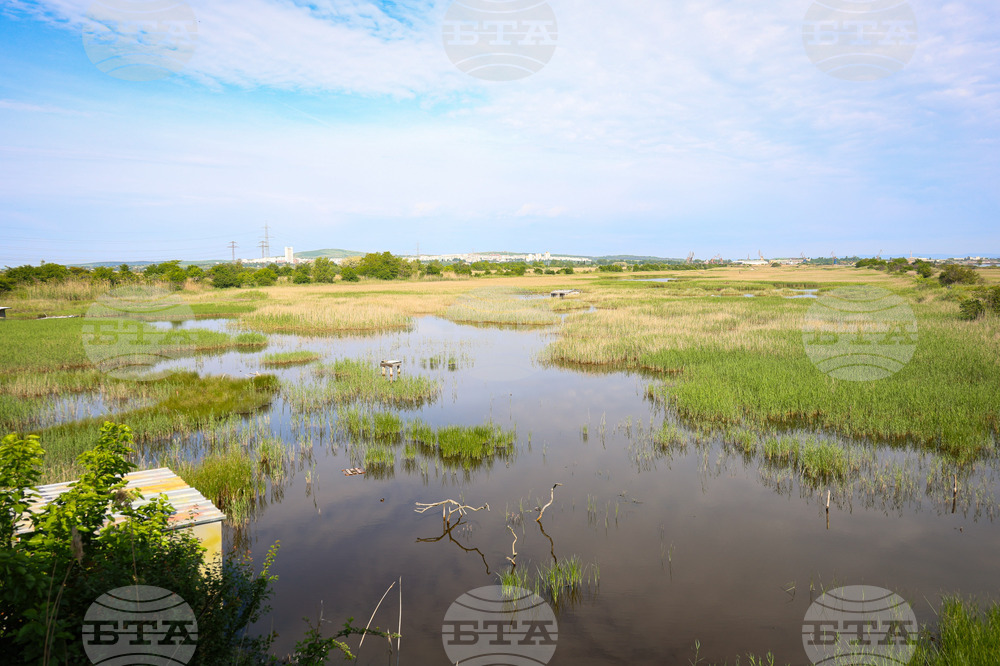
![EU Law Helps Protect Water and Biodiversity, Says Bulgarian Expert]() The Poda Nature Conservation Centre near the Black Sea city of Burgas (BTA Photo/Hristo Stefanov)
The Poda Nature Conservation Centre near the Black Sea city of Burgas (BTA Photo/Hristo Stefanov)
site.btaEU Law Helps Protect Water and Biodiversity, Says Bulgarian Expert
European legislation helps Bulgaria achieve a clean environment, protect natural resources and preserve biodiversity, Irina Mateeva, European policy officer at the Bulgarian Society for the Protection of Birds (BSPB), told BTA, commenting on the implementation of the EU Water Framework Directive. The interview was conducted in connection with a BTA project on applying European legislation in Bulgaria.
According to Mateeva, environmental directives provide a stable framework to ensure the protection of Europe’s natural wealth. She emphasized that the right to a clean and healthy environment is enshrined in the Bulgarian Constitution. EU legislation helps achieve this by setting high-level frameworks and standards. The expert noted that it is necessary only to follow the measures outlined in the directives in a reasonable and motivated manner.
What the Water Framework Directive entails
The EU Water Framework Directive is the main legal instrument governing the protection and management of water in the European Union, according to the European Commission’s website.
It was adopted in 2000 as Directive 2000/60/EC by the European Parliament and the Council of the EU and provides the general legal framework through which member states are to protect, restore and use all surface and groundwater resources sustainably. Implementation is coordinated by the European Commission, with actions carried out at national level, aiming to achieve good water status for the benefit of citizens and the environment.
Each member state develops river basin management plans and programmes of measures to improve water quality, restore river sections, limit pollution and use resources sustainably. Measures include building and upgrading wastewater treatment plants, reducing agricultural pollution, restoring wetlands, and monitoring groundwater.
Implementation of the directive in Bulgaria began with the country’s EU accession in 2007, Mateeva explained. Four river basins were defined, for which corresponding measures are developed and implemented. These are the Danube basin, covering all rivers flowing into the Danube and associated wetlands; the Black Sea basin, including rivers flowing into the Black Sea and related wetlands; the Eastern Aegean basin, with the Maritsa, Tundzha and Arda catchments; and the Western Aegean basin, covering the Mesta and Struma catchments.
The directive responds to growing pressures on EU waters due to rising demand for sufficient quantities of water that must also be of good quality, Mateeva said. The concept of “good status” includes protection of all water types – surface and groundwater – and restoration of ecosystems surrounding these water bodies.
BSPB and the mission to protect water and birds
While the directives are implemented by state institutions, BSPB focuses on biodiversity conservation in wetlands, which makes the Water Framework Directive relevant to its work.
“Our contribution to the directive is indirect, but our projects are directly linked to preserving water conditions. For example, we manage the Poda protected area near Burgas. We maintain water ecosystems, clear reeds to provide suitable habitats for birds, and maintain vegetation that naturally purifies water,” Mateeva explained.
Protecting wetlands is crucial, and BSPB urges this issue to be central in national policies. Examples include the Kalimok-Brashlen and Persin wetlands, and parts of the Northern Black Sea coast.
“We monitor pollutants in water and follow BirdLife International’s initiative to phase out the use of lead shot in hunting. Lead shot contaminates water bodies, so the EU banned its use in wetlands. This measure is important for water quality,” she said.
Bulgaria is home to around 420 bird species, over 100 of which are water-dependent, Mateeva reported. These include ducks, swans, pelicans (including Dalmatian pelicans), herons, storks, terns, gulls, a large group of waders, and the kingfisher. Birds of prey such as the white-tailed eagle and osprey rely heavily on aquatic ecosystems for food.
Applying EU law comprehensively, not selectively
Mateeva noted that EU legislation is often not applied as intended, leading to distortion or partial implementation at national level. “Problems arise that are blamed on ‘European law’, which is incorrect, because the directives are the same for all – the question is how states apply them,” she said.
“We need to be more critical of our own implementation because water is a key resource – for nature and people. Much remains to be done regarding water cleanliness and reducing pollution from various sources,” she added.
She stressed the importance of riparian vegetation, which reduces erosion, stabilises banks, and regulates water flow. “Often, when cleaning riverbeds, trees are cut first, which is absolutely wrong. Cleaning should mean removing silt and fallen branches, not destroying the banks,” she said. She also called for more nature-friendly measures to retain water, such as restoring old meanders, allowing rivers to flood naturally to slow water flow, and maintaining vegetation along banks. These practices exist as good examples and should be applied in practice, Mateeva urged.
/VE/
news.modal.header
news.modal.text