site.btaUPDATED PM Radev Says He Will Oppose EU's 21st Sanctions Package Against Russia
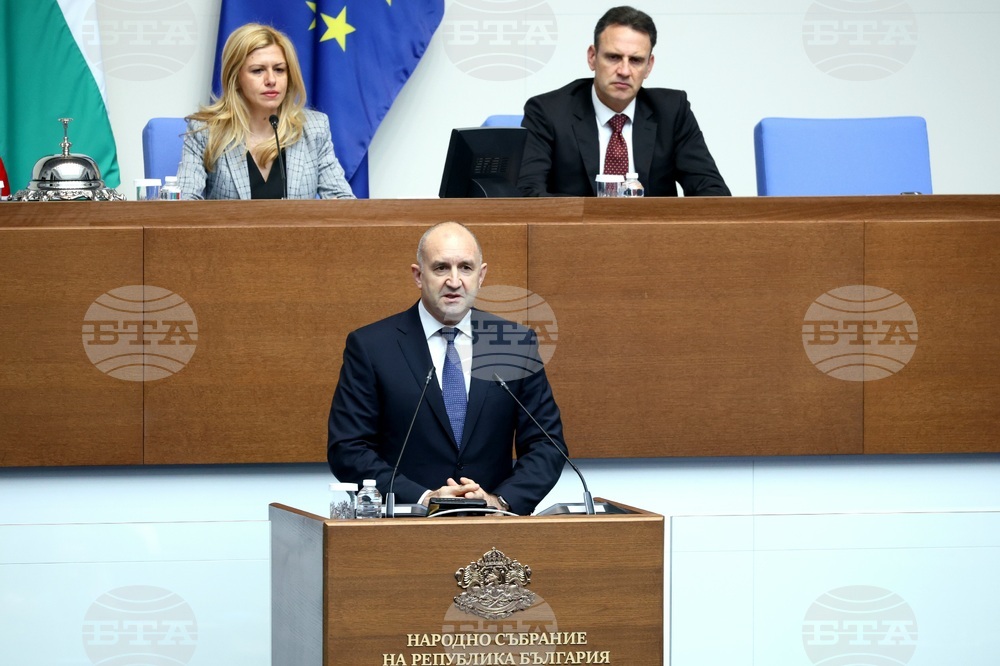
Bulgarian Prime Minister Rumen Radev said on Friday that he would formally oppose the European Union's proposed 21st package of sanctions against Russia, arguing that his decision was driven by Bulgaria's national interest. Responding to a question from Yordan Ivanov of the Democratic Bulgaria parliamentary group on whether he was prepared to block the next round of EU sanctions, Radev said he would do so without hesitation.
He said that it was not merely a matter of being prepared to lodge reservations over the 21st sanctions package, but that he would indeed do so, stressing that his responsibility was to protect and uphold Bulgaria's national interest. Asked about the possibility of sanctions against Russian Patriarch Kirill, Radev said he was not interested in the individual himself, but noted that Kirill was the head of the Russian Orthodox Church.
Commenting on his reservations regarding Vagit Alekperov, Radev said the arrival of Litasco in Bulgaria on its own initiative immediately after he announced those reservations spoke for itself. He argued that the objective was to ensure the stable and reliable operation of the Burgas oil refinery. According to the PM, employees responsible for operating and maintaining the refinery had warned that if the current sanctions regime, including restrictions imposed through Litasco, remained in place, the refinery risked being forced to halt operations.
Radev added that he would make every effort to avoid arbitration proceedings related to the issue.
At end-June, Deputy Prime Minister and Minister of Economy, Investment and Industry Alexander Poulev said at a briefing that the Bulgarian government has taken the first step towards reaching an out-of-court settlement with Litasco – a member of the Lukoil Group, is a shareholder in Lukoil Neftochim Burgas and Lukoil Bulgaria. The briefing followed a meeting between Prime Minister Rumen Radev, Deputy Prime Minister and Finance Minister Galab Donev, Economy Minister Alexander Poulev, and representatives of Litasco and Lukoil. Poulev said the meeting resulted in an agreement for Litasco to immediately lift its restriction preventing Lukoil Neftochim Burgas from trading crude oil supplied by companies registered in Switzerland.
On Friday, Radev said that representatives of Litasco had told the Bulgarian government they had not maintained regular dialogue with the previous management of Lukoil Bulgaria, particularly with its then special commercial administrator Rumen Spetsov.
Radev explained that in November 2025, following Litasco's claim over a substantial unpaid loan to Lukoil Bulgaria, a court attachment had been imposed that effectively prevented Lukoil Neftochim Burgas from purchasing crude oil from companies registered in Switzerland. Since many of the world's major oil trading companies are based there, he said, the measure had significantly narrowed the refinery's options for sourcing crude. According to him, after changes in the refinery's management and the appointment of a new special commercial administrator, it became clear that the facility had faced serious logistical challenges in securing crude oil supplies. As a result, it had been forced to process heavier grades of crude, creating significant operational difficulties.
He explained that the refinery had originally been configured to process Urals crude, which was no longer available, and therefore had to source different grades of oil that could be blended to achieve similar characteristics. With supply options severely limited, this had often proved impossible, forcing the refinery to use heavier crude instead. Radev said this had led to the rapid clogging and accelerated wear of refinery installations, increased pressure on personnel who had to continually reconfigure the processing units, longer tanker routes, higher transportation costs, and ultimately higher production costs.
He said the government had reached an agreement under which Litasco would lift the attachment, allowing Lukoil Neftochim Burgas to purchase crude oil without such restrictions while remaining fully compliant with international sanctions. As a result, the refinery would be able to source crude with the required specifications more easily, while transportation would become more efficient by eliminating some of the longer delivery routes, Radev added.
/PP/
news.modal.header
news.modal.text