site.btaEuropean Parliament Debates "Danger of Normalizing Relations with Russia", Placing Focus on Culture and Sports
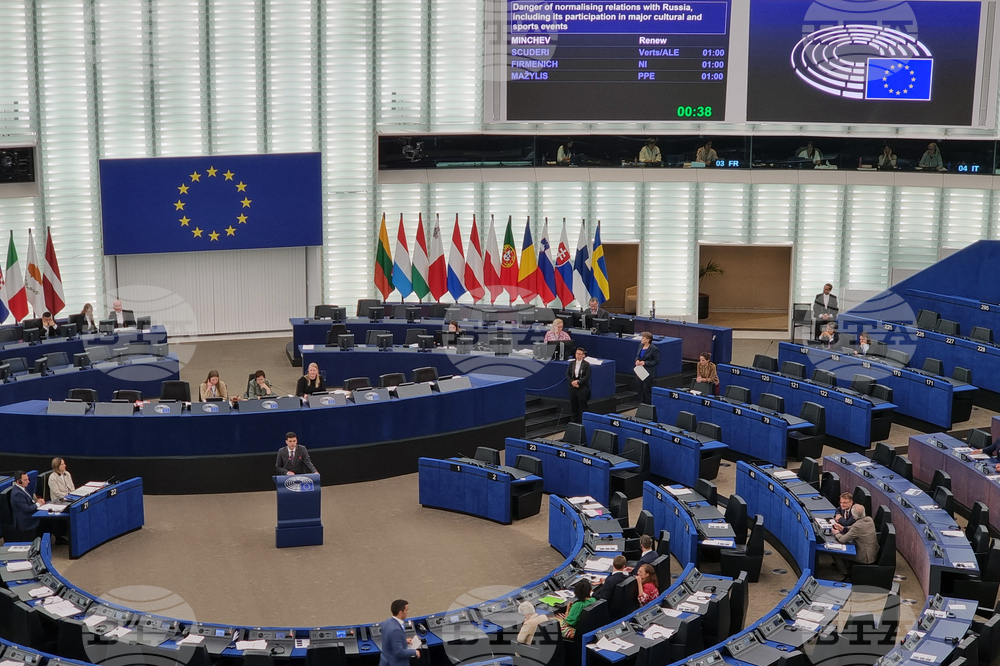
During its plenary session in Strasbourg on April 29, the European Parliament (EP) debated the "danger of normalizing relations with Russia", including with regard to that country's participation in major cultural and sporting events.
Representatives of the larger political groups in the EP, including the centre-right European People's Party, the Progressive Alliance of Socialists and Democrats, the liberal Renew Europe, the Greens, and the European Conservatives and Reformists, opposed restoring cultural and sporting ties with Russia. In their view, such a move would legitimize the Russian authorities while they continue their war against Ukraine.
Russian President Vladimir Putin uses athletes for his political purposes, said Austrian MEP Hannes Heide from the Socialists and Democrats group, stressing that it is unacceptable to allow this.
Representatives of The Left, the right-wing Patriots for Europe, and Europe of Sovereign Nations, as well as some non-attached MEPs, argued against what they described as the politicization of culture and sport, which "should build bridges". Some speakers questioned why similar measures were not being taken against the United States and Israel over attacks on Iran, while others challenged the very premise of the debate.
European Culture and Sport Commissioner Glenn Micallef emphasized that, in addition to waging a brutal war against Ukraine, Russia is conducting a hybrid war that includes culture and sport. "We face two possible choices: to normalize the aggressor and become its accomplices, or not to tolerate it," Micallef summarized.
He specifically criticized the decision to allow Russian and Belarusian athletes to compete under their national flags at the 2026 Winter Paralympic Games in Milan-Cortina and the decision to invite Russia back to the Venice Biennale. Micallef warned that the EU will withdraw its funding from this major cultural event if the decision is not reversed.
Two Bulgarian MEPs took part in the debate: Petar Volgin from Patriots for Europe/Vazrazhdane and Nikola Minchev from Renew Europe/CC–DB.
In his speech, Volgin stated that only "individuals fanaticized to the point of absurdity" would claim that normalizing relations with a superpower is dangerous. He also drew historical parallels, noting that whereas in the past the Nazis expelled talent because of Jewish origin, today concerts are being cancelled solely due to the participation of Russian artists.
Volgin also slammed the European Union's cultural policy. "At the same time [while Russian cultural figures are being banned], EU taxpayers' money is funding performances with no artistic value," he said.
Taking the opposing view, Nikola Minchev asked why Russia should be "rewarded" while it continues to kill civilians and destroy sports infrastructure in Ukraine. In his view, normalizing relations at this moment would amount to legitimizing Russian actions.
Minchev stressed that in the lives of artists and athletes in Kyiv and across Ukraine, "there is nothing normal". "There must be no concessions to violence, and there can be no return to normal relations" with Russia, he said firmly.
At the Winter Olympic Games in Milan-Cortina in February 2026, several Russian and Belarusian athletes competed in various disciplines under a neutral flag. At the Winter Paralympic Games the following month, Russia participated under its own flag—raised at an international sporting event for the first time since the start of its full-scale invasion of Ukraine in February 2022.
On April 30, the European Parliament is expected to vote on a resolution to ensure accountability and justice in relation to the ongoing Russian attacks against Ukrainian civilians. This would allow the EU to join the convention establishing an international claims commission concerning Russia's war against Ukraine.
/VE/
news.modal.header
news.modal.text