site.btaBulgarian Craftsman Shares How Glass Christmas Ornaments Are Made
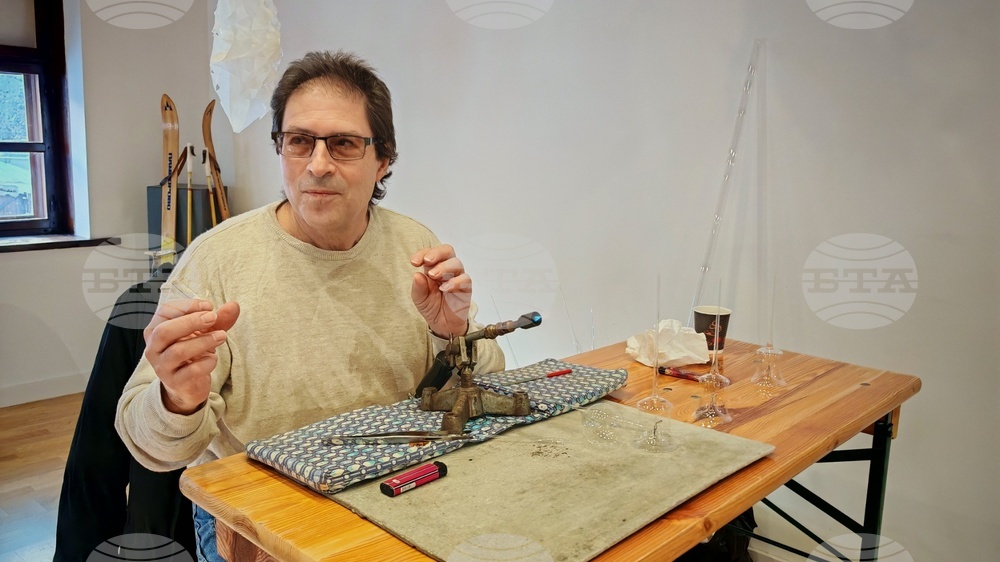
Ivan Stanev from Plovdiv (South Central Bulgaria), the only master of blown glass in the National Crafts Chamber, demonstrates how glass Christmas ornaments are made at the Etar Regional Ethnographic Open Air Museum. The delicate decorations are coming to Etar for the first time.
The Christmas spirit at the museum can be felt everywhere - in the workshops, in the market, in the shouts of the carolers, in the generosity of the craftspersons who welcome them with gifts, in the smell of freshly baked bread, in the whiteness of the strings of popcorn, in the new Museum Centre where a Christmas tree decorated with thirty-year-old glass ornaments shines. Next to the Christmas tree is the creator of the fragile elegance, Ivan Stanev. On December 26 and 27, he shows visitors how glass can be transformed into a bell, a ball, or even a small mouse in a matter of seconds.
Visitors describe the demonstration as magic. Everything that does starts with a simple glass tube made of soft sodium glass. "We heat this glass on a gas burner," says Stanev, without taking his eyes off his work table. "At 800 degrees, the glass begins to soften, and when it softens, we pull out small pieces from the tube, which are called single or double spikes. I use them to make these beautiful Christmas ornaments. Actually, only the ball is made from a single spike, which is closed on one side. All other shapes are made from double spikes," explains the craftsman.
Stanev's fingers keep turning the small tube as he stretches it into a straight line. "I practiced for eight hours a day for six months to get a perfectly straight line," he says. "We only have one try. This is not clay that we can knead again; we have 10 seconds to shape a piece. We twist and pull at the same time to distribute it evenly. The glass we work with is 1.5 millimetres thick. When we blow (this glass has a coefficient of expansion three times that of air), a tube that is 20 mm in diameter becomes six cm in diameter, so the wall of our mold is much less than a millimeter thick," Stanev describes the process.
For 48 years, he has been watching the blue flame of the burner and knows it perfectly. Glass is a poor conductor of heat. It only softens where it is heated, and that is where it can be shaped. That is why he is so focused all the time, assessing when and where to move the glass tube to different parts of the flame.
Stanev is not a hereditary craftsman. Quite by chance, he ended up in a cooperative for people with disabilities, where he spent 12 years learning the basics of working with glass. The skill that today allows him to make the glass bell he is giving to the BTA correspondent in two minutes, took him 12 years of his life to acquire.
To the right of his workbench is another table with various brushes and paints. There, visitors can sit down and decorate the glass form created by Stanev. The craftsman is happy to share that, thanks to an initiative by Plovdiv Municipality, he also has students.
/DS/
news.modal.header
news.modal.text