site.btaAI-driven Growth Strategy Includes Competition, Education, and Flexible Security, Nobel Laureate Philippe Aghion Says
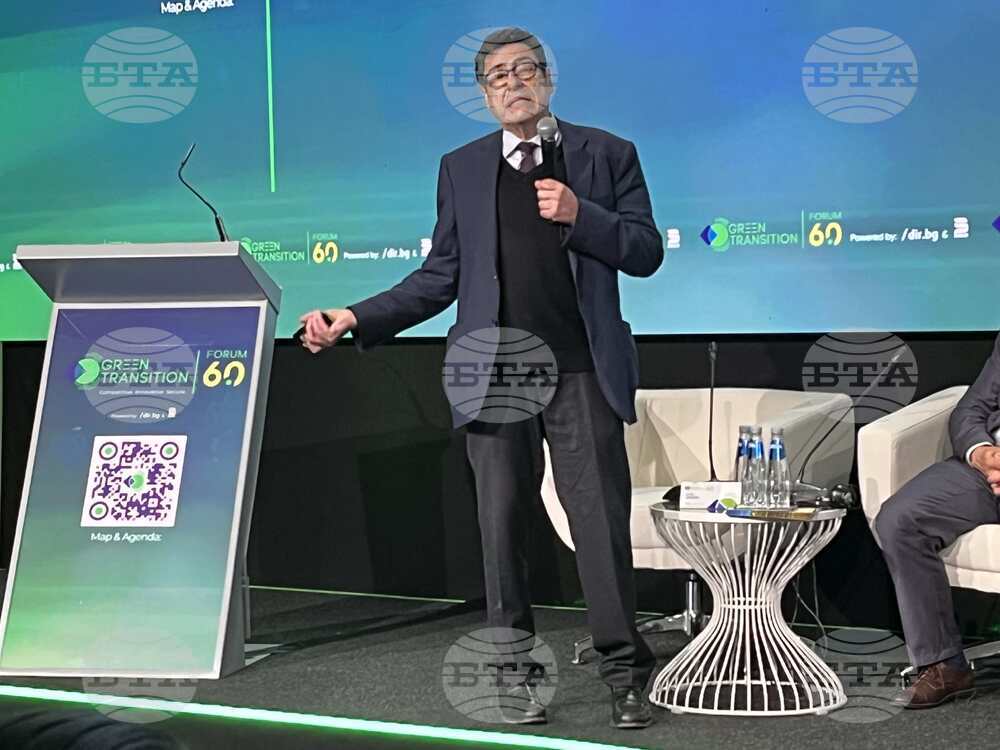
Creative destruction and artificial intelligence can lead to sustained and inclusive growth and prosperity, provided the right policies are implemented, said French economist Philippe Aghion, laureate of the 2025 Nobel Memorial Prize in Economic Sciences, professor at the College de France, INSEAD, and the London School of Economics, speaking on Wednesday at the Green Transition Forum 6.0, held at the Sofia Event Center. The June 1-5 forum is organized by internet platform Dir.bg, with BTA among the media partners.
Aghion said that the main pillars of the AI-driven growth strategy are competition, industrial policy, education, and flexible security. He added that Bulgaria has abundant resources, human capital and world-leading scientists who are extremely dedicated to their country.
Aghion received the Nobel Prize together with Joel Mokyr and Peter Howitt for developing a growth model through creative destruction, based on three main ideas.
The first is that long-term growth is driven by a cumulative process of innovation, in which each innovator builds on previous innovations. The second idea is that innovation is the result of entrepreneurial activity - entrepreneurs invest in research and development and in innovation because they know that this will give them a monopoly for a certain period of time. This, however, gives them an advantage until they are displaced by the next innovators. The third idea in the model is creative destruction.
Aghion pointed out that firms that are closer to the technological frontier in their sector respond to greater competition by implementing more innovations. Those that are far below the frontier, however, are discouraged by greater competition and implement fewer innovations, while the discouragement effect dominates at very high levels of competition, the professor said. He added that developed economies have more firms in the first category, meaning that growth is stimulated by competition.
The Nobel laureate said that Europe is stuck in mid-tech innovation, falling behind both the US and China, which have shifted their focus to the high-tech, breakthrough sector.
"To make breakthrough innovations, you need to be able to fail. In basic research, to be able to fail, you need long-term research funding, which we don't have. We don't have enough venture capital or institutional investors to allow startups or larger companies to fail," Aghion said. He pointed out that against this backdrop, Bulgaria is nonetheless dynamic and very likely to surpass France. What we would like is a model that combines the innovative side of the US with the social side of Europe, he added.
Education is another policy that can make us more innovative - it must be accessible to everyone, because that increases the likelihood of producing more scientists and innovators, the professor said.
When asked whether we should fear AI, Aghion said that it has great potential to sustain growth. AI automates tasks in the production of goods and services, which will lead to growth of 0.7 percentage points per year. What is more, AI stimulates the generation of ideas, but the downside is that the same thing could happen as with IT - a few companies could monopolize AI and discourage new firms, Aghion added.
/RY, VE/
news.modal.header
news.modal.text