site.btaSTEM Best Practices Take Centre Stage at Sofia Forum
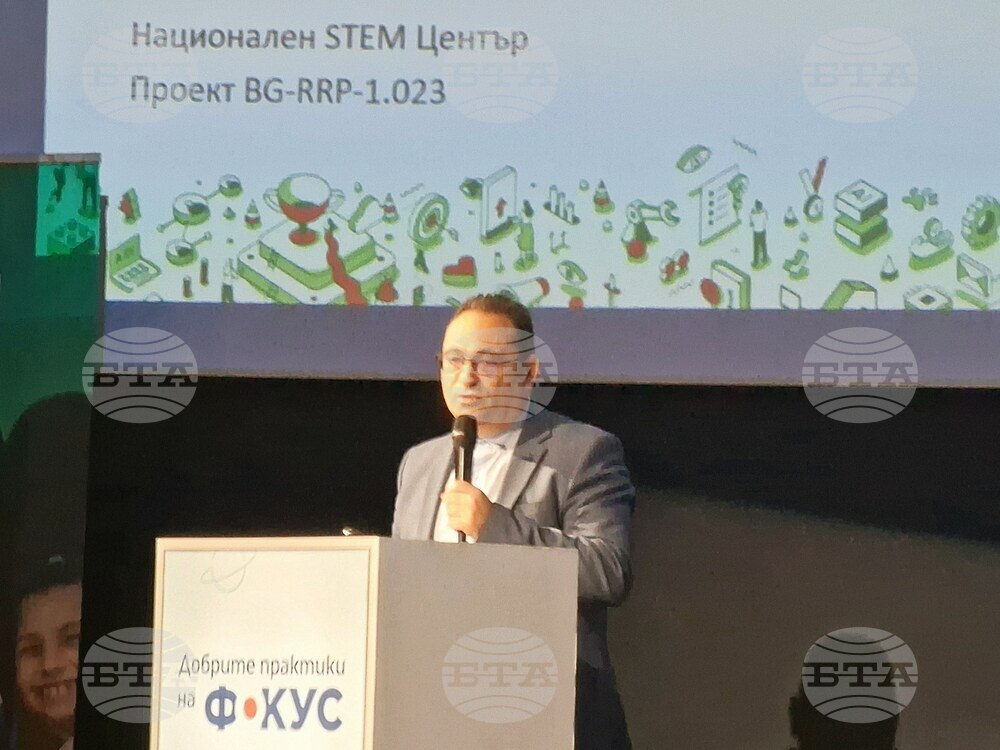
Bulgaria was invited by the EU STEM Coalition to present its STEM best practices, National STEM Centre Director Nayden Shivarov said on Saturday. He was speaking at the Best Practices in Focus forum in Sofia, which focuses on STEM education and artificial intelligence in the classroom.
“At first, the Ministry of Education and Science, under a national project, decided to open a competitive call for the construction of STEM centres in Bulgarian schools. After a selection process, around 250 schools were chosen and built their centres. Then the pandemic happened, so some of the centres were delayed. Based on the very successful implementation, a decision was made under the Recovery and Resilience Plan, worth more than BGN 500 million, to build school STEM centres in all State and municipal schools in Bulgaria. This is one of the Ministry’s largest projects under the Recovery and Resilience Plan. A small part of the large project also went to the construction of a national STEM centre and three regional STEM centres, which would both support school centres and train teachers,” Shivarov added.
“At first there were around 250 STEM centres, and more than 2,200 school STEM centres are now being built. The aim is equal access for all students to STEM education. Even in Germany, one of the most developed countries in Europe, there are STEM centres, something like our Bulgarian chitalishte community cultural centres, with one or two in every city. This is very inconvenient even logistically, because you know how difficult it is to organize a class visit to a given place. In our case, equal access is really provided, because every State or municipal school has such a STEM centre. Many of them have opened, and the rest will open by the end of June this year,” Shivarov said.
Shivarov said the main fields in which STEM centres work are Natural Sciences, Green Technologies and Sustainable Development, Robotics and Cyber-Physical Systems, Design and 3D Prototyping, and Mathematics and Informatics. He added that interest is strongest in Natural Sciences and Green Technologies, which fall within the same field.
“Our main goals in developing STEM in Bulgaria are integrating STEM fields into our everyday work, building confidence in trying new methods and techniques, using problem-based, project-oriented and research approaches, encouraging professional development, and creating a community of teachers aimed at sharing best practices,” Shivarov said.
Black Run map creator Martin Atanasov, a 12th-grade student, discussed problems in the Ministry of Education and Science system and the introduction of artificial intelligence in the classroom.
“Thinking about the problems of the education system, I realized there is not much we can do about them. They exist. And this system we are talking about cannot be changed or fixed with a magic wand, because in a system we very often look for the big solutions, the big reforms. When we talk about a system that needs change, the strongest change does not begin where we expect it to. It does not begin with a bill, it does not begin with a strategy. It begins from the system. From within. Not from outside, not from above. It begins from within, because the education system is built in a very complex way: curricula, regulations, requirements, assessments and all sorts of things,” Atanasov said.
“A system is nothing more than the people in it. The education system is not the strategies, the curricula, the requirements of the Ministry of Education and Science or anything else. The education system is a classroom with a teacher inside and 20 or so children, or more. These are 40 minutes that are repeated several times a day in hundreds of schools across the country, and these 40-minute lessons take place thousands of times a day from Monday to Friday. This is the real education system, as it is and as it should be,” Atanasov added.
Best practices are “super important, because when we talk about education in Bulgaria, the conversation too often begins and ends with the problems,” Atanasov said.
“For me, the question should be what can work despite this: despite the problems and despite the flaws of the education system, how we can produce people who go beyond the framework set for us. The education system sets a framework that sometimes seems too slow for its time, and it is very difficult to prepare students for a world that moves much faster than the time and the framework set by the system,” Atanasov explained.
Human Resource Development Centre Selection, Contracting and Reporting Directorate Director Monika Yanakieva thanked the organizers on behalf of the centre. “I very much want to thank our colleagues from Teach For Bulgaria and Prepodavame.bg for turning to us this year so that we could become official partners in this event. I am very glad, because I believe the Erasmus+ programme is the programme that reaches everyone and gives us the opportunity to truly examine best practices, both in Bulgaria and in Europe, and this provides a good example in our education system,” Yanakieva said.
Yanakieva presented the Human Resource Development Centre stand at the exhibition. She said visitors there can learn about eTwinning, which enables the exploration of best practices between schools and kindergartens.
/КT/

news.modal.header
news.modal.text