site.btaNew Centre for Cleantech and Biomass Resource Efficiency Opens at Agricultural University of Plovdiv
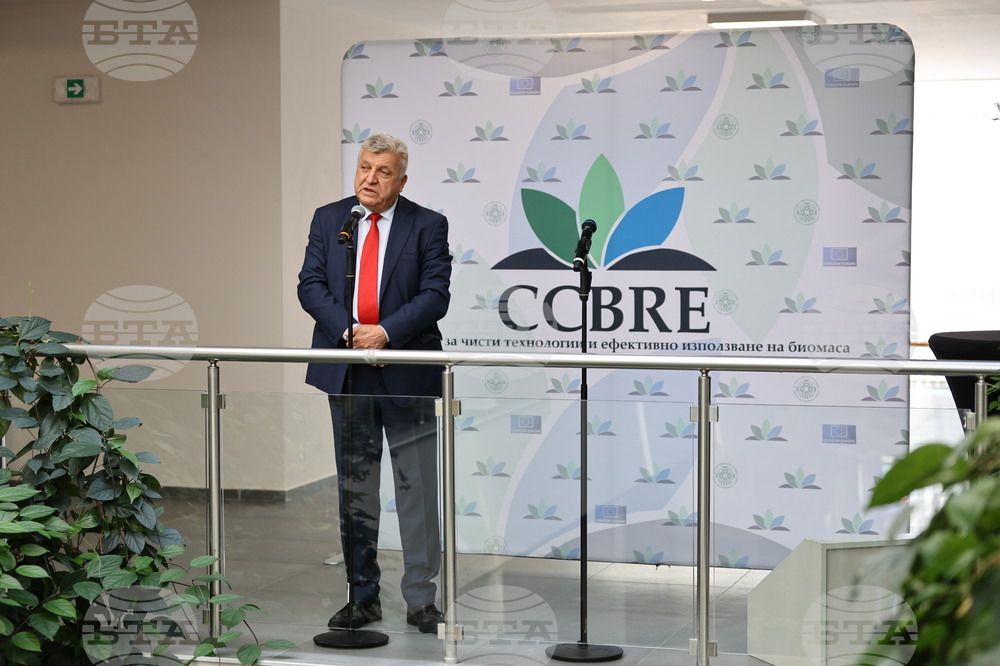
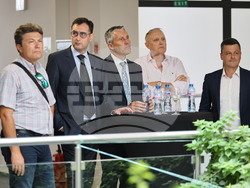
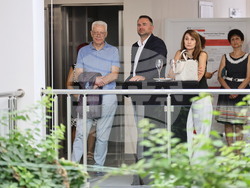
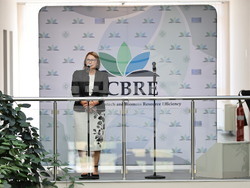
A Centre for Cleantech and Biomass Resource Efficiency (CCBRE) was officially opened at the Agricultural University of Plovdiv on Tuesday. The Centre focuses on developing technologies for converting biomass and waste into high-quality products and energy, reducing pollutants such as heavy metals and microplastics, and innovating nutrient recycling, particularly phosphorus recovery. A unique feature of the Centre is its integration of digital tools and AI for more precise analysis, process optimization, and impact assessment.
Attending the opening ceremony was Environment and Water Minister Manol Genov, who congratulated the team behind the CCBRE and expressed hope that its work would lead to tangible results in tackling environmental challenges, particularly the issue of microplastics. “We’re witnessing strong economic interests from major oil producers and processors, while we are trying to limit plastic use and its deposition. We have serious tasks ahead, and hopefully artificial intelligence will help separate microplastics from sludge,” Genov said.
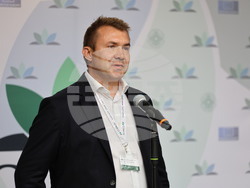
The event was opened by the University’s Rector, Prof. Boryana Ivanova, who noted that the opening of the Centre would not have been possible without the support of the Ministry of Education and funding from the European Research Executive Agency. “Of course, the funding would not have come without a compelling idea, transformed into a project proposal through the hard work and determination of many. Today’s achievement is the result of significant effort from numerous individuals and institutions. Much hard work has been done, but the most difficult and responsible tasks are still ahead,” Ivanova said.
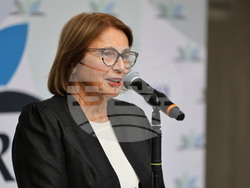
Plovdiv Regional Governor and former rector of the Agricultural University, Prof. Christina Yancheva, also addressed the event. She stressed that the project must succeed in order to demonstrate that the University is a hub for knowledge and innovation at the national, regional, and European levels. “Plovdiv Region is among the fastest-growing economically in Bulgaria, home to the Trakia Economic Zone and high-level investors. The city is an established industrial, scientific, and educational centre,” she said.
Yancheva shared an early achievement of the Centre, highlighting cooperation with the Plovdiv water utility company. “We are working with the local wastewater treatment plant on a filter that has already shown evidence it can remove plastics, antibiotics, and other harmful substances, helping ensure clean drinking water for our residents,” she said.
Prof. Petar Mandaliev, Chair of the CCBRE team and a graduate of the Plovdiv Language School who spent 30 years working in Germany and Switzerland before returning to Bulgaria, said: “Our goals are quite simple. On the one hand, we want to provide solutions to industrial problems. To do that, we need to understand the problems first. We also want to offer retraining opportunities, especially in skills with direct practical applications in industry”. Mandaliev noted that the Centre is currently working on three scientific topics, two focused on microplastics, and one on the development of a new fully organic fertilizer with a high phosphorus content.
The Centre aims to become a leader in research and innovation. Its mission is to conduct both fundamental and applied research, train new experts, and address key challenges related to energy, resources, and the environment, leveraging artificial intelligence and advanced infrastructure.
/KT/MR/
Additional


news.modal.image.header
news.modal.image.text
news.modal.download.header
news.modal.download.text
news.modal.header
news.modal.text