site.btaMedia Review: August 12
HEADLINES
Wednesday's media coverage focuses on the fatal beating of Georgi Kuzev in Plovdiv and the broader problem of youth groups organizing violence online. Reports examine the Government's proposed prevention measures, the role of families, schools and social media, and the possible influence of foreign vigilante movements.
POLITICS
Bulgarian National Television (BNT) reported that Prime Minister Rumen Radev condemned Kuzev's killing at the start of Wednesday's government meeting and said children should be raised by their families and schools rather than in the “toxic environment” of social media. “There is no place for fascist acts of violence in Bulgaria, and we will do what is necessary,” Radev said.
***
Trud reports in an interview with political psychologist Antoaneta Hristova that President Iliana Iotova is strongly placed to win the October 25 presidential election, possibly in the first round. Hristova says Iotova's political experience and support from the Bulgarian Socialist Party give her a clear advantage, while the fragmented opposition lacks a credible alternative. “Even if all the opposition parties field a joint candidate, they still have no chance,” Hristova said.
She says Vazrazhdane leader Kostadin Kostadinov could reach a run-off but would remain unlikely to defeat Iotova. Progressive Bulgaria also benefits from the absence of a viable governing alternative, Hristova adds.
DEFENCE AND SECURITY
BNT and Bulgarian National Radio (BNR) reported that investigators were examining the deliberate or accidental introduction of an ignition source, a destructive change in components used in production and possible breaches of security or occupational-safety rules at the EMKO ammunition facility near Belitsa. “We are considering the deliberate or negligent introduction of a source of fire or a device capable of causing a fire,” Gabrovo District Prosecutor Tihomir Petkov said. The pre-trial proceedings concern arson that caused explosions, endangered workers and nearby properties, and destroyed assets of significant value.
BNT added that teams from the Interior Ministry's Specialized Police Unit for Combating Terrorism continued surveying the site and disposing of unexploded ammunition. A localized fire had been extinguished, although smouldering areas and scattered ammunition remained a risk. There was no danger to nearby settlements.
***
bTV reported that former Defence Minister Boyko Noev regarded the EMKO blast as part of a systematic attack on the defence industry and said the National Investigation Service should take over the case. “Someone brought in whatever caused this explosion, as in every previous case,” Noev said. He said prosecutorial failures and foreign influence had impeded earlier investigations into explosions at defence facilities.
bTV also reported that former Deputy Defence Minister Rumen Kanchev said it was too early to identify the cause of the EMKO incident but questioned how quickly external involvement had been ruled out. “We are 15 years late,” Kanchev said of the country's counter-drone capabilities, adding that it must adapt rapidly to the threats posed by drones and modern missile systems.
***
BNR reported that residents of Sofia's Oborishte district had filed a police complaint over drones flying close to residential buildings. Fifteen aviation and drone-sector organizations opposed a blanket tenfold increase in penalties that would raise the current range of EUR 1,500 to EUR 5,000 to between EUR 15,000 and EUR 50,000.
United Drone Community Chair Anton Puliyski supported tougher maximum penalties but said sanctions for minor or first-time violations should be proportionate. “EUR 15,000 is unaffordable and even unprecedented in European legislation,” Puliyski said.
SOCIETY AND HOME AFFAIRS
24 Chasa writes that Prime Minister Rumen Radev and representatives of the relevant institutions discussed legislative and organizational measures to prevent juvenile crime following recent violence involving minors, including the fatal assault in Plovdiv. Amendments are being prepared to the Control of Juvenile Anti-social Behaviour Act, adopted in 1958 and last revised in 2019.
Radev wants the National Programme for the Prevention of Violence and Abuse against Children expanded for 2027-2030. Immediate measures include stronger Interior Ministry monitoring of online content containing or inciting violence, heavier penalties for distributing drugs and alcohol in schools, closer work with parents and more extracurricular activities.
***
Dnevnik writes that the fatal beating in Plovdiv has closer parallels with Russian neo-Nazi vigilantism than with Western self-styled paedophile-hunter groups. Maxim Martsinkevich, known as Tesak. The daily adds that vigilante groups may compromise police investigations, contaminate evidence and publicly punish people before trial, while the Russian model placed violence and extremist propaganda at its core.
***
Nova TV reported that 24 Chasa journalist Eduard Papazyan and crime reporter Nikolay Hristov said online groups of mostly young people had organized attacks in cities across the country for years. They cautioned against assuming that all participants were neo-Nazis or ideologically motivated, describing many as groups of hooligans seeking to punish people they considered different.
“They become prosecutor, judge and executioner at the same time,” Papazyan said. The journalists said policing alone would not resolve the problem and that coordinated action was needed from institutions, schools and families.
***
BNR reported in an interview with data analyst and former journalist Vu Nguyen that the country lacked comprehensive national statistics on child sexual abuse. He said 94% of reports made through a dedicated helpline were not followed by an investigation, while institutions considered only 6% serious enough to examine.
“We do not even have separate statistics on child sexual abuse. Different sources produce different figures,” Nguyen said. He said more detailed centralized data were needed, together with public access to the national register of convicted child sex offenders.
***
Telegraph writes that a draft Council of Ministers ordinance provides for 120-minute integrity tests for civil servants holding posts with a high corruption risk. The Institute of Public Administration will administer the tests electronically, with psychologists interpreting automatically generated scores. Successful results will remain valid for three years, while anyone who fails must wait one year before retaking the test.
The questionnaire may examine personality traits, professional attitudes and ethical dispositions but may not cover political or religious beliefs, health, sexual orientation or private and family life. The result cannot serve as evidence that corruption has occurred. Technical preparations are due by December 1, 2026, and public consultation closes on August 20. The daily notes objections that the draft provides no administrative or judicial appeal procedure despite the potentially serious employment consequences.
***
Trud reports that the Employment Agency will create a register of economically inactive people, particularly young people who neither study nor work, so its staff can contact and encourage them to seek employment. The measure is outlined in a written response by Minister of Labour and Social Policy Nataliya Efremova, who notes labour shortages in healthcare, social care, tourism, industry and transport.
The Ministry also plans a programme subsidizing municipal employment for people aged over 55 whose skills no longer match employers' requirements.
***
Telegraph reports that Vazrazhdane MP Kosta Stoyanov and Varna municipal councillor Svetoslav Yordanov say finishing construction work is continuing at properties in the Baba Alino area near Varna despite access bans, while some buildings remain occupied and connected to electricity and water. “We came following reports from citizens, and within minutes we identified violations that the institutions had failed to prevent,” Stoyanov said.
The two also say a formally sealed illegal borehole remains in operation. They notified the Interior Ministry and Varna Municipal Police, and Stoyanov says another complaint will be filed with the prosecution service. He wants physical access restrictions enforced and utility supplies cut where orders require this.
ECONOMY
Dnevnik writes that economists describe the Government's proposed methodology for determining the fair value of food as a “statistical hodge-podge” that would operate as a price cap without making food more affordable. Retailers would have to justify prices outside a permitted range or face substantial fines.
Economist Shteryo Nozharov says fair value is used in specific financial-market and accounting contexts but not to determine food prices. “There is no such thing as fair value in product market prices, especially for food,” Nozharov said. Association for Modern Trade Executive Director Nikolay Valkanov says the proposal mixes annual, monthly and daily data and disregards quality, seasonality and packaging. “This is the most restrictive and brutal legislation in the EU,” Valkanov said.
***
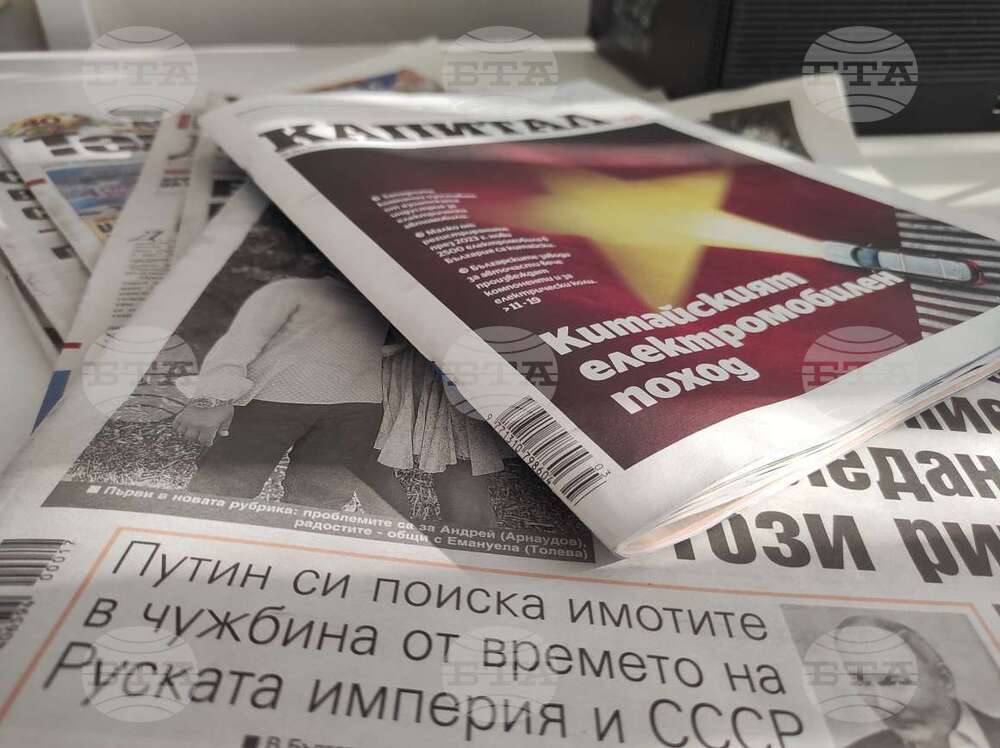
Capital writes that the Bulgarian Development Bank (BDB) appears to be preparing to replace its entire Management Board after submitting Angel Naydenov, Kostadin Karanlakov and Nadya Koshinska to the Bulgarian National Bank (BNB) for regulatory assessment, although its July competition sought one executive director to replace Ivaylo Moskovski. The weekly says the regulator's rules require an assessment of the board's collective suitability, meaning the three names cannot simply form a pool from which one candidate is later selected.
The weekly notes that Koshinska served on the board of First Investment Bank, in which BDB holds an 18.35% stake, while Karanlakov has a political background in GERB and a past link to a company later involved in a problematic BDB exposure. BDB has EUR 3.37 billion in assets and ranks eighth by size.
ENERGY AND TRANSPORT
Mediapool.bg writes that installed battery-storage capacity reached 8.6 GWh by May 2026, up from 3 GWh in 2025 and almost none in 2023. An Ember report says this could shift 77% of newly generated daily solar power into hours without solar generation, placing the country ahead of Chile and Australia on this measure.
Solar power and batteries together met 24% of evening peak demand in the first half of 2026. “Batteries have become cheap and effective enough to unlock the next stage of solar growth,” Ember Global Electricity Analyst Kostantsa Rangelova said. The report notes that further gains depend on electricity-market rules allowing storage to participate fully.
***
Capital writes that energy-efficiency policy remains dominated by certificates, quotas and formally recorded savings, while deep renovation and industrial projects remain limited. The country must reduce primary energy consumption by 11.6% by 2030, but the energy-saving obligation scheme covers only 16% of the cumulative target and lacks public data separating capital investment from inexpensive operational or behavioural measures.
“The share of deep building renovations is smaller because they are expensive and have long payback periods,” Sustainable Energy Development Agency Executive Director Ivaylo Aleksiev said. The weekly adds that businesses have not used the option to contribute to the National Decarbonization Fund in the past five years, partly because no clear method or mechanism for contributions exists. Standard energy-performance contracts, a central savings register and transparent pricing could help turn formal compliance into investment.
***
Capital reports that Mini Maritsa Iztok has awarded Energoremont-Galabovo a EUR 76,440 contract excluding VAT to train 208 employees in welding technologies and systems. It is the state-owned company's first retraining contract this year after several 2025 tenders failed for lack of interest from training providers.
The weekly notes that around 6,000 people work at the company, which posted a BGN 253 million net loss in 2025, as authorities seek alternative employment amid coal's declining role. The training comes as Mini Maritsa Iztok and TPP Maritsa Iztok 2 are being separated from Bulgarian Energy Holding.
***
Trud reports that former Kozloduy Nuclear Power Plant board chair and nuclear energy expert Georgi Kaschiev says a further fall of around 30 cm in the Danube could force the plant to shut down. A decline of 10 to 12 cm would reach the first critical threshold and require reduced output; another 20 cm could cause cavitation in the cooling-water pumps. “If it falls another 20 cm, the plant must be shut down,” Kaschiev said.
Nova TV also reported that the plant was producing electricity to schedule and had introduced technical and organizational safeguards. “The danger is real. If the river continues to fall, output will first have to be restricted and, with a further drop, stopped entirely,” former Deputy Energy Minister Yavor Kuyumdzhiev said. Former Energy Minister Alexander Nikolov said the plant's intake canal and emergency procedures provided additional protection.
***
BNT reported that another vessel had run aground near the village of Gomotartsi as the Danube continued to fall. The river stood 1.16 m below the reference zero at Ruse, down a further 2 cm.
A vessel previously stranded near Lom had resumed its journey. The vessel near Gomotartsi was outside the navigation channel and did not obstruct traffic, BNT added.
HEALTHCARE
Trud reports that Prime Minister Rumen Radev and Minister of Health Katya Ivkova met representatives of the innovative health technology sector to discuss advanced treatment facilities. “Bulgaria has the potential to establish itself as a regional centre for innovative medicine,” Radev said.
The proposals include a centre of excellence in robotic orthopaedics, a reference centre for non-invasive radiosurgery in neurosurgical oncology and better access to insulin-pump therapy for children with diabetes.
***
24 Chasa reports in an interview with Mothers for Donation Foundation Management Board Chair Mariela Kurteva that more than 4,500 children have been born with the organization's assistance. Kurteva says an older official estimate of 145,000 people with reproductive problems may now be twice as high.
About 1,000 families receive an opportunity to use donated reproductive material each year, but the wait for a Bulgarian donor egg is around 18 months, forcing clinics to import eggs and sperm. The Centre for Assisted Reproduction allocates about EUR 11 million annually, although donor-egg in vitro fertilization remains outside state financing. “Many more donors are needed,” Kurteva said.
AGRICULTURE
Trud reports that Minister of Agriculture and Food Plamen Abrovski met representatives of nut growers and processors to discuss protection against low-priced imports and produce from non-EU countries. The sector also wants clearer rules for harvesting from unmanaged nut trees, stronger traceability and equal conditions for market participants. “We will seek workable solutions together with the industry and focus on stronger controls and greater transparency,” Abrovski said.
***
24 Chasa reports that the Bulgarian Food Safety Agency is urging farmers and organizers not to bring live sheep or goats to churches, monasteries or other religious sites for the Dormition of the Mother of God because of the sheep and goat pox outbreak. Animals of uncertain origin must not be traded, donated or transported, and ritual meals should use only traceable products obtained under veterinary supervision.
Movement remains prohibited in protection and surveillance zones except where the Agency expressly authorizes it. Sheep and goat pox poses no risk to humans but is highly contagious among the affected animals and can cause major losses.
EDUCATION
Dnevnik writes that vocational education is attracting more pupils but remains poorly aligned with labour-market demand. More than 60% of new upper-secondary pupils will enter programmes covering almost 150 occupations in the 2026/2027 school year, while the share of vocational classes with a first-round minimum admission score above 300 points rose from 28% to 36% over five years.
The daily notes that estimates by the Institute for Market Economics put IT-related occupations at around 18% of vocational admissions, although only 3% of employees with vocational qualifications work in the sector. Manufacturing accounts for 13% of admissions but employs 34% of vocationally qualified workers, while dual training represents only about 9% of vocational admissions.
***
Capital reports that Junior Achievement Bulgaria's 72-hour Practical Finance programme raised the average test grade of 137 participating pupils from just over 3 to 4.56 on the six-point scale, equivalent to nearly five additional correct answers per pupil. More than 9,000 pupils have completed the programme since 2017, including over 900 at more than 30 schools during the past school year.
The weekly notes that the course covers budgeting, saving, debt, payment services, investing, risk, pensions and consumer decisions for pupils in grades 9 to 12, but is not a compulsory subject. Junior Achievement Bulgaria is seeking partners to widen free teacher training and plans more innovation camps, competitions and activities involving parents.
/KT/
news.modal.header
news.modal.text