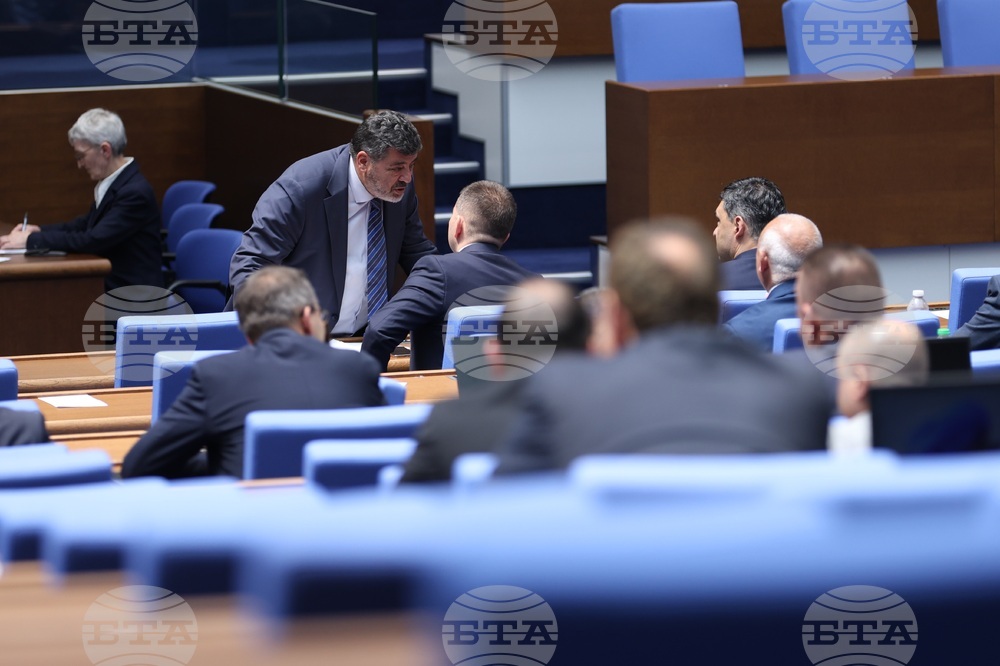
The National Assembly passed at first reading on Thursday all three bills amending the Judicial System Act, introduced by Progressive Bulgaria, Democratic Bulgaria, and Continue the Change.
The Progressive Bulgaria bill was approved unanimously with 189 votes in favour by all parliamentary groups. The other two bills received support from lawmakers from Progressive Bulgaria, GERB-UDF, Democratic Bulgaria, Continue the Change, and Vazrazhdane, while the Movement for Rights and Freedoms abstained.
The amendments relate to the criteria for selecting members of the judiciary. All three bills provide for limiting the powers of the Supreme Judicial Council (SJC) whose term has expired to make personnel decisions. The bill, proposed by Progressive Bulgaria (PB), provides for the possibility that after the term expires, these powers may be exercised only in exceptional cases to ensure the normal functioning of the judicial system.
The ruling party proposes measures to limit the concentration of influence, suggesting that individuals who have held senior leadership positions should not be immediately eligible for election as members of the SJC.
The PB-proposed amendments provide that, within one month of their entry into force, the Plenum of the Supreme Judicial Council shall appoint an acting chair of the Supreme Administrative Court and acting prosecutor general. The SJC organizes elections for members of the Supreme Judicial Council from the quota of the judges, prosecutors, and investigators, within a month of the law’s entry into force. To ensure the smoothness of the election procedures and to guarantee accessibility for magistrates throughout the country, a transition to paper-ballot voting at regional courts is envisaged.
The bill proposed by Democratic Bulgaria (DB) introduces a "double majority" requirement for key decisions both in the SJC plenary and the Judges Chamber on personnel and disciplinary matters. Decisions will require not only an overall majority but also a majority of members directly elected by judges, with the aim of strengthening the professional quota and limiting political influence.
The bill proposed by Continue the Change (CC) suggests changes to the method of selecting the parliamentary quota in the SJC so that it takes on a public rather than a partisan character, creating an opportunity for the academic community and the bar to nominate their own representatives. More specifically, one member of the Judges Chamber is appointed at the recommendation of the General Assembly of Attorneys in Bulgaria; one member of the Judges Chamber at the recommendation of the Union of Jurists in Bulgaria; one member of the Prosecutors Chamber at the recommendation of the Academic Council of Sofia University; and one member of the Prosecutors Chamber at the recommendation of the Bulgarian Academy of Sciences.
During the debate, concerns were raised regarding the provision in the ruling party’s bill allowing the Supreme Judicial Council, whose term has expired, to make personnel decisions on an exceptional basis, as well as regarding the CC’s proposal for nominations of SJC members from the academic community. Key points in the debate included the proposal for a public quota and voting with paper ballots in regional courts.
PB MP Elena Noneva said that in order to end the crisis in which the SJC finds itself, the procedure for electing members should begin six months, rather than two months, before the expiration of the body’s term, so that by the end of the term there would be a new SJC.
CC MP Stoyu Stoev said that everyone agrees on a moratorium preventing the SJC with an expired term from making personnel decisions. However, in the ruling party’s bill, there is a provision allowing this SJC to decide on its own and make these personnel appointments. "The problem is that you are proposing that the election of the professional quota using paper ballots take place at regional level," he added. In his words, DB’s proposal for a centralized procedure is the best, and if it cannot be done centrally, then at least it should be at the appellate level, in order to eliminate all possibilities for interference in this selection.
PB MP Milen Trifonov explained that the idea behind allowing exceptions to the moratorium is to account for force majeure circumstances. He noted that the idea of having the academic community participate in nominating candidates for the SJC is excellent, but then someone might claim that Sofia University has a representative or a lobby within the SJC. Therefore, in his view, it is more appropriate to expand the scope of the academic community that can make nominations.
CC MP Velislav Velichkov said that the public quota is proposed by MPs. "Sofia University or the Bulgarian Academy of Sciences cannot propose a candidate for a vote in the plenary hall, the MPs endorse the candidates."
Parliamentary ad hoc committee on legal affairs chair and PB MP Yanka Tyankova said she finds the proposal to allow Sofia University to nominate candidates discriminatory toward other universities. Tyankova added that PB have not yet accepted the opposition’s proposals but are opening the discussion on them and will wait to receive opinions from legal institutions and entities.
According to Velislav Velichkov, there is a way to find a solution for the public quota. In his words, otherwise the party quotas will remain, and it will be difficult to convince the public that parties have not divided them up among themselves.
DB MP Nadejda Yordanova believes that there is a consensus on improving the procedures for selecting members of the Supreme Judicial Council and limiting the powers of the SJC once its term has expired. She expressed concerns about the possibility that, out of necessity and as an exception, the restriction on the powers of the SJC with an expired term might not be observed. Yordanova said that DB would support the right of the Justice Minister to challenge the acts of the SJC, but added that consideration should be given to whether the appeal should suspend implementation.
CC MP Miroslav Ivanov said that it is troubling for an appeal to suspend the implementation of these acts. "There could hardly be a more direct political interference by the executive branch in the judiciary," he said.
Vazrazhdane MP Petar Petrov said that the party would support the motion to elect new members of the SJC and its Inspectorate, as well as the corresponding amendments to the Judicial System Act, which would limit the powers of the SJC whose term has expired until the election procedures are completed.