site.btaMedia Review: March 19
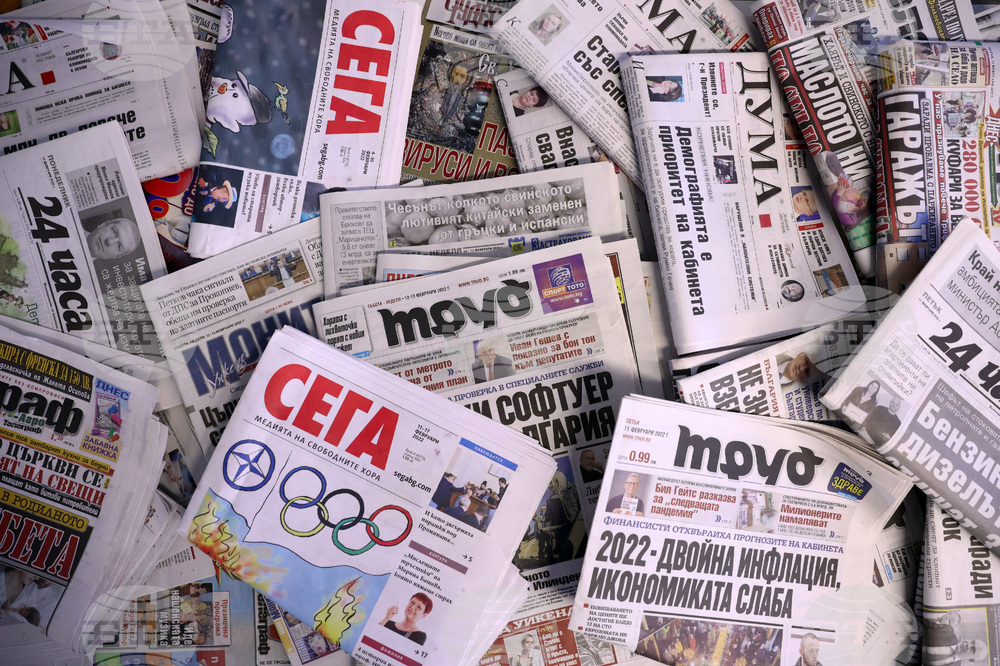
POLITICS
According to an analysis in mediapool.bg, which has perused relevant public documents, it is highly unlikely that Bulgaria's Constitutional Court will be able to determine explicitly whether a Judicial System Act amendment that limited the term in office of an acting prosecutor general to six months applies specifically to the incumbent holder of the office Borislav Sarafov because the scope of a case pending before the Court is limited to determining whether the amendment in question is constitutional. The publication speculates that the Constitutional Court may rule by mid-May, which is when the newly elected MPs will be sworn in. The six-month term will most likely be found consistent with the basic law because Parliament is vested with a power to appoint temporary officer holders in the three branches of government. Following the ruling, only two options will remain: the legislature urgently initiates a process for election of a new Supreme Judicial Council, or the Supreme Judicial Council initiates an interpretative case. "In this context, Sarafov remains a useful figure in the political landscape. He will remain in office for as long as he is useful to his supporters," mediapool.bg comments.
***
bTV has interviewed Bogdan Bogdanov MP of Continue the Change - Democratic Bulgaria (CC-DB), who is also a former minister of economy and industry. The interviewee says that CC-DB has proven itself to be irrepressible and aims to eliminate political corruption in the next parliament. The MP argues that precisely corruption has prevented Bulgaria from having proper healthcare, education and road infrastructure. "Corruption steals from each and every one of us. Thanks to corruption and theft, Bulgaria is getting deeper and deeper into debt. People are fleeing entire regions", he commented. "The fact that the attack is entirely directed at us shows that we have a tight grip on them at the moment, but they should know that this time we will not let go", he added.
bTV has also interviewed Petar Stoychev, a former minister of physical education and sports, swimming World Cup winner and Guinness World Records holder. He is a leading candidate of the Progressive Bulgaria coalition in Smolyan, southern Bulgaria. Stoychev said that he had received a personal invitation from former president Rumen Radev but declined to elaborate on their conversation. The candidate's main political motivation is to see a return to normalcy in political dialogue. He also emphasized his personal motivation: "Bulgaria has always held a special place in my heart. When it comes to the country's future, it is only natural for someone like me to put himself forward". According to Stoychev, his coalition will focus on positive campaign messages. "We plan to run a very positive election campaign. Normalcy will return with normal debates." The interviewee criticized the lack of familiar faces in politics, stating that the top-of-the-list candidates in some constituencies are dark horses. Regarding the inclusion of famous athletes in the lists, Stoychev said that he does not think they will be a stumbling block in Bulgarian politics. "We account for some 2% of 240 MPs, which is a negligible proportion," he argued, adding: "Each one of us is a winner and has overcome many difficulties to defend our name and the honour of our homeland."
***
Bulgarian National Radio (BNR) runs on its website an article titled "National Assembly's Last Day of Business: What Will Be Enacted?" The first item on the agenda is an amendment to the Rail Transport Act, which would empower the Railway Administration Executive Agency to act as a registration authority. A first-reading plenary vote is also due on revisions of the Non-Profit Legal Persons Act that move up from December 31, 2022 to December 31, 2026 the deadline for the re-registration of associations, foundations, and community centres that have not yet been entered in the Register of Non-Profit Legal Persons which is maintained by the Registry Agency.
ECONOMY
24 Chasa carries an article by Georgi Angelov, Senior Economist at the Open Society Institute in Sofia, on the impact of fuel price shocks resulting from the Middle East conflict. According to Angelov, Bulgaria has not yet felt the full extent of the petroleum shock, and it is unclear which sector will be hit hardest. Therefore, it is too early to start spending money on anti-crisis measures, as this would be a waste of resources and the country would not be able to react when the real crisis hits. Angelov also highlights the lack of data on who has been worst affected and who will be unable to weather the crisis. He recalls that during the previous energy crisis in 2022, many sectors claimed they would be affected and received generous electricity price subsidies. However, when the financial statements were released a year later, it transpired that at least half of these industries had reported record excess profits, which means that they had profited from the crisis and had not needed any support after all. However, they never returned the billions in aid to the State. Therefore, anti-crisis measures should provide targeted support only to those most affected who cannot cope without it. Furthermore, the financial burden of these measures should not be placed entirely on the State budget, which is already under considerable strain. In the previous crisis, mechanisms were introduced through which excess profits of energy and oil companies could be invested in financing anti-crisis measures. These mechanisms should be revisited if non-market excess profits are found to be made at the expense of the real economy and households. This would ensure that those affected are helped at the expense of those who profit from the crisis rather than at the expense of taxpayers, the author argues.
***
According to Segabg.com, tour operators and agencies are adjusting the prices of already booked and paid holiday packages and trips abroad for the increased cost of aviation fuel. Users on social media have reported that travel agencies have asked for an extra payment of EUR 30 per person from tourists due to travel to Egypt because the airline operating the charter flight has increased the fare. This additional fee is referred to as a 'fuel surcharge' in standard travel package contracts and allows for a possible price increase. The cited reason is a recent rise in the price of Brent crude oil, which has reached USD 104-106 per barrel. Due to tensions in the Middle East, the upward trend will persist, directly affecting airlines' fuel costs. According to the Tourism Act, a price increase of up to 8% due to objectively stated reasons cannot give tourists grounds to cancel their holiday.
***
In an interview on NOVA TV, Bulgarian National Bank (BNB) Governing Council member Lyubomir Karimanski commented on the current measures to support those most affected by rising fuel prices. "The right approach is targeted measures - targeting groups rather than all companies," he said, drawing a parallel with energy aid during the war in Ukraine. Regarding the EUR 20 aid for households whose monthly income does not exceed EUR 780, Karimanski noted that it is important to understand the calculations and logic behind them. "It is crucial to ascertain whether the Finance Minister and his colleagues have performed detailed calculations and discussed this matter," he emphasized. He added that the successful implementation of the measures depends on their administration and precise targeting of those in need.
EDUCATION
Mediapool.bg runs an article titled "Paradox: Chapels in Schools but No Responsible Institutions" about the various schools across the country that have built Eastern Orthodox chapels in their schoolyards or within the school buildings themselves. While there is no formal ban on the construction of chapels in schools, it transpires that there is also no clarity as to which institution is responsible for their construction. According to the Government Information Service, the design and construction of religious facilities is regulated by the Spatial Development Act and the Religious Denominations Act. In order to build a chapel as a stand-alone structure, say, in a schoolyard, a building permit and approved plans must be obtained. "If a school is state or municipal, the rules of the State Property Act will also apply in addition to the Preschool and School Education Act," the Government Information Service specified in response to Mediapool's query. Regarding the compatibility of such practices with the secular nature of Bulgarian education as defined by law, the Ministry of Education and Science states that the presence of a chapel in no way compromises the secular nature of education. They add that construction is permissible for educational purposes only.
***
Dnevnik.bg reports that the Ministry of Education and Science is planning to integrate artificial intelligence (AI) into the curricula of all schools and subjects except physical education and sports for third- to twelfth-grade pupils. Experts who spoke to Dnevnik commented that the introduction of AI in education is mandatory and even overdue. From the third grade, when the introduction to AI begins, pupils will work with chatbots. In Bulgarian language classes, for example, pupils will be assigned to produce a detailed written summary of a literary text based on an AI-generated plan. They will also be expected to detect differences in the words used by humans and AI, instruct AI to generate images and detect logical inaccuracies in sentences. In foreign language lessons, pupils will use AI to practise writing, reading, listening and repeating, as well as practising lexical and grammatical patterns. Pupils will also be permitted to communicate using an AI-generated model. The experts that Dnevnik approached said that teachers are not prepared for this integration. Although countries such as Estonia are ahead of Bulgaria in integrating AI into their education systems, experts are cautious about identifying a specific country as a role model and categorically stating how much AI should be incorporated into the curriculum. This is because in education, results are not seen after a year or two, but after a generation or two. What seems successful after a year or two of implementation among pupils may not produce good results once they are adults, the website comments.
SOCIETY
According to 24 Chasa, 12 tonnes of narcotic drugs have been destroyed in the incinerator of a Sofia hospital, which is apparently a regular occurrence. The item describes how international drug trafficking works, explaining that once the drugs have been seized by the National Customs Agency at the border, samples are taken from each shipment and transported to the agency's laboratory for testing. The remaining quantity is burned in furnaces at factories around the country, usually near where it was seized or at other suitable sites, under the supervision of the fire department. In 2025, the customs warehouse received drug samples under 8,636 protocols - a record for the institution. A total of 12,012 kg of drugs were destroyed in seven separate procedures. However, the warehouse for storing the samples has now reached maximum capacity. The quantity of drug samples stored increases every year. The National Customs Agency says that the drug problem in society is growing and that customs and police officers are seizing larger and larger quantities of narcotics. Over the past 14 months, Bulgarian customs officers have seized over 4,000 kg of drugs and precursors in more than 130 cases.
***
BNR reports that Varna (on the Black Sea coast) may be left without water as the 100-kilometre-long network of water and sewage pipes from the Kamchia Dam to the city is old and compromised in many places. Vesselin Rusev, the manager of the local Water Supply and Sewage utility, said that such a scenario is possible in case of accidents and that the project for a backup supply from the Devnya springs is at a standstill. Rusev also said that there is significant investment interest in construction projects in the southern part of Varna but the existing water supply network is already at capacity. For this reason, the utility is requesting a temporary moratorium on new building permits. Rusev called for the implementation of a project to build infrastructure in the Asparuhovo area so that residential construction can go ahead.
/LG/
news.modal.header
news.modal.text