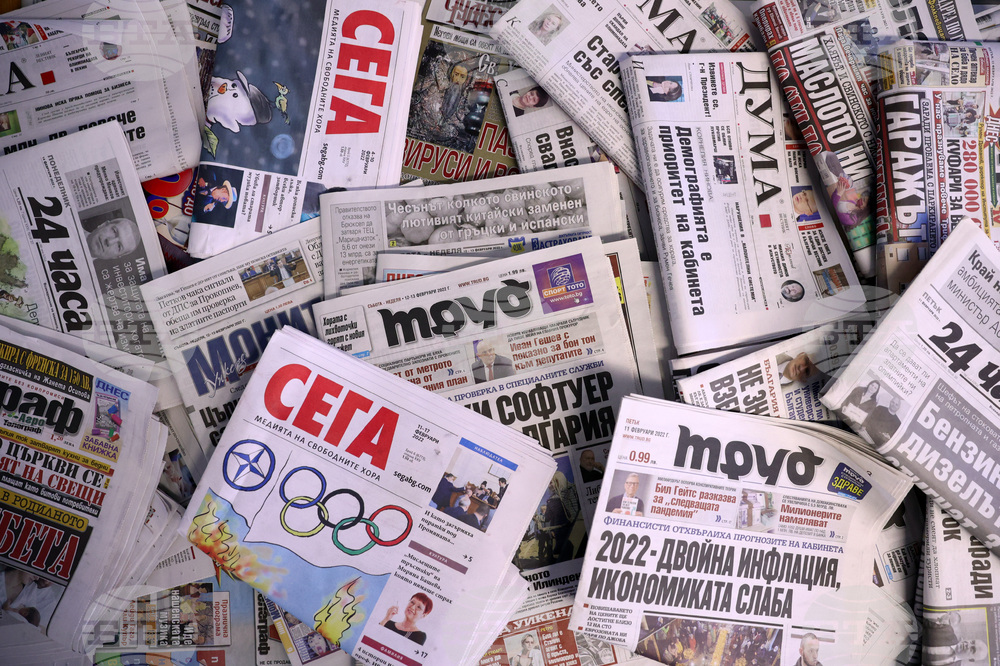
site.btaMedia Review: January 27
POLITICS
Mediapool: President Iliana Iotova will meet later on Tuesday with the Chair of the National Assembly, Raya Nazaryan of GERB. The meeting is part of the constitutional procedure for appointing a caretaker government.
Nazaryan has already stated her position that she would not agree to serve as caretaker prime minister and is expected to repeat this stance to Iotova.
Under the Constitution, when the appointment of a caretaker government becomes necessary, the president does not freely choose the prime minister, but must nominate a person from among the Chair of the National Assembly, the Governor and Deputy Governors of the Bulgarian National Bank, the Ombudsman and Deputy Ombudsman, or the Chair of the National Audit Office and his or her deputies.
The signing of the decree appointing the caretaker government will also determine the date of the upcoming snap parliamentary elections.
On Monday, Iotova said she was beginning the talks with Nazaryan not only because of the order in which the meetings are scheduled, but also as a gesture and an expression of respect toward the National Assembly in its capacity as the main institution in a parliamentary republic.
She announced that the schedule of the remaining meetings would be made public later in the day.
***
bTV quotes former Parliament Chair and Bulgarian Socialist Party (BSP) MP Nataliya Kiselova as saying it is entirely possible that, after all constitutional consultations are held, a caretaker government could be formed as early as this week.
The date of the early parliamentary elections - whether March 29 or April 19 - will depend on how quickly the caretaker government is appointed. Kiselova emphasized that the Constitution does not provide deadlines for meetings with potential caretaker prime ministers, and the procedure, after the 2023 amendments, is slower.
BSP is not giving recommendations for a specific date. “This is entirely within the powers of the President. At the moment, it is not appropriate to give advice from the outside,” Kiselova said, expressing confidence that President Iliana Iotova will approach the formation of the caretaker cabinet “with style and class.”
Regarding preliminary refusals, including that of Raya Nazaryan, Kiselova said it is not appropriate for persons involved in drafting and voting on constitutional amendments to refuse easily. “This is part of the job description,” she stressed, adding that, in her opinion, if the Parliament Chair is appointed as caretaker prime minister, they should not participate in the subsequent parliamentary elections.
BSP is not indicating a specific favorite. According to Kiselova, the choice will narrow “by the method of elimination.” She ruled out the Parliament Chair because of their intention to run for MP, as well as the Governor and Deputy Governors of the Bulgarian National Bank, because their appointment would require resignation and early termination of their term in office.
More suitable, in her view, are figures who could return to their previous posts after the caretaker government’s term ends, such as the head and deputy head of the National Audit Office.
Kiselova described talks about a future political project of President Rumen Radev as “speculative.” She said that until there are clearly stated intentions, a team, and a program, such comments remain mere guesswork.
She was clear that “the left is not dead” and warned of the dangers of hate speech and radicalization in politics. According to her, BSP must clearly defend the parliamentary form of government as the only alternative.
On the outgoing government’s signing of a document joining the Board of Peace, Kiselova confirmed that the document must be ratified by Parliament, as it concerns participation in an international organization and has political and potentially financial implications. She emphasized that the lack of an official translation and public information is a problem, but the signing itself is not outside the outgoing government’s powers. BSP ministers supported the signing of the document.
Commenting whether she will run for Parliament, Kiselova said the decision will be made after the BSP Congress on February 7–8. Internal party discussions will determine whether the party should face the elections with new leadership.
***
Bulgarian National TV: Vazrazhdane Co-Floor Leader Petar Petrov said his party will assess any potential partnership with a political project of former president Rumen Radev once his election campaign platform is clear. He stressed that the party was the first to invite cooperation with Radev six months ago, but they will wait to see his positions and policies before making a decision.
Petrov does not expect Radev’s potential project to draw votes away from Vazrazhdane, noting that their supporters are dissatisfied with rising prices due to Eurozone membership, the lack of a NATO referendum, and other issues. He hopes that Radev’s participation in politics could increase voter turnout.
Vazrazhdane also outlined its own platform, including a national program spanning 1,400–1,600 years of Bulgaria, constitutional reform toward a semi-presidential republic, reducing the number of MPs, and exiting the Eurozone.
Regarding the formation of a caretaker cabinet, Petrov said President Iliana Iotova has only two options: to appoint either central bank Deputy Governor Andrey Gurov or National Audit Office President Dimitar Glavchev as caretaker prime minister.
***
Sofia Mayor Vasil Terziev handed over Bulgaria’s one-year presidency of the B40 Balkan Cities Network to Zagreb at the ZAGREB B40 SUMMIT 2026, highlighting achievements in digitalization, green policies, and civic participation. He warned that pressure on democratically elected mayors represents a threat to local democracy across the Balkans, drawing parallels between Bulgaria and Turkey.
During Sofia’s presidency, the network focused on green and digital reforms, citizen participation, economic cooperation, and cultural exchange. Sofia showcased projects such as its digital services model, the “Solve Sofia” civic platform, an AI chatbot for kindergarten and school admissions, the Green Ring linear park, and ambitious climate targets. Sofia concludes its term with strengthened regional cooperation mechanisms and an enhanced international profile.
The topic is covered by major media outlets.
***
bTV: Former Bulgarian Prime Minister and GERB leader Boyko Borisov sharply dismissed claims that he had moved tons of gold, saying he lives in the house where he was born and leads a modest life. Speaking in an interview with Martin Karbovski, Borisov called the accusations “nonsense” and criticized people for spreading them without knowing the facts. He emphasized that he is rarely seen in cafes, restaurants, or resorts, and that his routine is simply between home and work.
ECONOMY
Bulgarian National Radio: About one-third of freight transport companies registered in Bulgaria’s southwestern region of Blagoevgrad are owned by citizens of North Macedonia, who are of Bulgarian origin and also hold Bulgarian identity documents.
Although new EU rules on the stay of third-country carriers in member states do not affect them, these carriers joined border protests. Unlike the long-lasting Greek farmers’ blockades at Bulgaria’s southern border, which caused massive disruptions for heavy transport across Europe, the current protests by transporters at the western borders are not as severe.
In total, there are around 3,000 registered transport companies in the Blagoevgrad region, with about one-third owned by North Macedonia citizens of Bulgarian origin.
***
Mediapool examines the question when the Bulgarian and Romanian capitals will be connected by a high-speed motorway. This question has been asked for decades by people living on both sides of the border.
At present, the journey between Sofia and Bucharest takes around six to seven hours, depending on traffic and waiting times at the Danube Bridge.
From Sofia, the route follows the Hemus motorway, which was completed up to the Lukovit junction at the end of 2025. From there to Veliko Tarnovo (North-central Bulgaria) and towards Ruse (on the Danube), traffic continues on a first-class road with one lane in each direction, with occasional three-lane sections. Construction of the long-awaited Ruse–Veliko Tarnovo motorway (133 km) began at the end of 2023 but stalled due to loess soils, with little visible progress. This prompted residents of Ruse to form an initiative committee and threaten to block the Danube Bridge to push authorities to speed up the project.
At the same time, Romania recently signed a contract to study the construction of an 85-kilometre motorway between Bucharest and Giurgiu (on the Danube). The project is linked to plans for a second bridge over the Danube between Ruse and Giurgiu, which are being led by the Romanian side. Currently, traffic between Bucharest and Giurgiu uses national road DN5, where the 50-kilometre journey takes between 45 minutes and one hour, slowed by numerous settlements and speed limits.
Road experts from both countries estimate that the realistic deadline for both the motorway and the second Danube bridge is around 2035, provided there are no administrative or technical delays.
On 19 January 2026, the Romanian National Road Infrastructure Company approved the implementation of a contract for a pre-investment study of the Ruse–Giurgiu motorway. The EUR 6.6 million contract, financed by EU funds, was signed with a Romanian–Turkish consortium at the end of 2025. The study will examine route options, construction technology, and whether the motorway should be built with concrete or asphalt.
The feasibility study is due within 16 months. If completed on time, tender procedures for design and construction could follow in 2027, with construction potentially completed between 2033 and 2035. Romanian experts note that progress also depends on whether Bulgaria manages to reach the second bridge with a motorway in time.
Meanwhile, Bulgaria’s Ruse–Veliko Tarnovo motorway has seen limited progress. Work on the 35.4-kilometre bypass of Byala began in 2023 but was delayed throughout 2025 due to geological issues. Another section, from Ruse to Byala (40.6 km), has yet to start construction despite contracts signed in 2022, causing public frustration and protest threats in Ruse.
The Bulgarian Road Infrastructure Agency (RIA) insists that technical projects are ready and that construction permits are expected soon, although delays related to planning amendments and procurement procedures continue. The first two sections of the motorway are officially scheduled for completion by 2029, with nearly EUR 1 billion in funding secured under the Transport Connectivity Programme 2021–2027.
At the same time, procedures for selecting contractors for the remaining 60 kilometres toward Veliko Tarnovo have been stalled since mid-2025, amid criticism over high projected costs.
Delays also affect the Romanian side. The tender for a feasibility study for the second Danube bridge between Ruse and Giurgiu, worth EUR 14.4 million and financed by EU funds, has been pending since July 2025. Once completed, a separate tender for design and construction of the bridge will follow, which could take four to five years. Romanian experts warn that without strong political pressure and secure financing, the second bridge may not be completed even by 2040.
***
Capital’s online edition leads a detailed story about how Bulgaria is moving belatedly and controversially toward establishing a national deposit return system for beverage bottles and cans, according to a draft amendment to the Waste Management Act submitted by MPs from the Bulgarian Socialist Party. The proposal foresees the creation of a National Deposit Operator as a public enterprise, a model strongly criticised by business and environmental organisations as opaque, inefficient and prone to state control. Industry representatives warn that bypassing public consultation and involving recycling organisations with potential conflicts of interest could undermine the system’s effectiveness, risking Bulgaria’s ability to meet its EU target of collecting 90% of single-use beverage containers by 2029.
***
Trud: Sofia’s cost of living in 2026 is comparable to that of Ajman in the United Arab Emirates, according to Numbeo’s cost of living index. Sofia ranks 297th out of 479 cities worldwide, with prices nearly identical to those in Ajman and Bucharest. Although overall living costs in Sofia are about 54% lower than in New York, prices of many basic food products—such as milk, chicken, cheese, rice, potatoes, and bananas—are higher than in Bucharest and Warsaw, despite lower incomes in Bulgaria.
Zurich is the most expensive city in the world, excluding rents, with six Swiss cities in the global top 10. The cheapest city is Coimbatore, India.
In terms of quality of life, Plovdiv ranks higher than Sofia and Varna in Bulgaria, mainly due to better safety and climate. Overall, cities in the Netherlands dominate the global quality-of-life ranking, with The Hague in first place.
WORLD
Dnevnik: Today, Europeans are among the world’s leading pessimists. Most doubt that the future will bring anything good for their countries, for the world, or for themselves. At the same time, people in some other parts of the world see significant potential in Europe.
How Europe perceives itself in a post-Western global order—with a “normal” America, China as a superpower, and many countries embracing multipolarity—is examined in a survey conducted for the European Council on Foreign Relations (ECFR). The data show that people in ten EU countries, including both large member states and smaller ones such as Bulgaria, tend to see this situation more as a risk than as an opportunity.
Most Europeans do not believe that the EU is a power capable of dealing on equal terms with the United States or China, and these doubts have increased over the past 12 months. Europeans are among the least confident globally in the EU’s strength, while majorities in South Africa, Brazil, China and Ukraine say the EU is a force that must be taken into account.
Much remains to be done for Europeans to embrace their own power, and the path forward begins from a gloomy starting point.
According to the authors of the report, European pessimism may be a reaction to contradictory messages from political leaders. European leaders recognise that the transatlantic relationship as it once existed has ended, yet they have spent much of the past year trying to limit the damage—seeking to appease Donald Trump and pretending that the old alliance still exists.
Aggressive and dismissive views of Europe expressed by Donald Trump and Vladimir Putin also shape perceptions, particularly as they are echoed by anti-liberal, nationalist populist parties across the continent. Europeans appear to be undergoing a mental shift toward a post-Western world in which Europe increasingly finds itself alone.
They harbour no illusions about the United States under Trump and increasingly believe that his leadership is not even good for Americans themselves. Fewer Europeans now see the US as an ally or partner. At the same time, there is broad support for increased defence spending and a growing awareness that Europe lives in a dangerous world.
Many Europeans believe they are experiencing a moment of acute risk, expressing strong concern about Russian aggression against another European country, the possibility of a major European war, and the use of nuclear weapons. Support is widespread for higher defence budgets, the reintroduction of compulsory military service, and even the development of a European nuclear capability.
Political leaders are struggling to understand how to guide their countries through this dangerous period, but the report argues they are partly responsible for failing to explain what recent dramatic events mean for Europeans. The authors stress that different elements of Europe’s geopolitical awakening do not necessarily overlap in public consciousness.
Trump’s intervention in Venezuela, the report notes, suggests he believes it is better for a great power—once Europe’s closest ally—to be feared rather than loved. China, meanwhile, is not only rising but has already reached a position of significant global influence. European leaders no longer need to ask whether citizens understand the radical nature of today’s geopolitical changes—they do.
The key question now is what Europe should look like by 2030 if it wants to defend itself across all dimensions of power: military, economic, cultural and political. Leaders must be both bold and realistic, as excessive pessimism or optimism is unhelpful. Europe must find ways not only to survive in a multipolar world, but to become one of its poles—or risk fading into irrelevance.
The report raises urgent questions for 2026, including whether Europe can secure a safe and prosperous future for Ukraine on its own, how it can avoid a “dirty peace” without being accused by its citizens of obstructing peace, and whether a politically divided continent has the coordination, power and will to confront Russia militarily, China economically and the United States politically. It also asks whether the EU should pursue closer ties with China to offset weakening relations with the US, and whether a “new West” could emerge with partners such as Canada, Australia and Japan.
The survey was conducted among 25,949 respondents in 21 countries in November 2025, one year after Donald Trump’s victory in the most recent US presidential election, as part of the ECFR–Oxford University research project “Europe in a Changing World.”
***
bTV: The special envoy of Russian President Vladimir Putin, Kirill Dmitriev, said on Tuesday that Ukraine’s withdrawal from Donbas is the path to peace. “Withdrawal from Donbas is the path to peace for Ukraine,” Dmitriev said.
Russia controls about 90% of Donbas, and Putin has repeatedly stated that if Ukraine does not give up the remaining areas, Russia will take them by force.
The Kremlin insists that Ukraine cede strategically vital, unconquered territory in Donetsk and freeze the front line in other areas as part of a ceasefire agreement. This demand was first put forward in the middle of last year.
JUSTICE
NOVA TV: Investigative journalist Kiril Borisov of 24 Chasa commented on the latest information about the Bulgarian “cryptoqueen” Ruja Ignatova, who is wanted in connection with a global fraud scheme worth more than GBP 3.6 billion. Speaking on the programme Your Day, Borisov said the most recent data comes from German police sources, according to whom there is no evidence that Ignatova is dead. According to a senior police official, she may still be alive.
The opposing version—that Ignatova died and her body was dumped in the Ionian Sea—first emerged in 2018 but has remained unconfirmed.
The journalist noted that her last known appearance dates back to 2017, when she travelled by plane from Sofia to Athens. Since then, she has disappeared from public view and has been the subject of an international manhunt, including by authorities in the United States, Germany, the United Kingdom and Bulgaria.
Ignatova is a co-founder of OneCoin, a notorious crypto pyramid scheme through which more than three million investors worldwide were defrauded. Borisov explained that the scheme operated through the sale of educational packages promising profits from the OneCoin cryptocurrency, which never became convertible and did not function as a real cryptocurrency.
He said that fraud and money laundering are the two main crimes for which Ignatova is being investigated, and that the scheme was part of a larger international criminal structure.
Borisov added that despite her disappearance, some international investors still believe she is alive and continue to participate in similar projects, albeit on a smaller scale. He also noted that some of her assets in Bulgaria, including three houses in central Sofia, are under investigation and potentially subject to seizure.
The journalist expressed skepticism that Bulgarian investigations will succeed in recovering assets or ensuring justice for defrauded investors, stressing that the billions involved have been distributed through international channels and companies.
Borisov said there is speculation that Ignatova may have changed her identity and could be living a “different life” in an unknown country, but in his view it is unlikely she would have managed to remain anonymous for so long given the scale of the case.
He also noted that other individuals linked to the organization, such as her brother Konstantin Ignatov and her mother Veska, were used as public faces of the scheme but could not replace her leadership.
According to Borisov, the chances of Ignatova being found are minimal, although international authorities will continue their investigations. He added that defrauded investors worldwide are unlikely to be compensated, while investigations in Bulgaria and abroad face a lack of evidence and limitations in tracing cryptocurrency transactions.
/MY/
news.modal.header
news.modal.text