site.btaMedia Review: January 8
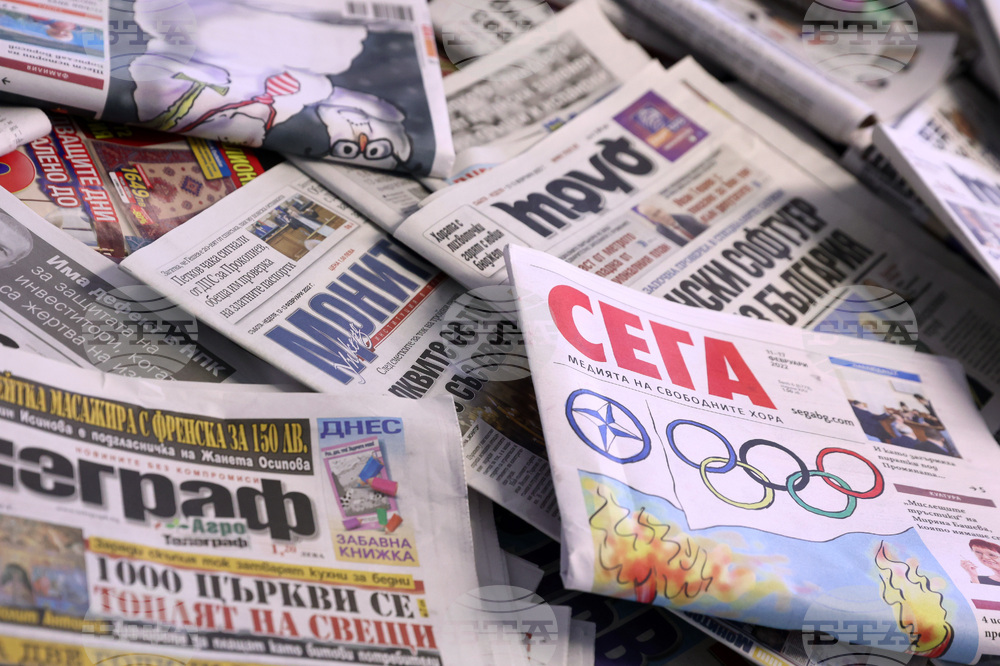
ELECTIONS
bTV hosts a debate with experts on the measures to prevent election result manipulation ahead of the likely early general elections.
The issue of how to prevent manipulation of election results ahead of a possible snap parliamentary elections was debated in view of how the most recent parliamentary elections were partially annulled due to irregularities, leading to the entry of an entirely new parliamentary group into the National Assembly [that of Velichie].
Rumyana Decheva, former deputy chair of the Public Council to the Central Election Commission (CEC), said last-minute amendments to the Election Code are a very poor practice and should only be made in exceptional circumstances. She cited examples from Romania, Germany and France, where emergency changes were introduced during the COVID-19 pandemic to allow postal or proxy voting.
[Voting machines supplier] Ciela Norma CEO Veselin Todorov warned that late [Election Code] changes become problematic when they affect electoral districts, voter lists or voting rights. However, he said adjustments to voting technology are acceptable if there is sufficient time for their implementation.
Both experts stressed that voting machines provide greater reliability and transparency. Decheva argued that machines were designed to make voting easier and more functional and cautioned against reopening the system in ways that could introduce even greater risks. Todorov added that machines could also be used for voter authentication, noting that one of Bulgaria’s biggest problems remains “dead voters” and multiple voting by the same individuals.
EURO INTRODUCTION – ECONOMY
Bulgarian National TV reports that social payments in Bulgaria have been converted into euros, with monthly financial support for people with disabilities increasing by 19.7%, while personal assistants will also receive higher wages. Despite the absence of an adopted state budget, the Ministry of Labour and Social Policy has assured that all social payments are guaranteed.
The increase is linked to a higher poverty line from the beginning of the year. Around 770,000 people are expected to receive higher disability-related support in February. According to the ministry, payments will be made regularly and in the new euro-denominated amounts.
About 83,000 personal assistants to people with disabilities will also see their salaries rise from next month. Officials said all social benefits have been converted into euros at the exchange rate set by the Bulgarian National Bank, and no action is required from beneficiaries unless they wish to change their bank details or payment method. Disbursement of social benefits via banks and post offices begins on January 15.
***
Trud runs a story headlined “Why Czechia Resists the Euro”. It’s an abridged version of a Deutsche Welle story by Rob Cameron.
The new government in Prague wants to change the constitution to anchor the Czech crown as the country's legal tender and guarantee the right to use cash, not just cards.
The new right-wing populist government of Andrej Babis has made a firm pledge to ensure Czechia never adopts the euro.
"We commit that our government will not adopt the euro nor take any steps toward its introduction," reads the policy program approved by the new coalition government at its inaugural cabinet meeting. The coalition includes Babis' ANO party, the euroskeptic Motorists for Themselves, and the far-right SPD.
"We will propose to parliament that the Czech crown be anchored in the constitution of the Czech Republic - along with the right to hold and use cash as legal tender," the program states.
For now, it is largely an empty promise. The Babis government commands 108 seats in the lower house of parliament. Changing the constitution requires a three-fifths majority - at least 120 of the 200 lawmakers in the Chamber of Deputies. Even if that hurdle were cleared, the Senate presents an even higher barrier, as the government currently has support from only 15 of the 81 senators.
The parliamentary arithmetic makes the policy pledge largely symbolic. So, why make it?
"It's a political gesture," said Robert Brestan, editor-in-chief of the independent news outlet Hlidaci Pes (Watchdog).
"It's an unspoken demonstration of resistance to the euro, or more broadly to the European Union, from part of the governing coalition, especially the SPD. Their voters respond to this," Brestan told DW. He added that the chance of a paragraph on "the Czech crown for all eternity" being added to the Constitution is essentially zero.
The final wildcard is President Petr Pavel, who enjoys popular support. He has called for the nation to at least start discussing its commitment to adopting the euro under the terms of its EU accession two decades ago. So far, however, his call has largely fallen on deaf ears.
***
24 Chasa leads with a story about how the first euro pensions were paid out to Bulgarians amid early-morning queues.
Bulgaria’s pensioners received their first payments in euros on Wednesday, the first month of the new currency. Across the country, people queued outside post offices, sometimes before dawn, to collect their payments. Many were seeing euros for the first time, while others had been shown the new banknotes by their children or grandchildren.
For most pensioners, the first spending priorities were utility bills - electricity, heating, and water - though some treated themselves or their grandchildren. Many approached the change with curiosity rather than concern, saying they would quickly adapt to the new currency. A few were cautious, double-checking amounts with calculators or carrying two wallets - one for euros, one for remaining levs.
Authorities reported minor delays at some locations due to early arrivals and careful counting of the new notes. The police warned citizens to avoid phone scams offering favorable exchange rates and to report any suspicious banknotes or requests for personal data.
***
Bulgarian National Radio: Bulgaria’s outgoing government has decided to open the market for government securities to citizens and small investors, a move approved at its last meeting before Christmas. While no start date has been set, the proposal has been put out for public consultation with a shortened deadline until January 13.
Investment consultant Ivaylo Tomov told Bulgarian National Radio that the idea is positive but remains at an early stage. He noted that although individuals can already buy government securities, this rarely happens due to multiple barriers, including the lack of transparent and accessible financial advice. According to Tomov, banks have little incentive to promote direct ownership of government securities, as they prefer clients to keep their money in deposits or invest in more complex products. He added that government securities remain the main alternative to bank deposits for individual investors.
***
Capital: One day before Christmas Eve, Bulgaria’s Ministry of Regional Development and Public Works issued construction permits for a further 36 km of the Hemus motorway, according to a Capital check of the ministry’s register. The permits cover a subsection of so-called Section 4 between the Pleven interchange and Road III-301, as well as Section 5 from the Letnitsa interchange to Road III-303.
Despite this progress, development of the northern motorway remains slow and controversial. In early October, 10 km of the 15 km-long first section were opened, while the remaining part, including a road connection, was completed a month later, on November 4.
Officially, construction of Hemus is being carried out by the state-owned company Avtomagistrali under two in-house contracts with the Road Infrastructure Agency, signed in late 2018 and late 2019. In practice, however, it is widely known that major private construction companies are building large parts of the motorway. This contradicts public procurement law, which does not allow subcontractors under in-house contracts and requires state companies awarded contracts without competition to carry them out using their own capacity.
So far, the only public information on which companies have contracts with Avtomagistrali has come from an audit report by the National Audit Office published in mid-2021. Avtomagistrali has repeatedly refused Capital access to information on its contractors and payments, despite the projects involving hundreds of millions of leva in public funds, leaving unclear which private firms are effectively building the Hemus motorway.
WASTE CRISIS – SOFIA
Mediapool runs a story about how Titan takes over cleaning in six more Sofia districts amid a waste-collection crisis.
Sofia’s waste collection business continues to consolidate, with companies linked to the Titan holding temporarily taking over cleaning in six additional districts after old contracts expired on January 7. This brings the total of districts served by Titan-affiliated firms to 14.5 of the capital’s 24 districts, while another 1.5 are handled by a company sharing legal representation with Titan International Holding.
The municipality extended contracts for the districts of Pancharevo, Iskar, and Kremikovtsi (Zone 2) to the consortium “Titan Sofia East 1,” owned mainly by BCS Chistota. The price for waste collection and transport increased by 19% to BGN 209 per ton. BCS Chistota is also likely to secure long-term contracts for this zone and for Zone 5, which includes Bankya, Vrabnitsa, and “Novi Iskar districts.
Zone 4 - Ilinden, Nadezhda, and Sredets - will be serviced by crews from neighboring Titan consortia at rates of BGN 175–209 per ton, as the long-term contract with Turkish company Norm Sanayi is challenged in court. A decision on preliminary execution allowing the contract to start is expected by January 12.
The only districts still facing a crisis are Zone 3 - Poduyane, Slatina, and Izgrev, where waste collection is handled by municipal enterprises and district resources. Zone 6 (Lyulin, Krasna Polyana, Krasno Selo) is now covered by municipal company Sofecostroy.
The municipality stressed that ongoing legal disputes over contract awards and extensions have delayed the signing of new contracts or the announcement of fresh tenders.
***
Duma reports that the National Toll Administration warns against overpriced e-vignettes offered online.
The National Toll Administration (NTA) has alerted drivers that some online platforms are offering electronic vignettes at inflated prices with hidden fees. Motorists are advised to purchase vignettes only through the official NTA website (www.bgtoll.bg), mobile app, or partner network at the official rates.
E-vignette prices for 2026 remain unchanged: annual EUR 49.60 (BGN 97), quarterly EUR 27.61 (BGN 54), monthly EUR 15.34 (BGN 30), weekly EUR 7.67 (BGN 15), weekend EUR 5.11 (BGN 10), and one-day EUR 4.09 (BGN 8), valid from February 3 for 24 hours on the national road network for vehicles up to 3.5 tons.
Purchases are available online, via mobile apps, at partner outlets, cash desks, and self-service terminals. Drivers must ensure the correct registration number, vehicle category, and validity period are entered.
E-vignette validity can be verified at www.bgtoll.bg, showing status as “active,” “expired,” or “unused,” including for deferred-start purchases.
WORLD
Dnevnik: US seizes Russian-flagged tanker escorted by submarine in Atlantic. The United States detained a Russian-flagged oil tanker, Bella-1 (renamed Marinera), on Wednesday in the North Atlantic after a more than two-week pursuit, officials told Reuters. The operation, about 200 km southeast of Iceland, involved the US Navy and Coast Guard, and marks the first modern US seizure of a vessel under the Russian flag.
British forces reportedly provided aerial surveillance support, and US European Command used UK air bases. The vessel, sanctioned by the US for transporting Iranian oil, was targeted as part of global efforts to enforce sanctions and prevent illicit Venezuelan oil exports.
US officials said Bella-1 had been operating under a false flag with altered Russian registration, avoiding a previous US maritime blockade. No confrontations with Russian naval forces or submarines, reportedly near the operation, were reported.
Separately, the US Coast Guard intercepted another Venezuelan tanker, M Sophia, in the Caribbean. The White House stressed that the blockade on sanctioned Venezuelan oil remains fully in force worldwide.
Russia condemned the seizure, citing freedom of navigation under international law.
SNOWFALL
NOVA TV: “Heavy Snowfall Disrupts Traffic in Sofia”.
Heavy snowfall early Thursday morning severely disrupted traffic in Sofia. Rain during the night turned into snow around 4:00 a.m., accompanied by a sharp drop in temperatures.
Sofia Municipality said 109 snowploughs and gritting vehicles were operating across the city, treating roads against icing and clearing snow from major streets and boulevards. Roads in Vitosha Nature Park leading from the Dragalevtsi district to Aleko Hut and from Boyana to the Zlatnite Mostove area were sanded.
Public transport services on trolleybus lines 1 and 5 and bus lines 74, 77, 82, 86 and 101 have been restored, while tram line 6 remains suspended due to icy tracks. Snow clearing is also under way at public transport stops and along bicycle lanes in the capital.
BNR quoted the police as urging Sofianites to refrain from driving in the snowy conditions. The other media also cover the news of the snowfall in Sofia.
/MY/
news.modal.header
news.modal.text