site.btaMedia Review: January 7
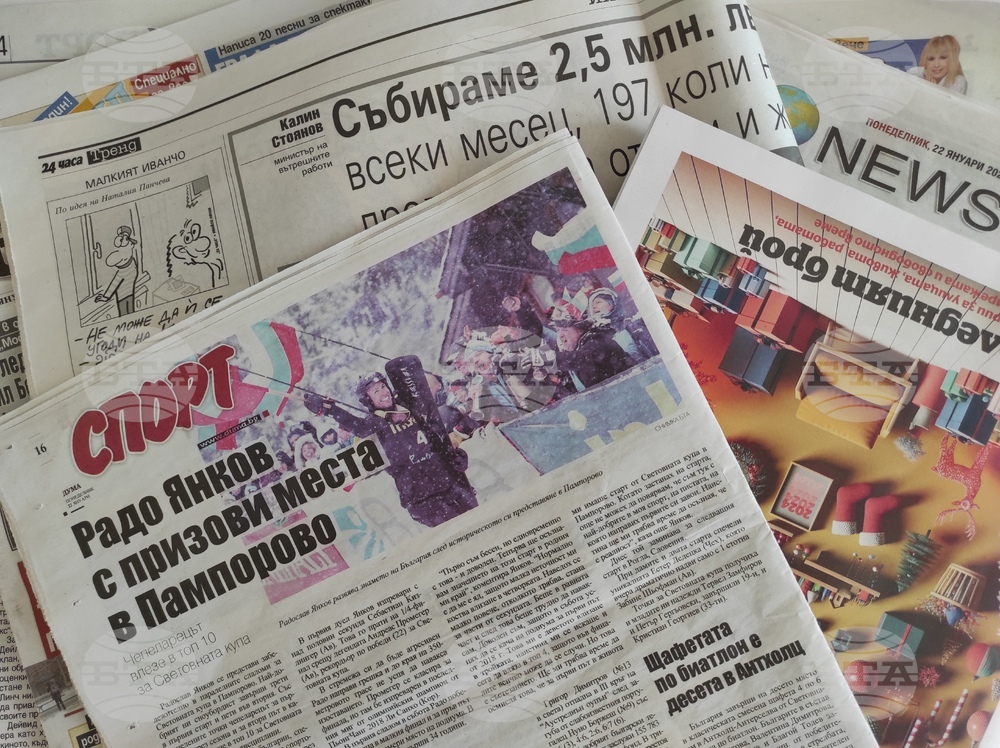
The topics of the euro's introduction in Bulgaria and the upcoming snap elections dominate Wednesday's news media.
POLITICS
On Bulgarian National Radio, political expert Georgi Prodanov said that the big issue for the upcoming elections is not how many votes each party will receive but whether the confrontational model, which all parties have been feeding, will be discontinued. According to him, there are now blatantly visible personal, regional, and other interests aimed at plundering state resources. No one wants to engage in politics in the name of the public interest, he noted. "A consensus is emerging on the issue of voting machines, but it is a tragic one because of the discrepancy in the parties' motives; it suggests that this is the last hope for all parties. This is an uncoordinated attempt to mislead voters," the expert said.
Telegraph has an interview with Prof. Milena Stefanova, a political expert, about the political situation in Bulgaria. According to her, the President will hand the first government-forming mandate around January 15.
On Bulgarian National Television's morning show, Prof. Mihail Konstantinov commented that the authorities and the public are once again making a fundamental mistake that has long been rejected by the Venice Commission: making changes to the electoral legislation right before the elections. As for the issue of voting technology, he believes the changes proposed are aimed at isolating large masses of Bulgarian voters from the electoral process. Stoil Tzitzelkov commented that Bulgaria is not following any of the recommendations made by the missions here of the Organization for Security and Co-operation in Europe, the Venice Commission, the Council of Europe, and the International Foundation for Electoral Systems. “The voting technologies were not introduced in our country in an appropriate manner. If we are going to use machines, let us use them to their full capacity, as they were designed - as a specialized device for electronic machine voting,” he argued.
On bTV's morning show, sociologists Genoveva Petrova from Alpha Research and Svetlin Tachev from the Myara polling agency commented on whether it is possible to form a cabinet in this National Assembly, and whether President Rumen Radev's party will emerge. "It no longer matters who will be prime minister - in this format, the cabinet will probably be dominated by the major political force that has the strongest personnel influence on the caretaker cabinet's head," Petrova and Tachev commented. The sociologists also highlighted the greater risk – an institutional crisis if a situation arises again where no one listed in the Constitution as potential caretaker prime minister wants to take the post, which could postpone the date of the early elections.
***
Immunologist Prof. Andrey Chorbanov, former MP of There Is Such a People (TISP), told Nova TV why he left the parliamentary group and the party. His decision was announced publicly in a Facebook post on December 19 and was preceded by an extensive eight-and-a-half-page letter addressed to the TISP leadership and members of the party. He explained on Nova TV that he had developed a deep disagreement with the way the party operates. and participates in decision-making. According to him, TISP has transformed from "a party that won elections to a marginal formation" that does not actually participate in governance but implements decisions taken outside the parliamentary group. He emphasized that compromises in coalition formats had led to a dilution of the party's programme and identity, and that the specialists with whom TISP had started gradually left. "Today, the party represents areas in which it no longer has experts," he summarized.
***
Capital.bg has an analysis by Evgeniy Kanev on Bulgaria veering between Russia, the EU, and the United States, trying not to choose a single side. "This vacillation in Bulgaria's policy is not new - it has deep roots in the country's failed attempt to break away from Russia's geopolitical orbit after the end of communism. What is more, political events and Bulgaria's evolving economic model since then correlate with the strength of Russian influence in the country. Thus, we can clearly distinguish three different phases and corresponding models of Bulgarian capitalism," the analysis reads. The phases are: Phase 1 (1985–1996) of State capitalism under Soviet influence; Phase 2 (1997–2008) of market capitalism under European influence; and Phase 3 (2009–2020) of oligarchic capitalism under Russian influence. The current phase (from 2021 to present) could be a way out of the crossroads but a lasting solution to the crisis in the Bulgarian governance model is unlikely to be found before the outcome of the war in Ukraine and the future of Europe become clear, the analyst argues.
***
In an analysis on the EU’s future for 24 Chasa, Arkadi Sharkov calls a great illusion the position that Europe must choose between two extremes: either to become a federation or disintegrate. “Europe works best when it accepts its reality - it is not a single country, but a continent of nations with different memories, languages, and customs. That is why these nations can do a lot together where the benefits are obvious and the rules are clear - a common market, common standards, technologies, and infrastructure. But they cannot be overlooked as if they were merely an administrative detail. When decisions are made as if there were already a common people, people feel that they are being ruled from outside and without real control. This is where resistance, apathy, and that unpleasant feeling of foreign power that you pay for come from.” The analyst sees the EU’s future in “a more modest Brussels, clearer responsibilities, fewer ideological campaigns, and more practical deals,” a Europe of nations that uses the word ‘sovereignty’ as a tool for democracy.
ECONOMY
The main topic of Wednesday’s TV morning shows is the euro’s introduction in Bulgaria. Bulgarian National Television shows what scams people should watch out for. The programme also shows how the first pensions in euro are paid to citizens at postal offices and banks under increased security. bTV’s morning show, too, shows how the pensions in euro are paid. Nova TV checks whether banks and postal offices observe the rules for exchanging BGN for EUR.
Duma’s headline reads that banks have imposed illegal fees on euro exchange and have introduced illegal limits on the exchange of coins in BGN. Such information was published by the Bulgarian National Radio and Nova TV but was refuted by the Association of Banks in Bulgaria. The Euro Coordination Centre told a briefing on Tuesday that they are looking into the matter.
Segabg.com reports that National Ombudsman Velislava Delcheva has referred to the Association of Banks in Bulgaria alerts from citizens about problems with exchanging banknotes and coins in BGN for EUR at commercial banks. Among the irregularities reported are the charging of fees, the requirement for declarations of the origin of funds even for amounts under BGN 1,000, restrictions on the exchange of amounts, fees for counting coins, a lack of euro banknotes, and a unilateral change in ATM withdrawal limits from BGN 400 to EUR 100.
Telegraph’s front-page story reads that Bulgarians are flooding banks with coins as they exchange their remaining money in BGN for euro.
24 Chasa has an interview with economist Petar Ganev about the euro’s adoption in Bulgaria. Regarding some issues in the first days of 2026, he says that any system that is more complex and is being introduced or changed will encounter problems. "From a historical perspective, in a few months, let alone a few years, no one will remember whether a particular ATM or POS terminal worked from the very first hour of January 1. What will remain in history is the entry into the eurozone." According to him, dirty money, even when exchanged into euro, will remain in cash; the transition to the euro will bring into the light only money from the grey sector, not those of criminals. In his words, the consumer is the best control of inflated prices during the transition to the euro, because the State cannot check everything. Excessive control is dangerous, he warns. On the potential use of the euro topic in the upcoming election campaign, the senior economist at the Institute for Market Economics says: “It is important now not to fall into a series of elections, because one resignation is an episode, but a series of elections is a crisis.”
HOME AFFAIRS
Trud’s front-page article warns the forests of Vitosha are dangerous for tourists in strong winds, because many trees are old.
Mediapool.bg reports that even the revised management plan for Vitosha Nature Park must be reworked. This recommendation was made in statements by Sofia Municipality and the Union of Architects in Bulgaria regarding the draft of the new park management plan. The same is insisted upon by environmentalists and long-time observer of the issue Toma Belev. Katerina Rakovska, an expert at WWF, told Mediapool that the draft updated management plan lacks an environmental assessment, which is mandatory under the Environmental Protection Act. The e-zine recalls that the first version of the document, which was released for public discussion in 2015, received hundreds of specific comments. It took over ten years to address them, and the updated document was released for further discussion in early December 2025. The collection of opinions ended on January 5. The draft management plan itself covers a period that has already expired (from 2015 to 2024).
***
Trud has an interview with civil pilot Mario Bakalov, who talks about flying in dangerous weather in relation to the strong wind that affected flights at Sofia Airport recently. In his words, it is understandable that passengers were frustrated by cancelled flights, but safety always comes first in aviation; there can be no compromises.
24 Chasa’s front-page story reads that according to a survey into popular professions, being a pilot is no longer an attractive profession.
***
Trud has an interview with ophthalmologist Botyo Angelov, who advises people not to buy sunglasses from street vendors because those are dangerous for their eyes.
/DS/
news.modal.header
news.modal.text