Wrap-up
![Through Dialogue, Employers and Unions Approve Government's Revised Budgets]()
![Through Dialogue, Employers and Unions Approve Government's Revised Budgets]() The National Council for Tripartite Cooperation approves the Finance Ministry's revised 2026 budget proposals for the State, the National Health Insurance Fund, and the public social insurance system. Sofia, December 8, 2025 (BTA Photo/Minko Chernev)
The National Council for Tripartite Cooperation approves the Finance Ministry's revised 2026 budget proposals for the State, the National Health Insurance Fund, and the public social insurance system. Sofia, December 8, 2025 (BTA Photo/Minko Chernev)
site.btaThrough Dialogue, Employers and Unions Approve Government's Revised Budgets
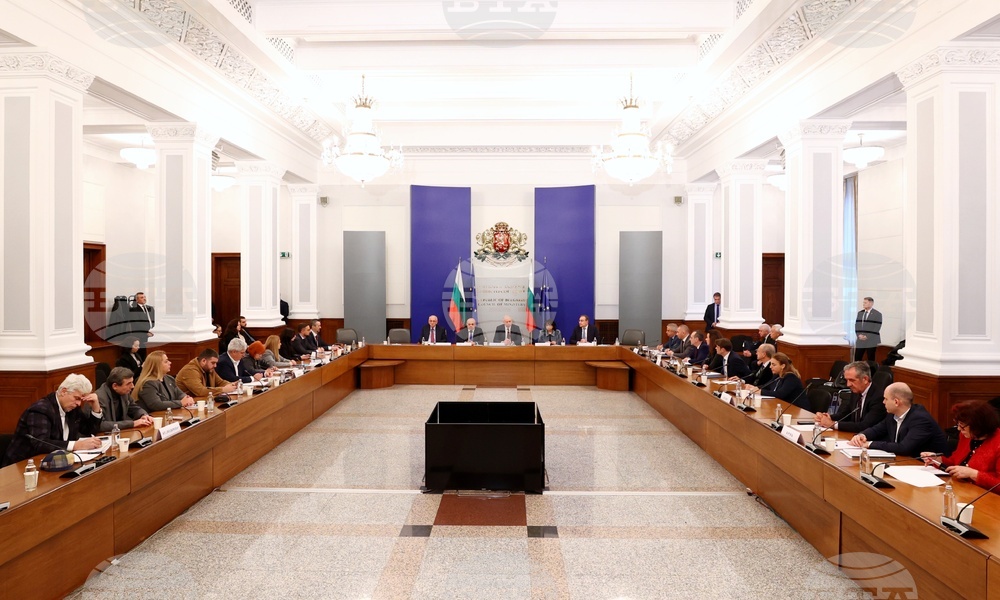
The National Council for Tripartite Cooperation (NCTC), which brings together the government, employers and trade unions, Monday approved the revised 2026 budget proposals for the State, the National Health Insurance Fund (NHIF) and the public social insurance system.
The Public Social Insurance Budget Bill was approved unanimously, while the Bulgarian Industrial Capital Association (BICA) voiced reservations over the other two.
Finance Minister Temenuzhka Petkova presented the key parameters of the 2026 State Budget Bill, saying that it is not possible to resolve all the problems accumulated in recent years: "Over the past four years, these issues were not addressed but rather deepened." She highlighted the government's decision to abandon, in the current budget proposal, an increase in contributions to the Pension Fund from January 2026, a twofold increase in dividend tax and a rollout of sales management software in retail outlets.
Employers and trade unions supported the 2026 State Budget Bill, although some remarks were raised by partners during the session.
Employer organizations expressed support, stressing the need to eliminate automatic mechanisms for determining wages, strengthen financial discipline, streamline the administration, and support investments and innovations. BICA Chairman Rumen Radev told a briefing after the meeting that while the government fulfilled its commitment to remove the automatic mechanisms for determining remuneration in 2026, full implementation of the commitment also requires amendments to other laws. "When this is completed, you will have our full support," he said.
The influential trade unions - the Confederation of Independent Trade Unions in Bulgaria (CITUB) and the Podkrepa Confederation of Labour - described the proposed new version of the State budget for 2026 as "acceptable". CITUB President Plamen Dimitrov said the union backs the State budget on two conditions, both of which the finance minister has committed to fulfil: securing EUR 15 million in funds for the Bulgarian State Railways (BDZ) - Passengers and allocating an additional EUR 7.8 million to Bulgarian Posts. Podkrepa Chief Economist Atanas Katsarchev said the union prioritizes income policy, demographic policy, and tax and social security policy, adding that to him, the only notable aspect of demographic policy is the increase in maternity benefits for the second year of childcare leave from BGN 780 to BGN 900.
Presenting the NHIF Budget Bill, NHIF Governor Petko Stefanovski said revenues, including transfers, are projected at EUR 5,288,592,000, which is EUR 444 million more for healthcare compared with 2025, up by 9.2%. The NHIF reserve is set at EUR 155,193,000, up by more than 9.3% from 2025.
Overall, the social partners appreciated the government's effort to improve the budget, with Podkrepa Confederation of Labour President Dimitar Manolov acknowledging that "this budget has its shortcomings, but it could have been far worse". In contrast, the Confederation of Independent Trade Unions in Bulgaria (CITUB) abstained from supporting the NHIF Budget Bill. CITUB President Plamen Dimitrov said that although the Health Ministry's budget sees an increase, there are no solutions addressing the problem of staff shortages sustainably.
BICA Governing Board Chairman Rumen Radev argued that this budget follows the pattern of all previous NHIF budgets. He said BICA traditionally does not support it, because the expenditure side for hospitals and medicines continues to dominate overwhelmingly, whereas its philosophy should be precisely the opposite - to increase funding for prevention.
Presenting the 2026 Public Social Insurance Budget Bill, National Social Security Institute Governor Vesela Karaivanova-Nacheva said the minimum monthly wage for 2026 will be EUR 620.20, and the maximum contributory income EUR 2,300. Expected revenues will amount to EUR 8.4 billion, about 8.3% more than in 2025, while expenditures are planned at EUR 15.3 billion, EUR 1.3 billion more than the previous year. The transfer to cover the deficit in 2026 is expected to amount to EUR 6.6 billion, an increase of EUR 579 million compared to the previous year.
Labour and Social Policy Minister Borislav Gutsanov stressed the importance of dialogue, which led to the unanimous approval of the Public Social Insurance Budget Bill. He argued that raising the minimum wage to EUR 620.20 in 2026 from EUR 550.67 now is necessary, as Bulgaria remains at the bottom of the EU in this regard, ahead only of Hungary.
Gutsanov summed up the participants' agreement on the importance of the roadmap for pension system development.
Maria Mincheva, Deputy Chair of the Bulgarian Chamber of Commerce and Industry, noted the need for a roadmap for legislative amendments and long-term solutions to ensure the sustainability of funds.
Opening the meeting, Prime Minister Rosen Zhelyazkov said it was extremely important due to the high public expectations and the current political climate. He stressed it is crucial for the proposals to be endorsed by the NCTC, rather than found to be merely "acceptable" to social partners: "This is not a political fig leaf for the future of the cabinet. It is necessary so that we enter 2026 with a budget adopted by the National Assembly and receiving the broadest possible support." Zhelyazkov warned that the coming year will require safeguarding households' purchasing power in a complex international and domestic environment. He described the budget proposal as balanced, neither extravagant nor overly restrictive, and emphasized its social focus.
Speaking to the media after the meeting, Finance Minister Temenuzhka Petkova said that as a result of the NCTC's joint work, the government is able to propose a budget that will allow Bulgaria to enter the eurozone smoothly and with dignity. She stressed the revised draft budget received near-unanimous support, only BICA expressed some concerns and abstained, which is "understandable and standard practice". She said the draft budget provides that between 2026 and 2028, some 5,500 permanently vacant positions in the state administration will be reduced.
Deputy Prime Minister Tomislav Donchev said Bulgaria must demonstrate a commitment to budget consolidation, gradually reducing its deficit in the coming years to return to the 25-year tradition of balanced budgets and zero deficit. He said concrete steps on deficit reduction are needed - a topic on which he saw consensus among business and union representatives. Another agreed measure is to decouple public sector payments from the average wage starting next year, aiming for a smarter approach to setting salaries.
Background
The initial State Budget Bill for 2026, which was approved by the Council of Ministers and submitted to Parliament for consideration in November, was withdrawn on December 2 by a decision of the Council of Ministers, following large-scale protests across the country on December 1. Also withdrawn were the National Health Insurance Fund (NHIF) Budget Bill and the Public Social Insurance Budget Bill.
On December 6, the Ministry of Finance published the new draft state budget for 2026 and the Updated Medium-Term Budget Forecast for 2026-2028 on its official website. On December 7, the Supervisory Board of the National Social Security Institute unanimously approved the draft public social insurance budget for 2026 and the Supervisory Board of the National Health Insurance Fund approved the NHIF draft budget for 2026.
/DD/
news.modal.header
news.modal.text