site.btaDecember 7 Bucharest Mayoral Election: Expectations and Promises
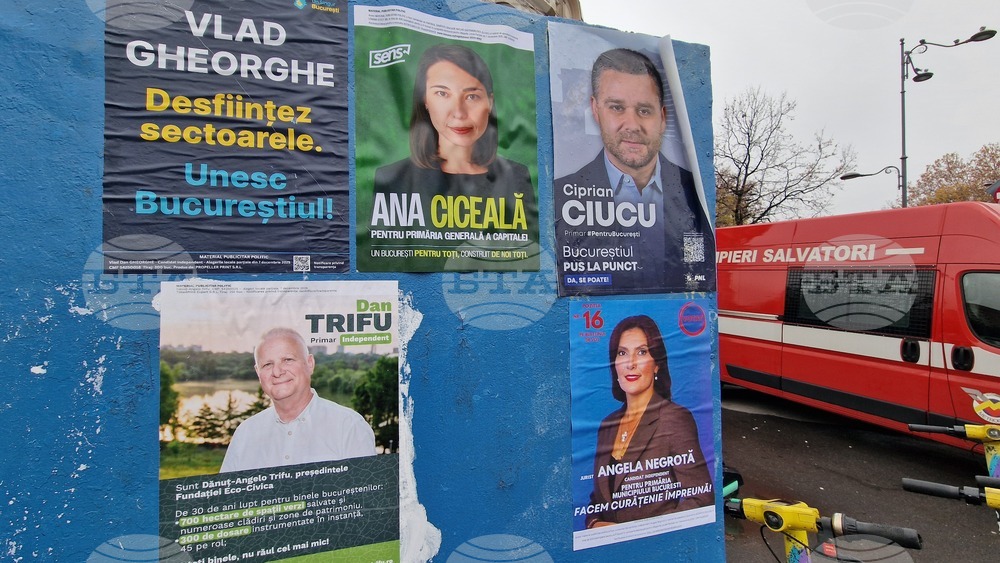
Bucharest residents are set to vote for their next mayor on December 7. Almost 1.8 million eligible voters are expected to cast ballots and choose the person who will lead Romania's largest and richest city until 2028. The winner will become Bucharest's 17th mayor since the 1990 collapse of the totalitarian regime.
Vacant after Nicusor Dan's election as president of Romania, the position is the subject of a fierce race between two contenders: the candidate of the Social Democratic Party (SDP) and the current mayor of Sector 4, Daniel Baluta, and the candidate of the National Liberal Party (PNL) and current mayor of Sector 6, Ciprian Ciucu.
This is confirmed by the latest poll by the American-Romanian Association for Public Opinion (ARA), commissioned by Antena 3 and CNN, and published Friday. It shows a difference of only 2 percentage points between the two candidates with Baluta having 26% of the potential votes and Ciucu 24%. The third place is taken by Union for the Salvation of Romania candidate Catalin Drula, with 20%. Next comes independent Anca Alexandrescu, supported by the opposition Alliance for the Unity of Romanians (AUR).
According to the majority of respondents, the top priority for the next five years should be the modernization of infrastructure. Other issues highlighted by local residents are central heating and green energy.
Daniel Baluta emphasized developing an integrated public transport network with routes adapted to traffic conditions, expanding the metro and doubling the bus fleet, and building an integrated transport system with a single fare and integrated timetables.
Chiprian Chuku proposed widening single lanes to create corridors for public transport, including special lanes for buses, trolleybuses and trams along the main roads, with priority traffic lights. He also proposes introducing a single integrated ticket for buses, trams, trolleybuses and the metro, as well as creating "park and ride" car parks outside Bucharest on the main roads leading into the city. He also wants to improve accessibility to stations and pavements by installing ramps, lifts, tactile markings and acoustic traffic lights.
Catalin Drula wants the municipality to take over management of the metro and integrate it into the public transport system. He is promising to invest in expanding existing metro lines, rehabilitating tram lines, constructing new lines, and purchasing new trams, buses, and trolleybuses.
The ideas on the platform of independent candidate Anca Alexandrescu are similar: integrating the metro into the public transport system and introducing integrated tickets and timetables, real-time monitoring, reconstruction and consolidation of the railway belt, and direct connections to stations and airports.
"Bucharest is perceived as a congested and suffocating city, and the slow pace of transformation contrasts sharply with the increasingly urgent needs of its residents. There is acute dissatisfaction with the way the capital looks and functions", commented Remus Stefureac, director of the INSCOB sociological agency, in an interview with Radio Free Europe. According to him, survey data show that Bucharest residents expect the future mayor to be more proactive. The analyst added that Bucharest residents want someone with experience and are no longer willing to be patient with someone who is learning on the job.
Therefore, demonstrating administrative competence and concrete results seems crucial for the candidates. The outcome of the vote also has political implications. It is a political test for the whole of Romania.
Dan Tapalaga of G4 Media explains that the decision of the three parties in the ruling coalition to each field their own mayoral candidate in Bucharest is an extremely risky gamble. "We have already seen with Traian Basescu and Nicusor Dan that it's not just an ordinary mayor who's being elected, but a potential presidential candidate. Even if such a scenario does not materialize, the mayor of the capital is the second most popular politician after the Romanian president, so gains enormous legitimacy through the vote".
He also believes that the date of the election, December 7, carries a certain risk. The journalist explains that, as winter approaches and the weather turns colder, accidents become more frequent and many Bucharest residents have no heating or hot water yet still receive high utility bills, they may change their minds at the last minute and vote emotionally.
/RY/
news.modal.header
news.modal.text