site.bta150th Birth Anniversary of Bulgarian Journalist Yosif Herbst
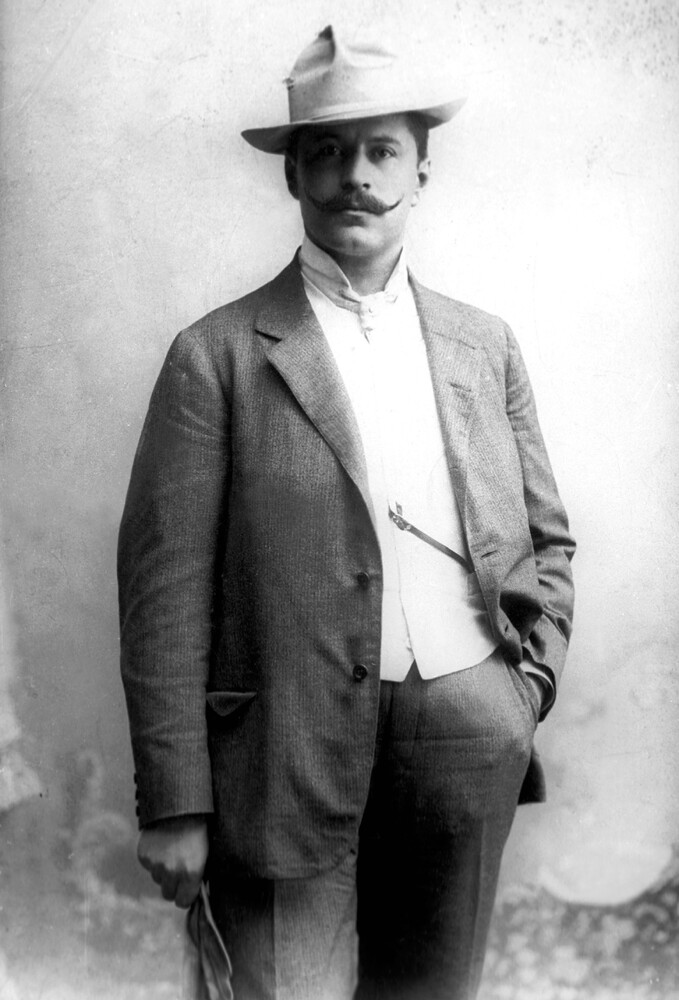
Yosif Herbst (1875-1925), a military officer, journalist and newspaper publisher, was born 150 years ago on Thursday. An outspoken government critic and Bulgaria's first Press Director, Herbst went missing shortly after the terrorist bombing of the St Nedelya Church in Sofia in April 1925.
He is famously quoted as saying: "A free person may and should write for free people. Independence is not some kind of sport for me; it is a journalistic weapon for achieving higher goals to the public benefit."
Born to a Czech Jewish family in Adrianople, the Ottoman Empire, on November 20, 1875, Yosif Yakov Herbst attended the French College in Sofia and the Sofia Boys' Secondary School, and graduated from the Sofia Military School in 1893. In 1898 he was appointed to the Voenni Vesti newspaper, published by the War Ministry's training bureau. Later that year he left military service to pursue a full-time career in journalism, contributing to and editing various periodical publications over the years: Vestnik, Dnevnik, Svobodna Tribuna, Vreme, Razvigor (Bulgaria's and Europe's first literary newspaper). In 1913 launched L'Echo de Bulgarie, a French-language pro-government daily that pioneered an information feed from Bulgaria for the rest of the world, especially designed for foreign users.
In 1902, together with prominent Bulgarian writers and public figures, Herbst co-founded the Society of Bulgarian Writers and Opinion Journalists, and in 1907-1908 he served as the first chair of the Association of Capital City Journalists.
In 1912-1913, Herbst was mobilized and fought in the First and Second Balkan Wars as a company commander. He was severely wounded and was decorated with an Order of Bravery.
When King Ferdinand I decided to create a special position of Press Director, tasked with putting the press under control and placing it in the service of government policy, in 1908 Herbst was the first appointee to that office. The Press Directorate with the Ministry of Foreign Affairs and Public Worship that he headed until 1911 and between 1913 and 1913 was the predecessor of the present-day BTA.
In this capacity, Herbst applied his journalistic experience to diversify the content of news bulletins and expand the foreign correspondents network. Under his leadership, the news bulletins covered more than 80 capitals and major cities from which the directorate received dispatches on international developments. The strongest links were with Constantinople, St Petersburg, Vienna, Prague, London and Berlin. The tone was objective, and the Press Director espoused the understanding that multiple sources should be located for each news development or claim. The coverage of military operations showed the situation on both sides of the front.
Herbst also doubled as a correspondent for Austrian, British, German and Romanian newspapers. He translated works of fiction from Russian, German, French, English and other languages, as well as articles and commentaries from the Russian, German, Austro-Hungarian, French and British press.
Amidst the escalating political violence triggered by the military coup that overthrew Alexander Stamboliiski's Agrarian government in June 1923 and the communist-led September 1923 uprising, the authorities launched bloody reprisals against Communists and their supporters, including progressive intellectuals. Thousands were arrested, tortured, and listed as "missing". In his publications between 1923 and 1925, Herbst openly opposed police brutality and government repression.
In February 1925, he became an unwitting witness to the dumping of the body of Bulgarian communist activist Valcho Ivanov, who had been killed by a group of army officers. The next day he described what he had seen in the newspapers. On April 16, 1925, Herbst was arrested and was subsequently pronounced unaccounted for.
In 1985, marking 110 years since Herbst's birth and 60 years since his death, the Bulgarian News Agency instituted the annual Yosif Herbst Award. It was intended as a distinction for former or present BTA staffers with outstanding creative achievements and significant public response.
"To judge the 'integrity' of a newspaper, I need information about the news on which it imposes a blackout rather than the news it reports. There is blackout that is truly a chivalrous feat, but there is also a blackout that is a hellish turpitude," Herbst wrote. It couldn't be truer today.
/LG/
news.modal.header
news.modal.text