Wrap-up
![9th International Summer Leadership Academy Puts Emphasis on Leadership during Crises, Management of Changes]()
![9th International Summer Leadership Academy Puts Emphasis on Leadership during Crises, Management of Changes]() 9th International Summer Leadership Academy in Sinemorets, on the Black Sea, June 6, 2026 (BTA Photo/Stanimir Dimitrov)
9th International Summer Leadership Academy in Sinemorets, on the Black Sea, June 6, 2026 (BTA Photo/Stanimir Dimitrov)
![Синеморец, Международна лятна академия по лидерство „Лидерство отвъд алгоритмите: от данни към решения“, организирана от Висшето училище по телекомуникации и пощи (ВУТП) Снимка: БТА]()
![Кирил Вълчев, генерален директор на БТА, Синеморец, Международната лятна академия по лидерство]()
![Антон Кутев, народен представител и председател на парламентарната Комисия по културата и медиите, Синеморе, Академия по лидерство]()
![д-р Диляна Дойчинова, Международната лятна академия по лидерство под надслов „Лидерство отвъд алгоритмите: от данни към решения“, организирана от Висшето училище по телекомуникации и пощи]()
![Милен Митев, директор на БНР Снимка: кореспондент на БТА в Бургас Станимир Димитров]()
site.bta9th International Summer Leadership Academy Puts Emphasis on Leadership during Crises, Management of Changes
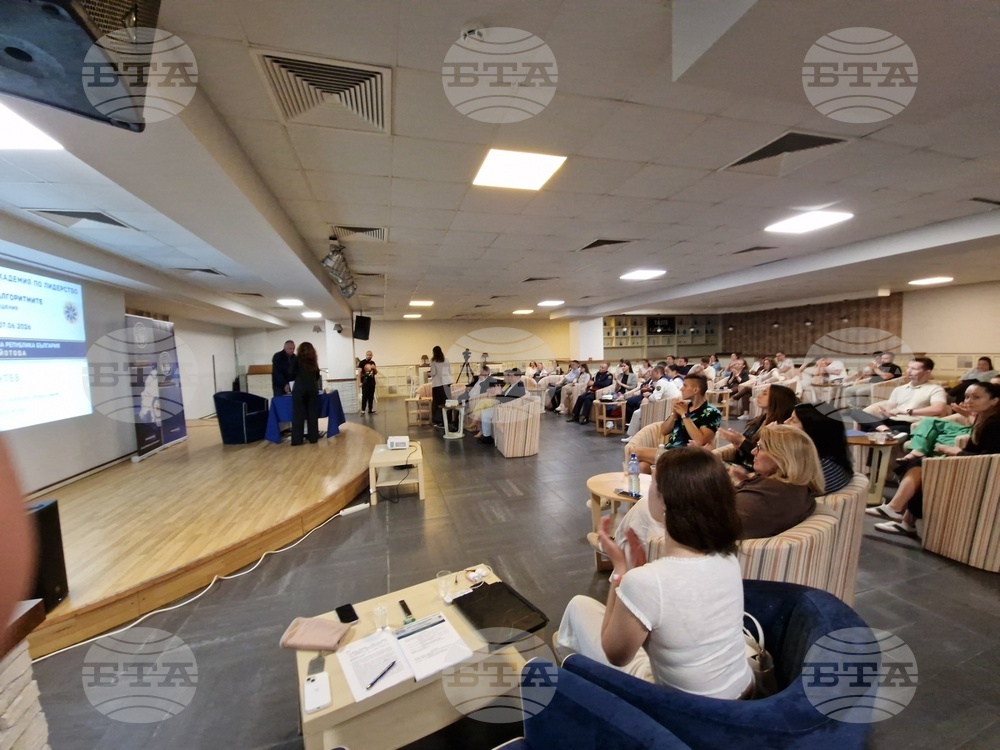
The fourth - and final - discussion day of the 9th International Summer Leadership Academy took place here on Saturday. Representatives from the media, the legislative branch, and academia delivered lectures to faculty and students.
Titled “Leadership Beyond Algorithms: From Data to Decisions,” the forum was organized by the University of Telecommunications and Post (VUTP) and held under the President's auspices. Every year, the event brings together undergraduate and graduate students from various Bulgarian universities, who exchange ideas and experiences with representatives from academia, business, government, and the media with the aim to develop leadership skills, strategic thinking, and decision-making abilities in a dynamic professional and social environment. This year's event also marked the VUTP's 145th anniversary.
As part of Saturday's programme, lectures were given by Anton Kutev, Chair of the parliamentary Committee on Culture and Media, BTA Director General Kiril Valchev, Bulgarian National Radio (BNR) Director General Milen Mitev, and Dr. Dilyana Doychinova, an expert in crisis communications and crisis management and Chief of Staff to the Deputy Prime Minister for Economic Policy.
In his lecture, Kutev said that leaders should not swim against the tide of social processes, but rather understand the direction in which society is moving and how to achieve their goals within that context. According to Kutev, one of the most important qualities of a successful leader is the ability to recognize social processes and act in harmony with them. In his view, leadership is not measured by the number of hours worked, but by an understanding of processes and the ability to organize effectively. According to him, successful leadership requires concrete actions that are recognizable to the public through clear public messages and symbolic gestures.
BTA Director General Valchev said that language can become an enemy, and the media amplify every public statement; therefore, the responsibility in journalism today is exceptionally great. Regarding the media environment, Valchev outlined three key issues. The first concerns whether information is a commodity or a human right. According to him, news should be viewed as a human right, and journalists have a role similar to that of teachers - to convey knowledge from the present day, which subsequently becomes history. The second major debate concerns the role of social media. There, there is a lack of accountability, unlike traditional media, which operate under clear rules and are responsible for their content. Valchev emphasized the need for people and institutions that verify facts and place them in context. The third issue concerns artificial intelligence. According to Valchev, artificial intelligence does not pose a threat to journalism, since it cannot, in practice, act as a reporter and is not present at the scene of an event; natural intelligence always stands at the forefront.
BNR Director General Mitev said that the world is constantly and rapidly changing, and the ability to adapt to these changes is key to success in today’s environment. According to Mitev, the modern world that young people are shaping is “perhaps the best lecture” humanity has ever had. He underscored the importance of communication in management, noting that insufficient information or poor communication can derail otherwise well-planned processes. Mitev also emphasized the role of leadership and teamwork. Regarding the media, Mitev noted that public media have a mission to work in the public interest and reach all social groups. The BNR Director General also outlined some of the challenges facing public media, including the need for a more active presence in the digital environment and reaching younger audiences. In his words, the media must adapt to new platforms and formats to remain relevant.
Dr. Dilyana Doychinova said that said that a leader must make decisions based on facts, not hypotheses, and combine emotional intelligence with a long-term vision. According to her, the most important qualities of a modern leader include emotional intelligence, the ability to build trust, a long-term vision, transparent communication, adaptability, and the ability to base decisions on verified facts and analysis rather than on assumptions. In her presentation, Doychinova examined various models of leadership through the lens of historical and contemporary examples. She also highlighted the differences between European and Asian models of governance.
/DS/
Additional


news.modal.image.header
news.modal.image.text
news.modal.download.header
news.modal.download.text
news.modal.header
news.modal.text