Summer Leadership Academy
![BTA Director General: Responsibility in Today's Journalism Is Exceptionally Great]()
![BTA Director General: Responsibility in Today's Journalism Is Exceptionally Great]() BTA Director General Kiril Valchev addressing the 9th International Summer Leadership Academy in Sinemorets, on the Black Sea, June 6, 2026 (BTA Photo/Stanimir Dimitrov)
BTA Director General Kiril Valchev addressing the 9th International Summer Leadership Academy in Sinemorets, on the Black Sea, June 6, 2026 (BTA Photo/Stanimir Dimitrov)
site.btaBTA Director General: Responsibility in Today's Journalism Is Exceptionally Great
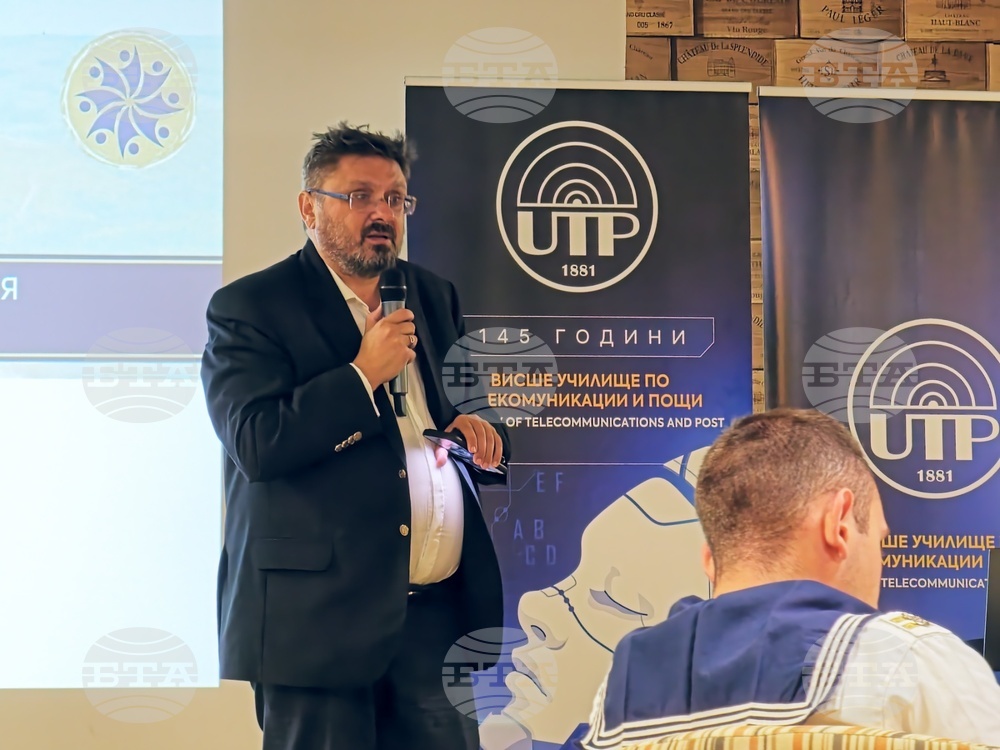
Addressing the 9th International Summer Leadership Academy here on Saturday, BTA Director General Kiril Valchev said that language can become an enemy, and the media amplify every public statement; therefore, the responsibility in journalism today is exceptionally great. The forum, titled “Leadership Beyond Algorithms: From Data to Decisions”, was organized by the University of Telecommunications and Post (VUTP).
In his address, Valchev presented data collected by BTA from 51 higher education institutions in Bulgaria regarding graduates in 2025 and international students in the country. According to the data, foreign students number 16,995. Valchev noted that the leading countries from which they come are not those traditionally defined as less developed. Greece ranks first with 3,277 students, followed by the United Kingdom with 2,335, Ukraine with 2,151, Germany with 1,532, and Italy with 990. “I would like to congratulate you on this, because you have made a choice that more and more people from Western countries are making, namely to study in Bulgaria,” he told the students in attendance.
The BTA Director General emphasized that Bulgaria has a good education system, but in his view, the lack of sufficiently visible and systematic information in the public sphere negatively affects public attitudes and the decisions of young people.
Valchev noted that Bulgaria ranks at least in the world's top third for living conditions. In his words, when comparing countries, it is important to consider not only the material aspects of life - food, water, climate, and security - but also the intangible conditions. He gave the example of social customs in different countries and noted that in Northern Europe, for instance, even a coffee date is often arranged weeks in advance, whereas in Bulgaria, social life is more spontaneous.
“Our leaders need to speak of us as successful people,” he said. According to Valchev, Bulgaria is a member of international organizations that recognize its contributions and achievements, and leadership requires building upon what has been achieved. He also cited the principle that when a person holds a certain position, they must leave room for those who follow to build upon what has been achieved.
The BTA Director General noted that the Agency has an archive spanning over 128 years, containing approximately 5,200,000 digitized pages. In his words, this is an important part of the country’s historical memory. He noted that BTA, together with Bulgarian National Television (BNT) and Bulgarian National Radio (BNR), has joint initiatives, including the 14 Centuries of Bulgaria in Europe project, as well as other cultural and historical initiatives. BTA is also working on an initiative to erect commemorative plaques at significant Bulgarian sites around the world - in Odesa, Leipzig, Izmir, and other cities connected to Bulgarian history.
Valchev explained that when he took over as head of BTA, he decided not to remain confined to his office but to maintain direct contact with the Agency’s day-to-day operations. He also noted that currently about 20% of BTA’s employees are students, and the Agency is actively recruiting young people.
He emphasized that BTA invests in the training of its staff. He is also implementing approaches entirely new to the Agency, modeled after the Italian ANSA, where young employees train older colleagues in working with new technologies, social media, and artificial intelligence.
Regarding the media environment, Valchev outlined three key issues. The first concerns whether information is a commodity or a human right. According to him, news should be viewed as a human right, and journalists have a role similar to that of teachers - to convey knowledge from the present day, which subsequently becomes history. The BTA Director General added that it is important for societies to support their media, including through various forms of funding, while warning of a decline in the physical presence of media in Bulgaria, especially in the regions.
The second major debate, in his view, concerns the role of social media. There, there is a lack of accountability, unlike traditional media, which operate under clear rules and are responsible for their content. Valchev emphasized the need for people and institutions that verify facts and place them in context.
The third issue concerns artificial intelligence. According to Valchev, there is a generational difference in attitudes toward the technology. In his view, artificial intelligence does not pose a threat to journalism, since it cannot, in practice, act as a reporter and is not present at the scene of an event. Generative language models work only with information that has already been collected and can assist in processing it, Valchev noted. At the Agency, there are about 20 applications of artificial intelligence, including for spell-checking, semantic verification, translations, and data processing.
“At the beginning and end of the process at BTA, natural intelligence always stands at the forefront,” said Valchev, highlighting five key concepts for BTA - freedom, truth, knowledge, community, and memory. He explained that the Agency published over 9,000 news stories about Bulgarian communities abroad last year alone. According to him, leadership in a community requires serving people. He cited the Gospel principle that whoever wants to be first must be “a servant to all.”
The International Summer Leadership Academy is an annual event that brings together undergraduate and graduate students from various Bulgarian universities, who exchange ideas and experiences with representatives from academia, business, government, and the media. The forum is aimed at developing leadership skills, strategic thinking, and decision-making abilities in a dynamic professional and social environment. This year's edition is held under the President's auspices and is part of the events marking the 145th anniversary of the founding of the University of Telecommunications and Post.
/DS/
news.modal.header
news.modal.text