site.btaBulgarian Producers Seek New Clients, Markets Through Participation in Berlin International Green Week
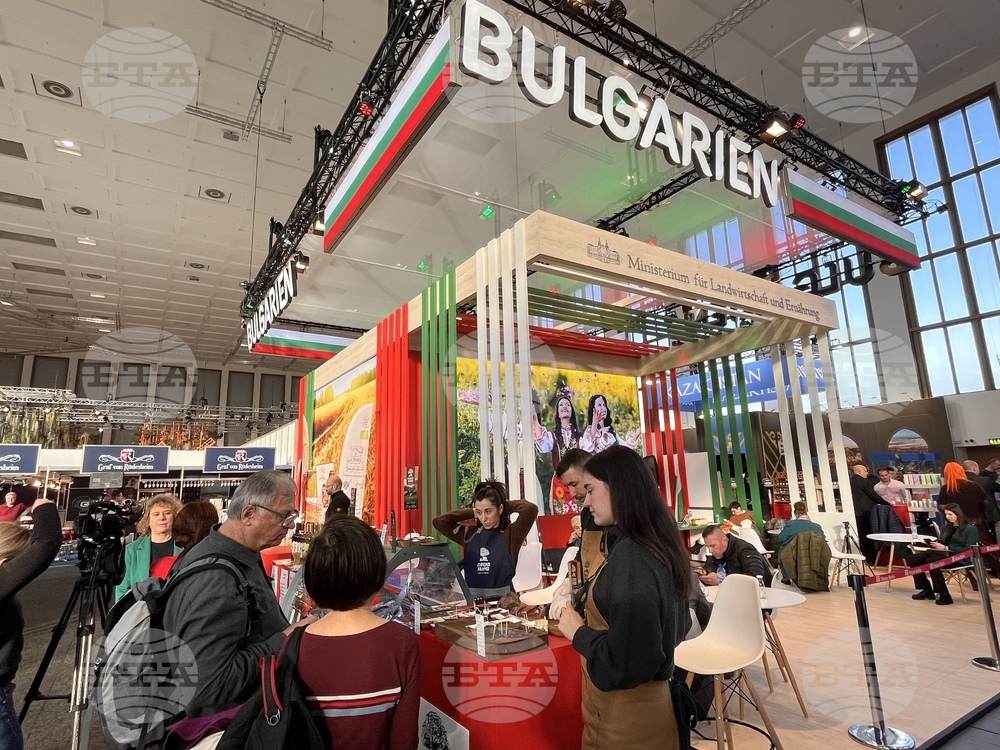
The jubilee 100th edition of the international food, agriculture and horticulture exhibition Berlin International Green Week opened on Friday, January 16, in Berlin and will run until January 26. Bulgaria is taking part in the event for the 35th time with a national stand.
This year, 15 Bulgarian exhibitors are represented at the country’s stand. They present dairy and meat products, wines and organic wines, honey and bee products, organic foods, rose oil, essential and cold-pressed oils, aromatic waters, natural cosmetics, and more.
First-time exhibitors
One of the debut participants at this year’s Green Week is the company Filipopolis, which produces dairy products. "We purchase raw milk from local farms and process it in three facilities – in Plovdiv, the village of Zhiglyartsi near Dobrich, and in Razlog," said Violeta Rangelova. The plants are deliberately located in three different parts of Bulgaria in order to secure supplies from local farmers. The company’s capacity is up to 200 tonnes of finished products per month.
Filipopolis has been exporting worldwide since 1993, when Violeta’s father, Rangel Rangelov, founded the company. Its main export markets are the United States, Australia and the European Union. At present, the company has one client in Germany and hopes to find more through its participation in Green Week.
Rangelova added that the company applies for EU-funded projects, the most recent of which concerns photovoltaic installations that significantly reduce its electricity costs.
Another debut participant this year is Gorsko Rancho. The farm is located in the village of Stokite and raises 130 head of Aberdeen Angus beef cattle. It produces dried meat delicacies, some of which are made using purchased raw materials. The products are positioned in the high-price segment.
Owner Dimitar Kosev said they are not competitive on price, but on quality. For the moment, they mainly sell at farmers’ markets, as their production capacity is limited. "This way we receive direct feedback from customers," Kosev explained.
He has been a livestock farmer for four years and invested directly in animals. The biggest challenges he identified are pasture maintenance and the mindset of people in the region, as many are no longer used to seeing the land actively farmed.
Kosev added that his other business is in tourism and that livestock farming complements it by improving the area, adding value to the region and supplying food for guests.
Honey from the Bulgarian valley
Medena Dolina is a small family farm from the village of Yasenovo near Kazanlak, Central Bulgaria. They manage around 700 bee colonies, mainly in the regions of Sredna Gora and the Balkan Mountains, with stationary apiaries located in forest areas.
"This is our third consecutive year at Green Week, and we are happy to be part of the jubilee edition," said Milena Ivanova, who runs the farm with her family. According to her, the exhibition helps them assess where they stand with their products and provides valuable opportunities to develop further partnerships.
"Things happen slowly, but they do happen," she said. The company exports small quantities to Germany and also participates in fairs in Slovenia.
She believes that Bulgaria’s accession to the euro area will be positive for business, bringing greater transparency and easier operations.
As for the main challenges facing the beekeeping sector today, Ivanova pointed to climate change. "To have sustainable beekeeping, you must know the life of the bee colony extremely well," she said, adding that sudden temperature changes can cause significant bee mortality. Another major issue, according to her, is the shortage of labour.
Wine from a nearly deserted village
Hands & Friends is a small family winery from the Burgas-region village of Esen, which has only 12 residents. The winery owns 200 decares of vineyards and produces mainly white and rose wines, with an annual capacity of no more than 20,000 bottles. The vineyards are in conversion to organic farming.
This is their second participation in Green Week. According to founder Andrey Melnikov, their previous participation had a positive effect, as visitors liked and bought their wines. On the Bulgarian market, he believes the winery performs well, with customers mainly being Bulgarians seeking something new, as well as Ukrainians and Russians.
Does the Bulgarian rose have a future?
Krimas 77 is participating in Green Week for the fourth time. Owner Petar Simeonov said the company is extremely satisfied with the results, as they meet both end customers and buyers of raw materials.
The company cultivates 150 decares of oil-bearing roses in two areas and 65 decares of organic lavender near Gurkovo and Kazanlak.
"The past year was the hardest for rose production in more than 30 years," said Simeonov, who is also chairman of the Professional Association of Rose Growers in Bulgaria. Yields of oil-bearing roses dropped to 50% compared to the previous year.
Climate change, he explained, has a dramatic impact: warm winters, cold springs, frost damage, low yields and reduced quality, which in turn affect rose oil and rose water. According to him, irrigation is the only real solution, but drilling wells is extremely expensive, especially in mountainous regions. Currently, less than 1% of rose fields in Bulgaria are irrigated.
He added that 30-40% of rose fields have been abandoned compared to the previous year. From around 60,000 decares, only about 30,000 are currently harvested. Rose blossom production fell to about 6,000 tonnes in 2025, compared to nearly 20,000 tonnes in 2017–2019.
Another concern is the import of rose oil into Bulgaria, mainly from Azerbaijan and Turkiye, as well as the export of Bulgarian planting material abroad.
The potential of rosehip
Balevski & Kirov is the only company in Europe, and possibly worldwide, specializing exclusively in rosehip products, said founder and managing partner Ivo Balevski. The company offers around 120 end products across four lines: foods, dietary supplements, extracts and cosmetics.
This is their fifth participation in Green Week, and almost every year it brings new valuable contacts. The company exports to Italy, Germany, the Netherlands, the UK, Czechia, Slovakia and Austria, and is developing markets in Poland, Romania, Asia and the UAE.
Balevski said their rosehip flour is the best in Europe due to a special micronisation process that improves absorption. They process between 220 and 300 tonnes of rosehips annually, working with seven agricultural producers rather than owning plantations themselves.
The company is also presenting its subsidiary brand Gourmoli, focused on walnut oil and flour, with plans to expand into salad dressings.
Balevski also spoke about a joint project with Bulgaria’s 34th Antarctic expedition, studying the effects of Bulgarian organic rosehip products on the human body in extreme Antarctic conditions. Results are expected at the end of March.
/YV/
news.modal.header
news.modal.text