site.btaBulgaria Completes Second Stage of European Prosecutor Selection Procedure, Six Candidates Heard
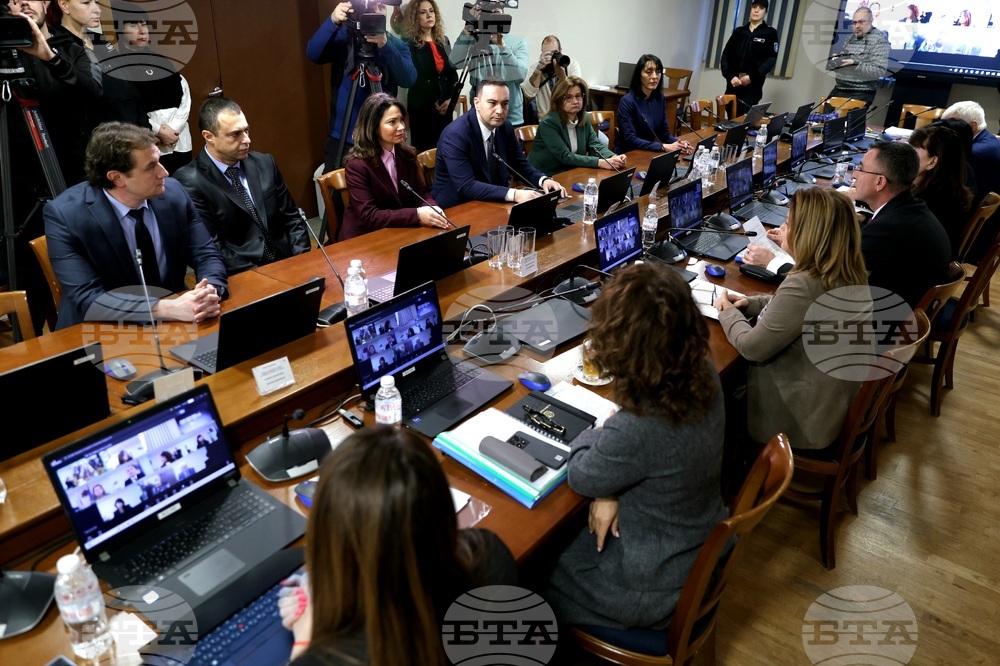
With the hearing of six candidates, the second stage of the procedure for selecting a new European Prosecutor from Bulgaria concluded on Wednesday. There were seven candidates in total - Boyko Atanasov, Desislava Pironeva, Dimitar Belichev, Ivaylo Iliev, Mihaela Raidovska, Plamen Petkov and Svetlana Shopova-Koleva - but Boyko Atanasov did not attend Wednesday’s procedure.
The candidates were heard at the premises of the Supreme Judicial Council by a special commission. It included Ministry of Justice Secretary-General Venera Milova, Veronika Imova and Tsvetinka Pashkunova from the Judges’ College of the Supreme Judicial Council, Kalina Chapkanova and Gergana Mutafova from the Prosecutor’s College, and Professor Georgi Mitov from the Department of Criminal Law Studies at the Faculty of Law, Sofia University St Kliment Ohridski.
The seven-member commission will propose three candidates from the seven nominees. With a report by the Justice Minister, the nominations should be submitted for approval by the Council of Ministers and then sent to the competent EU bodies for further selection. European Prosecutors are appointed by the Council of the EU for a six-year term, with the new term expected to begin on July 29, 2026.
The term of Bulgaria’s first European Prosecutor, Teodora Georgieva, expires on July 29, 2026. She was temporarily suspended due to an ongoing disciplinary investigation, with Dimitar Belichev appointed as her deputy.
In her presentation before the commission, Desislava Pironeva stated that she is a candidate who meets the regulatory requirements for the position. She recalled that she has already gone through this procedure once before, adding that her experience gives her sufficient grounds to believe she is suitable for the post of European Prosecutor from Bulgaria. “I have experience that is also related to the current activities of the European Public Prosecutor’s Office,” Pironeva said.
Dimitar Belichev told the special commission that the effectiveness of cooperation between the European Public Prosecutor’s Office and national investigative bodies must be improved, and that the volume of uncovered crimes must increase. Asked by reporters after the hearing whether he expects the selection to be fair, he replied: “Yes.”
Ivaylo Iliev said that if elected as European Prosecutor from Bulgaria, he would place emphasis on asset recovery. “I know that the European Prosecutor does not have legislative initiative, but I believe they must raise the alarm about problems and fight them. There is a lack of specialised structures dealing with crimes related to public procurement,” he added.
“If I am elected European Prosecutor from Bulgaria, I will work to increase the efficiency of the office of the European Delegated Prosecutors in our country, so as to ensure thorough investigations within a reasonable timeframe. This cannot be achieved, however, when prosecutors are extremely burdened with activities that are not directly related to the strategic management of investigations,” Mihaela Raidovska said during the hearing. She added that she would insist on filling vacant positions and increasing the number of European Delegated Prosecutors.
“My entire professional experience allows me to believe that I would be able to cope with the task of serving as European Prosecutor from Bulgaria,” Plamen Petkov said. He outlined three main challenges facing the European Public Prosecutor’s Office - combining its supranational level with different national legal systems, the constant evolution of criminal activity, and limited resources.
“Good two-way communication must be maintained between the Sofia office and the headquarters of the European Public Prosecutor’s Office,” Svetlana Shopova-Koleva said during the hearing. In her view, an insufficient number of cases reach the court phase. “Special provisions related to the awarding and execution of public procurement contracts should also be introduced into the Criminal Code. At present, this is a gap in our legislation,” she stated.
/RY/
news.modal.header
news.modal.text